Introduction
Picture this: you've spent years building operational expertise, and now you're ready to run your own company. One path has you cold-calling retiring business owners, negotiating to buy their profitable plumbing supply company. The other has you pitching Sand Hill Road investors on your vision for disrupting an industry — with no revenue, no customers, and a slide deck.
Both paths involve private capital and equity ownership. The similarities end there.
Search funds and venture capital get lumped together under the "alternative investment" umbrella, which creates genuine confusion — especially for entrepreneurs choosing a model or investors deciding where to deploy capital. In practice, the two target different business stages, draw entirely different personality types, and generate returns through opposite mechanisms.
This article breaks down both models clearly — definitions, a side-by-side comparison, and a practical framework for deciding which path fits your goals.
Key Takeaways
- Search funds acquire established, profitable businesses; VC backs early-stage startups chasing growth
- Search fund entrepreneurs become owner-operator CEOs; VC-backed founders answer to board members
- Search funds carry concentrated risk on one company; VC diversifies across a portfolio expecting most bets to fail
- The Stanford GSB's 2024 Search Fund Study found 35.1% aggregate pre-tax IRR across 681 U.S. and Canadian funds
- Choose search funds for proven cash flows and operational control; choose VC if you're building for high-risk, high-upside growth
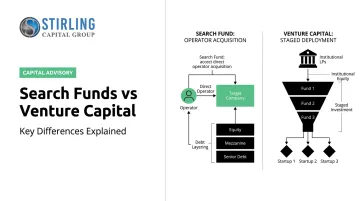
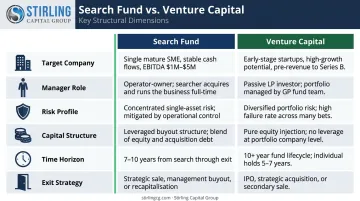
Search Funds vs. Venture Capital: Quick Comparison
| Dimension | Search Fund | Venture Capital |
|---|---|---|
| Target Company Type | Established, profitable SMEs | Early-stage startups |
| Investment Stage | Acquisition of operating business | Seed through Series B/C |
| Capital Raised | Two stages: search capital + acquisition capital | Large pooled fund deployed across portfolio |
| Manager's Role | Entrepreneur becomes CEO of acquired company | Fund manager provides capital and board seats |
| Investor Involvement | Active mentorship, concentrated bet | Passive LPs; GP manages portfolio |
| Time Horizon | 5–10 years | 8–10+ years to exit (per PitchBook) |
| Risk Profile | Concentrated (one company, one operator) | Diversified but high variance |
| Exit Strategy | Sale to PE, strategic buyer, or MBO | IPO or M&A acquisition |
Both models involve private capital and equity ownership, but they differ on what stage of business they target and what role the capital provider actually plays. For an entrepreneur, that distinction matters most: a search fund puts you in the operator's seat running an established company, while venture capital means backing founders through an uncertain build-from-scratch process.
What Is a Search Fund?
A search fund is an investment vehicle where one or two entrepreneurs raise capital to find, acquire, and operate a single privately held small-to-medium business. This approach — often called Entrepreneurship through Acquisition (ETA) — was pioneered in 1984 and has since been extensively studied by Stanford GSB.
The Two-Stage Capital Structure
Search funds raise money in two distinct phases:
Search Capital — Raised upfront to cover 18–24 months of operating expenses while the entrepreneur hunts for the right acquisition target. This includes salary, travel, due diligence costs, and advisory fees. The 2024 Stanford GSB Study reports a median initial capital raised of $500K per searcher.
Acquisition Capital — Raised once a target is identified. Original search investors typically hold the right of first refusal to participate in the acquisition round, maintaining their ownership stake through the deal close.
Three Models to Know
- Traditional search fund — Investors provide search capital upfront in exchange for equity. The entrepreneur searches full-time with institutional backing.
- Self-funded search — The entrepreneur uses personal savings and secures deal-by-deal financing, preserving more equity but accepting more personal financial risk.
- Independent sponsor — No upfront capital raised at all. Deals are financed individually once a target is identified. Investor relationships are built around specific opportunities.
What Search Fund Entrepreneurs Actually Buy
Target businesses share a consistent profile:
- Stable, recurring revenue with low customer churn
- Proven profitability — the Stanford 2024 study reports a median EBITDA of $2.2M and median revenue of $6.7M at acquisition
- Median purchase price of $14.4M for 2022–2023 deals, at a 7.0x EBITDA multiple
- A clear succession need — typically a retiring founder with no obvious internal heir
Industries most commonly targeted: healthcare services, tech-enabled services, B2B services, and specialty manufacturing.
Does the Model Work?
The 2024 Stanford GSB Search Fund Study covering 681 U.S. and Canadian funds reported an aggregate pre-tax IRR of 35.1% and an aggregate pre-tax ROI of 4.5x as of December 31, 2023 — consistent performance across multiple market cycles.
Financing a Search Fund Acquisition
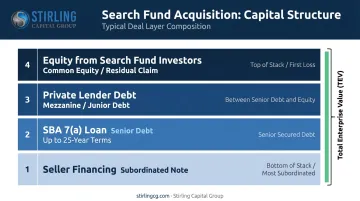
Search fund acquisitions rarely close on equity alone. The typical capital stack layers:
- Equity from search fund investors
- SBA 7(a) loans — with down payments as low as 10% and terms up to 25 years, these are particularly effective for deals under $10M enterprise value
- Seller financing — the departing owner carries a note, often subordinated to senior debt
- Private lender debt — for transactions that don't fit conventional bank criteria
Structuring that stack is genuinely complex, and getting it wrong can derail an otherwise sound deal. Stirling Capital Group works with search fund entrepreneurs navigating this process, connecting them with appropriate lenders across a network of 60+ private lending sources: SBA lenders, private credit funds, asset-based lenders, and senior secured lenders.
Stirling acts as a commercial finance consultant — not a direct lender — evaluating each acquisition and sourcing the right capital mix for that specific deal.
What Is Venture Capital?
Venture capital is a form of private equity where a fund manager raises a pooled fund from limited partners and deploys that capital across a portfolio of early-stage, high-growth startups in exchange for equity. Unlike search funds, VC funds bet on many companies simultaneously — intentionally.
Fund Structure and Scale
VC funds operate on a GP/LP model:
- General partners (GPs) manage the fund, source deals, and make investment decisions
- Limited partners (LPs) are passive investors — pension funds, endowments, family offices, and high-net-worth individuals
According to the 2024 NVCA Yearbook, the 2023 median U.S. VC fund size was $35.7M, with average fund sizes reaching $157.5M. Funds at the growth equity end can reach several billion dollars.
Investment Stages
VC is most active from seed through Series B:
| Stage | Median Deal Size (2024) |
|---|---|
| Seed | $3.1M |
| Series A | $12.4M |
| Series B | $28.0M |
| Series C | $45.0M |
Source: PitchBook-NVCA Q4 2024 Venture Monitor
What VC Actually Backs
VC-backed companies share a distinct profile:
- Scalable business model with a large addressable market
- Product-market fit potential (often pre-revenue at seed stage)
- A founding team with domain expertise
- A path to rapid market dominance
Software dominates VC deployment — $66.64B invested in 2023, representing 42% of all VC capital. Pharma & biotech ($21.36B) and healthcare services ($13.12B) round out the top sectors.
The Power Law Return Model
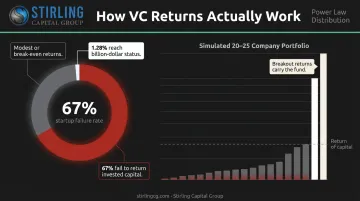
This is where VC diverges most sharply from search funds. CB Insights reports that 67% of VC-backed startups fail, and the probability of producing a billion-dollar company sits at 1.28%. VCs accept this by design: the model only works when one or two breakout investments return the entire fund. Every other position is a calculated loss.
Search funds operate on the opposite premise — a single acquired business generating consistent operational returns, with no expectation of a portfolio-wide home run to make the math work.
Search Funds vs. Venture Capital: Key Differences
Target Company and Business Stage
This is the most fundamental distinction in the entire debate.
Search funds acquire businesses that already work — companies with customers, cash flow, and operating history. VC backs businesses that might work — often pre-revenue ideas with strong founding teams and growth narratives.
The median search fund acquisition has $2.2M in EBITDA and $6.7M in revenue on day one. The median seed-stage VC investment goes into a company with neither.
Manager Role and Operational Involvement
- Search fund entrepreneur: Installs themselves as CEO. Responsible for every operational decision — hiring, pricing, customer retention, culture, strategy.
- VC fund manager: Provides capital, takes a board seat, offers strategic guidance. Does not run the portfolio company or manage its day-to-day operations.
This owner-operator vs. investor-operator distinction matters enormously for both entrepreneurs and investors choosing which model fits their temperament.
Risk and Return Profile
Search funds carry concentrated risk — one entrepreneur, one company, one outcome. That concentration is managed through:
- Thorough due diligence before acquisition
- Active investor mentorship post-close
- Targeting businesses with proven, stable cash flows
VC carries distributed risk across a portfolio, but with much higher variance. Most investments fail or return modest results; a few deliver the returns that make the fund work. PitchBook notes that the average GP builds a 20–25 company portfolio per fund, making roughly five new investments per year.
The risk structure you choose shapes everything downstream — including how long your capital stays locked up.
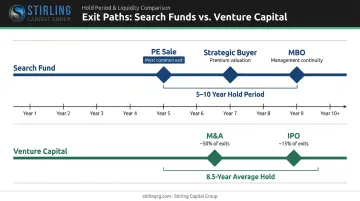
Time Horizon and Exit
| Search Fund | Venture Capital | |
|---|---|---|
| Typical Hold | 5–10 years | 8.5 years (first VC round to exit, per PitchBook) |
| Common Exits | PE sale, strategic buyer, MBO | M&A (~50% of exits), IPO (~15% of exits) |
| Investor Liquidity | Limited during hold period | Limited until fund distribution |
Search fund investors must be genuinely comfortable with illiquidity. Capital committed here is committed for the duration — plan accordingly before entering either structure.
Which Model Is Right for You?
For the Entrepreneur
Choose a search fund if you:
- Want direct operational control of a business from day one
- Prefer acquiring proven cash flows over building something from scratch
- Have an operator's mindset — you want to manage, not just pitch
- Can commit to a 5–10 year ownership journey
Choose VC (as a founder) if you:
- Have a scalable, technology-driven product concept
- Can tolerate a high probability of failure in exchange for potential outsized upside
- Are building toward rapid market capture and a fast exit
- Thrive on uncertainty and the pace of startup growth
For the Investor
Choose search fund investing if you:
- Want concentrated exposure to a single operator you've vetted personally
- Enjoy playing an active mentorship role post-acquisition
- Seek returns driven by operational improvement rather than market speculation
- Can commit capital for 7–10 years without needing liquidity
Choose VC if you:
- Prefer diversified exposure to early-stage innovation
- Are comfortable with power-law return distributions (most fail, few succeed big)
- Want professional fund management handling portfolio decisions
The Independent Sponsor: A Third Path
Worth noting as an emerging hybrid: the independent sponsor model shares DNA with both. No upfront fund is raised, deals are financed individually, and investor relationships form around specific acquisitions. More operators are turning to it — particularly those with deal flow and relationships who want flexibility without formal fund constraints.
If you've identified your path and need help structuring the acquisition financing stack, Stirling Capital Group offers a free consultation. We evaluate your specific opportunity and connect you with the right capital sources from our network of over 60 private lenders — spanning SBA loans, private credit, asset-based lending, and equity capital. Contact us at 614-470-4716 or info@stirlingcg.com.
Frequently Asked Questions
What is considered a search fund?
A search fund is an investment vehicle where one or two entrepreneurs raise capital to find, acquire, and operate a single privately held business — typically a profitable SME with proven cash flows. The model falls under Entrepreneurship through Acquisition (ETA), a structure formalized at Stanford GSB in 1984.
Are search funds successful?
The 2024 Stanford GSB Study covering 681 U.S. and Canadian funds reported a 35.1% aggregate pre-tax IRR and 4.5x ROI as of December 2023 — consistent performance across multiple market cycles. Individual outcomes vary based on the entrepreneur's execution and the quality of the acquisition target.
Are search funds risky investments?
Yes, but the risk profile differs from VC. Search fund risk is concentrated in one business and one operator, managed through rigorous due diligence, investor mentorship, and a deliberate focus on businesses with established cash flows.
What is the main difference between a search fund and venture capital?
Search funds acquire established, profitable businesses; VC funds invest in early-stage startups. The operator role also differs : a search fund entrepreneur becomes the owner-operator CEO, while a VC-backed founder retains leadership but answers to investor board members.
How do search fund entrepreneurs typically finance an acquisition?
Acquisitions typically combine equity from search fund investors with senior debt: SBA loans, seller financing, and private lending. Most deals involve layered financing, so structuring the right capital mix requires advisors with access to multiple lending channels.
Can individual investors participate in search funds?
Search funds typically invite a small group of accredited investors including entrepreneurs, family offices, and institutional investors, who provide both capital and mentorship. Entry is relationship-driven, and relevant business experience matters as much as capital, since active guidance through acquisition and operations is part of the value investors provide.