
Company recapitalization is the process of significantly changing a company's capital structure—the mix of its debt and equity. For business owners, entrepreneurs, and investors, understanding this process is critical. It’s not just for companies in distress; it's a strategic tool used by healthy, ambitious businesses to fund growth, facilitate ownership changes, or optimize financial health.
This guide will break down what recapitalization is, the key reasons to pursue it, the most common strategies, and how to navigate the process successfully.
Key Takeaways
- Recapitalization fundamentally alters a company's debt-to-equity ratio to achieve a specific financial or strategic goal.
- Common drivers include buying out a shareholder, funding a large dividend, defending against a takeover, or preparing for a future exit.
- Key strategies involve swapping debt for equity (or vice versa), using new debt to pay dividends, or executing a management-led buyout.
- The process requires careful financial modeling and expert guidance to ensure it aligns with long-term business objectives.
What Is Company Recapitalization?
Company recapitalization is a reorganization of a company's balance sheet. It involves changing the mix of debt and equity financing without raising capital for new business operations.
The primary goal is to create a more stable and efficient capital structure that better supports the company's strategic direction.
Recapitalization shouldn't be confused with refinancing. Refinancing typically involves swapping old debt for new debt, usually to get better interest rates or terms, without fundamentally altering the overall capital mix. A recapitalization, on the other hand, is a more significant restructuring of the entire debt and equity balance.
Why Companies Pursue Recapitalization
Recapitalization isn't an everyday event. It's a strategic move made to solve specific challenges or seize major opportunities. Business owners pursue it for several powerful reasons.
Facilitating Ownership Transitions
A recap is often used to manage ownership changes, providing an effective alternative to a full sale. It allows a company to:
- Buy out a founder, inactive family member, or departing partner.
- Provide liquidity for an exiting party.
- Consolidate control for the remaining owners or management team.
Funding Growth and Expansion
When ambitious growth plans require significant capital, a recap can fund these initiatives without a full sale. This strategy helps businesses:
- Finance a major acquisition or new product launch.
- Expand into new geographic markets.
- Inject capital by taking on new debt or an equity partner.
Shareholder Dividends
A "dividend recap" allows private owners to realize a return on their investment. The company takes on new debt and uses the proceeds to pay a large, one-time cash dividend to shareholders, extracting value without diluting ownership or selling equity.
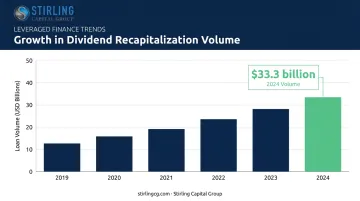
This strategy has become increasingly common. According to a report from Houlihan Lokey using PitchBook LCD data, dividend recapitalizations generated $33.3 billion in leveraged-loan volume in one recent year, nearing an all-time high.
Estate Planning and Generational Transfers
Recapitalization is a key tool for succession planning in family-owned businesses. It can be structured to transfer control to the next generation while providing the retiring owners with financial security by converting their equity into cash.
Corporate Defense or Restructuring
Recapitalization can also be used for defense or restructuring. For example, it helps:
- Deter hostile takeovers by taking on more debt.
- Simplify a complex capital structure during a turnaround.
- Reduce debt payments to create a healthier balance sheet.
Common Recapitalization Strategies Explained
The right recapitalization strategy depends entirely on the company's goals, its financial health, and current market conditions. While every deal is unique, most fall into one of a few common structures.
Leveraged Recapitalization (LBO/MBO)
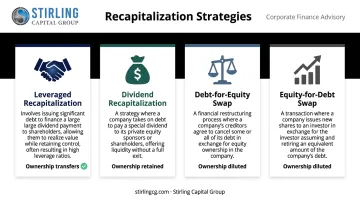
This strategy involves taking on significant new debt to finance a major transaction, most often a Management Buyout (MBO) or a Leveraged Buyout (LBO).
In a Management Buyout (MBO), the existing leadership team borrows funds to purchase the company from its owners. Conversely, a Leveraged Buyout (LBO) involves an external group, like a private equity firm, using debt for the acquisition.
In both scenarios, the company's assets and future cash flow act as collateral for the new loans. This results in a change of ownership and a more leveraged balance sheet, essentially using the business to finance its own sale.
Dividend Recapitalization
A dividend recap allows owners to extract cash from the business without selling their stake. The company takes on new debt and uses the proceeds to pay a one-time "special dividend" to shareholders. While owners retain control, the business is now responsible for servicing the additional debt.
Debt-for-Equity Swap
Often used in distressed situations, this strategy involves lenders forgiving company debt in exchange for an ownership stake (equity). This strengthens the balance sheet by lowering debt but dilutes the ownership of existing shareholders.
Equity-for-Debt Swap
In the reverse scenario, a company issues new stock to investors and uses the proceeds to pay down debt. This deleveraging process reduces financial risk and interest payments but also dilutes existing ownership. Choosing and structuring the right strategy is complex, often requiring specialized financial advisory.
Key Factors to Consider Before a Recapitalization
A recapitalization is a major financial event with long-term consequences. Before pursuing this strategy, business owners must conduct a thorough analysis of several key factors, often with the guidance of a financial advisor.
Company Valuation and Financial Forecasts
A credible and supportable valuation is the foundation of any recapitalization. As PwC notes, a deep understanding of the business and its market is "crucial to defining true value." You need a clear picture of your company's worth and a realistic financial forecast. This analysis will determine how much capital you can raise and on what terms.
Impact on Cash Flow and Debt Covenants
Taking on new debt has immediate cash flow implications. You must ensure the business can comfortably cover the new, higher debt service payments. Lenders will scrutinize metrics like your total debt-to-EBITDA ratio to assess risk.
Your company must also be able to comply with any new debt covenants. These are rules set by the lender that can restrict certain business activities, such as taking on more debt or paying dividends.
Ownership and Control
Every recapitalization strategy affects ownership and control differently.
- Issuing new equity to an investor will dilute your ownership percentage.
- A management buyout will consolidate control in the hands of the leadership team.
- A dividend recap leaves ownership unchanged but adds financial risk.
Be clear about your goals. Do you want to maintain full control, bring on a strategic partner, or prepare for an exit? The answer will guide your choice of strategy.
Market Conditions
The success of a recapitalization often depends on external factors. Interest rates, the availability of capital from lenders and investors, and overall economic health all play a critical role. The receptiveness of the capital markets can determine whether you can get a deal done and how favorable the terms will be.
How to Navigate the Recapitalization Process
Successfully executing a recapitalization is a complex, multi-stage process that requires a dedicated team of experts.
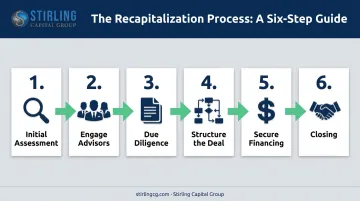
The typical steps include:
- Initial Assessment: Clearly define your goals. Are you seeking liquidity, funding growth, or transitioning ownership?
- Engage Advisors: Assemble a team of financial and legal experts to guide you through the process.
- Due Diligence: Prepare detailed financial statements, forecasts, and business documents for potential lenders and investors to review.
- Structure the Deal: Work with your advisors to determine the optimal mix of debt and equity.
- Secure Financing: Your advisors will market the opportunity to their network of capital providers to find the right partner and negotiate terms.
- Closing: Finalize legal documentation and close the transaction.
While these steps provide a roadmap, the role of a financial advisor is crucial for navigating the complexities of modeling scenarios and negotiating terms.
This is where a commercial finance consultant like Stirling Capital Group adds significant value. Because we are not a direct lender, we operate as a strategic advisor, leveraging our network of over 65 private lenders, debt funds, and equity groups.
Our approach allows us to find the right capital partner and structure a deal that aligns with your objectives, especially in complex situations that fall outside the scope of conventional banks.
Frequently Asked Questions
What does recapitalization mean for a company?
It's a significant change to its mix of debt and equity, aimed at achieving a strategic goal like an ownership change, funding growth, or providing liquidity to shareholders. It reshapes the company's financial foundation.
What is an example of recapitalization?
A common example is when a founder wants to retire. The company can take on a new loan to buy out the founder's shares, transferring full ownership to the remaining management team who will then run the business.
What is the difference between refinancing and recapitalization?
Refinancing simply swaps existing debt for new debt, often to secure a better interest rate. Recapitalization is a more fundamental restructuring that changes the company's overall mix of debt and equity.
How does recapitalization affect company ownership and control?
It can significantly impact ownership. Issuing new stock to an investor dilutes the stake of existing shareholders, while a buyout can consolidate control among a smaller group of owners or managers.
Is recapitalization only for companies in financial distress?
No. While it can be a tool for financial turnarounds, it is more often used by healthy, growing companies to facilitate buyouts, pay shareholder dividends, or fund major expansion projects.
How long does a typical recapitalization process take?
The timeline varies by deal complexity but often takes several months or longer to complete. This process involves extensive due diligence and securing financing, which affects the final schedule.