
Choosing the right financing partner is a high-stakes decision. The wrong one can stifle growth with rigid terms and slow processes, causing you to miss out on a game-changing acquisition or fall behind competitors. The right one, however, acts as a strategic ally, providing the fuel you need to scale effectively and seize opportunities.
This is where middle market lenders come in. As a powerful alternative to the banking system, they offer the speed and flexibility that growing companies demand. This guide provides a clear roadmap for navigating this landscape and finding the perfect capital partner for your business.
Key Takeaways
- Middle market lending provides flexible, timely capital for companies with annual revenues between $10 million and $1 billion, filling a critical gap left by traditional banks.
- Key lenders include private credit funds, BDCs, and specialty finance firms, offering structures like cash flow loans, asset-based lending, and mezzanine debt.
- Selecting a lender requires evaluating factors beyond interest rates, such as speed, covenant flexibility, industry expertise, and long-term partnership potential.
- Working with a commercial finance consultant streamlines the process, providing access to a vetted network of lenders and expert guidance on structuring the optimal deal.
Understanding the Middle Market Lending Landscape
The term "middle market" refers to a vital segment of the economy, generally comprising companies with annual revenues between $10 million and $1 billion. These businesses are often too large for small business loans but not yet large enough to access public capital markets, placing them in a unique financing gap.
Traditional banks, constrained by heavy regulation and a conservative approach to risk, often struggle to serve this market effectively. They tend to focus on historical performance and hard asset collateral, which doesn't always reflect the true potential of a growth-oriented company.
This is where private credit and middle market lenders have stepped in. The private credit market has seen explosive growth, with global assets and committed capital exceeding $2.1 trillion in 2023, according to the IMF.
Unlike banks, these lenders focus on a company's future cash flow, enterprise value, and growth story. This approach allows them to offer more flexible and creative financing solutions.
Types of Middle Market Lenders
The middle market is served by a diverse group of capital providers. Understanding the main players is the first step in finding the right fit.
- Private Credit Funds: These large capital pools from institutional investors operate outside the banking system, specializing in direct loans based on cash flow and enterprise value.
- Business Development Companies (BDCs): Publicly traded BDCs invest in mid-sized businesses, often providing both debt and equity capital in a single solution.
- Specialty Finance Companies: These firms focus on niches like asset-based lending (ABL), providing working capital by lending against receivables and inventory.
Key Benefits of Tapping into Middle Market Lenders
For a commercial borrower, turning to a non-bank lender offers several distinct advantages that are often critical for executing a growth strategy.
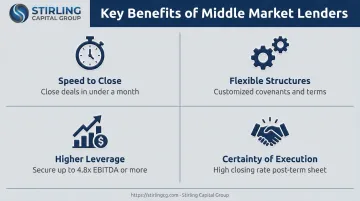
- Speed to Close: Close deals in under a month—significantly faster than the two-to-three-month timeline common with traditional banks.
- Flexible Structures: Get customized loan agreements with covenants and repayment terms tailored to your company's specific cash flow cycle.
- Higher Leverage: Secure more capital than banks, with leverage multiples often reaching 4.8x EBITDA or higher based on projected cash flow.
- Certainty of Execution: Benefit from a high closing rate once a term sheet is issued, which is critical for time-sensitive acquisitions.
Key Factors to Consider When Choosing a Middle Market Lender
Finding the right financial partner requires looking beyond the headline interest rate. The best lender is one whose strengths, structure, and philosophy align with your business goals.
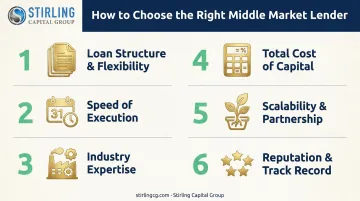
Loan Structure and Flexibility
The fine print of a loan agreement can have a massive impact on your business. Pay close attention to the covenants—the financial metrics you must maintain to avoid a default. These often include:
- Maximum Total Leverage Ratio: A cap on your total debt relative to your EBITDA.
- Fixed Charge Coverage Ratio (FCCR): A measure of your ability to cover all fixed costs, including debt payments.
Ensure the covenants provide enough cushion for your business to navigate normal fluctuations without tripping a default. You should also assess prepayment penalties, as you'll want the flexibility to refinance or pay down debt early if the opportunity arises.
Speed of Execution
For time-sensitive needs like an acquisition, a lender's timeline is a critical decision factor. A slow, bureaucratic process can kill a deal. When vetting potential partners, ask them directly for their average closing time on deals similar to yours. A lender who can move from term sheet to funding in a few weeks is a significant strategic advantage.
Industry Expertise
A lender with deep experience in your industry is an invaluable asset. They understand your business model, seasonality, competitive pressures, and market challenges. This shared understanding leads to a better-structured deal and a more productive long-term relationship. Before committing, check a lender’s portfolio to see if they have a track record of success with companies in your sector.
Total Cost of Capital
To understand the true cost of a loan, you must analyze every component beyond the headline interest rate.
- Origination Fees: Often structured as an Original Issue Discount (OID), this is an upfront fee deducted from the loan proceeds. For high-quality deals, this can be around two points, or 2% of the loan amount.
- Commitment Fees: Some lenders charge a fee on the undrawn portion of a credit facility, which can average around 1.83%.
- Other Fees: Be sure to account for legal fees, monitoring fees, and any required equity warrants or "kickers" that give the lender a small ownership stake.
Pro Tip: Create a simple spreadsheet to compare the "all-in" cost from different term sheets. This will give you a true apples-to-apples comparison.
Scalability and Partnership Potential
Your immediate capital need might be for one acquisition, but what about the next one? The ideal lender is a long-term partner who can grow with you. Ask about their capacity for follow-on funding. A lender with significant "dry powder" (uninvested capital) can be a reliable source of funding for your future growth initiatives.
Lender's Reputation and Track Record
Finally, conduct your own due diligence on a lender's history. Ask for references from their portfolio companies and learn about their experiences. Find out how the lender behaved during challenging times, such as an economic downturn or when a specific company faced headwinds.
This is where working with a capital advisor like Stirling Capital Group provides a distinct advantage. An experienced advisor has deep market intelligence and can offer firsthand insights into a lender's reputation for acting as a true partner when it matters most.
How a Commercial Finance Consultant Simplifies the Lending Process
For a busy executive or business owner, the process of finding, vetting, and negotiating with dozens of potential lenders is a massive drain on time and resources. This is where a commercial finance consultant acts as an expert guide, navigating the private capital markets for you.
Instead of approaching lenders one by one, a consultant uses a curated, pre-vetted network to find the best fit. For example, at Stirling Capital Group, we maintain deep relationships with a network of over 60 specialized lenders. This allows us to quickly identify the right capital partners for even the most complex or time-sensitive transactions.
Working with an advisor offers three core benefits:
- Pre-Underwriting and Strategic Positioning: A consultant does more than make introductions. They analyze your company’s financials, operations, and growth story to position your request strategically, increasing the likelihood of securing favorable terms.
- Access to a Competitive Marketplace: By taking your financing need to a select group of qualified lenders simultaneously, a consultant creates a competitive environment. This process ensures you receive the most favorable terms available in the market regarding rates, covenants, and fees.
- Deal Structuring Expertise: An experienced advisor acts as your advocate during negotiations. They ensure the final loan agreement aligns with your long-term strategic objectives and avoids restrictive terms or hidden pitfalls.
Your Partner for Growth
Securing middle market financing is about more than just finding money—it's about finding a strategic partner to help you achieve your vision. The right lender must align with your specific needs for speed, flexibility, and industry expertise.
Using this guide as a checklist helps you evaluate your options effectively. A dedicated capital advisor can navigate this complex landscape on your behalf, connecting you with a funding partner who will fuel your company's growth for years to come.
Frequently Asked Questions
What is middle market lending?
It’s a form of financing for companies typically too large for small business loans but not large enough to access public capital markets. These loans offer flexible debt solutions from non-bank lenders who underwrite based on cash flow and growth potential.
What is an example of a middle market company?
A regional manufacturing firm with $75 million in annual revenue or a family-owned distribution business with 300 employees. These companies form the backbone of the U.S. economy.
How does middle market lending differ from traditional bank loans?
It's typically faster, more flexible on covenants, and based more on a company's future cash flow (EBITDA). Traditional bank loans are often slower and more rigidly focused on the value of hard asset collateral.
What are the typical interest rates for middle market loans?
Rates are generally higher than bank loans to compensate for increased risk and flexibility. For qualified borrowers, pricing often falls in the range of SOFR + 5.25% to 5.75%, but this can vary widely based on risk profile and market conditions.
How quickly can middle market lenders provide funding?
Speed is a key advantage. Many private lenders can move from an initial conversation to a closed and funded deal in under 30 days—a timeline most traditional banks cannot match.
Why should I work with a finance consultant instead of going directly to a lender?
A consultant provides access to a broad, vetted network of lenders, creating competition for your loan to secure better terms. They also offer expert guidance on structuring the deal, which saves you time and helps you avoid costly mistakes.