

This is where mezzanine debt comes in. It’s a hybrid financing tool that blends features of traditional debt and equity, designed specifically to bridge that funding gap. For developers and investors, understanding how to use it can unlock opportunities that senior debt and equity alone cannot cover.
This guide will break down exactly what mezzanine debt is, where it fits in the capital stack, how the financing process works, and the key benefits and risks for your next real estate project.
Key Takeaways
- Mezzanine debt is a form of subordinate financing that sits between senior debt and common equity in the capital stack.
- Developers use it to increase leverage, reduce their required equity contribution, and fund costs that senior lenders won’t cover.
- It is more expensive than senior debt but less dilutive and offers more control than raising additional common equity.
- The process involves complex legal structures and negotiations, often requiring specialized financial expertise to secure.
What is Mezzanine Debt in the Real Estate Capital Stack?
Mezzanine debt is a hybrid capital solution that is subordinate to the senior mortgage but senior to the developer's common equity. Its primary purpose is to fill the financial gap between the total project cost and the combined amount from the senior lender and the developer's own equity.
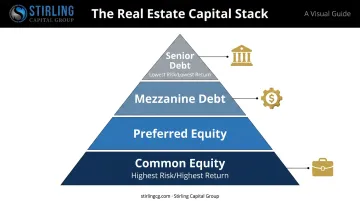
A project's funding is organized in a layered structure known as the capital stack. Each layer represents a different type of capital with varying levels of risk and return.
- Senior Debt: The primary mortgage with the first claim on assets. It is the lowest-risk and lowest-cost form of capital.
- Mezzanine Debt: Sits above the senior loan and is paid back only after the senior lender. This higher risk commands a higher interest rate.
- Preferred Equity: An equity investment with priority returns over common equity but subordinate to all debt.
- Common Equity: The developer's cash. It is the highest-risk layer but also receives the greatest rewards from a successful project.
Mezzanine debt gets its "hybrid" label because it combines features of both debt and equity. It carries a fixed interest rate like a standard loan but often includes an "equity kicker."
This feature gives the lender a share of the project's upside, such as a percentage of profits or an ownership stake, aligning their interests with the developer's success.
Why Real Estate Developers Use Mezzanine Debt
The main driver for using mezzanine debt is the ability to maximize leverage while minimizing the developer's out-of-pocket equity. This allows you to control a larger asset with less cash, freeing up capital to pursue multiple projects at once.
Here are a few common scenarios where mezzanine financing makes strategic sense:
- Bridge acquisition gaps. If a senior lender finances 65% of a property's cost, mezzanine debt can fund another 15-20%, reducing your required cash contribution.
- Cover construction shortfalls. When project costs overrun the senior construction loan, mezzanine financing can fill the funding gap to keep the project on track.
- Recapitalize stabilized assets. A developer can "cash out" equity from a successful project for new ventures without selling, retaining ownership and its income stream.
Beyond boosting leverage, mezzanine debt offers speed and flexibility that traditional bank loans often lack. The underwriting process is typically faster than securing institutional equity partnerships.
This structure also allows developers to retain greater ownership and control. Unlike bringing on a new equity partner, mezzanine lenders do not usually demand significant day-to-day decision-making authority.
How the Mezzanine Debt Financing Process Works
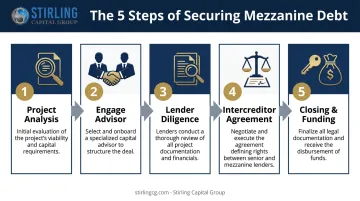
Securing mezzanine debt is a multi-step process that requires careful preparation and expert navigation. Here’s a high-level look at how it typically unfolds.
Step 1: Project Analysis and Identifying the Capital Gap
It all starts with your numbers. Before seeking a mezzanine loan, you must have a finalized project budget and a detailed pro forma. With these in hand, you’ll secure a term sheet from a senior lender. This term sheet specifies the senior loan amount, which clarifies the exact funding gap you need to fill with mezzanine debt or additional equity.
Step 2: Engaging a Capital Advisor and Preparing the Package
With the funding gap identified, the next step is to assemble a comprehensive financing request. This package typically includes the project summary, financial models, market analysis, details on the developer's track record, and the terms from the senior lender.
Partnering with a specialized commercial finance consultant like Stirling Capital Group provides significant value here. An advisor doesn't just shop your deal around; they help structure it for success.
They leverage an extensive network of private lenders to find the right match for your project, negotiate favorable terms, and navigate the complexities on your behalf.
Step 3: Lender Diligence and Term Sheet Negotiation
Once a potential mezzanine lender is engaged, they will conduct their own rigorous due diligence. They will scrutinize every aspect of the deal, including the project's viability, your experience, market conditions, and the senior loan terms. Key negotiation points often include:
- The interest rate and origination fees
- The repayment schedule
- The structure of the equity kicker
Step 4: The Intercreditor Agreement
This is one of the most crucial and complex steps. The intercreditor agreement (ICA) is a legal document between the senior lender and the mezzanine lender. It precisely defines the rights and remedies for each party, especially in the event of a default. The senior lender will want to protect their first-priority position, so negotiating this agreement requires a delicate balance and experienced legal counsel.
Step 5: Closing and Funding
Once the ICA is executed and all other legal documents are finalized, the deal moves to closing. This requires close coordination to ensure the senior and mezzanine loans are funded, often simultaneously, allowing the project to move forward.
Key Factors and Terms in a Mezzanine Debt Deal
A mezzanine loan term sheet includes several key components that differ from a standard mortgage:
- Interest Rate: The interest rate typically combines a monthly "cash-pay" portion with a "PIK" (Payment-In-Kind) rate that accrues and is paid off when the loan matures. For instance, a September 2023 deal for a large office portfolio included a mezzanine loan with a 10% cash-pay rate plus a 4.5% PIK interest, for a total rate of 14.5%.
- Equity Kicker / Profit Participation: This feature allows the lender to share in the project's success, often structured as a percentage of future profits rather than a direct ownership stake. One worked example from V&E gave the lender 15% of profit distributions after the developer achieved certain return thresholds.
- Loan-to-Value (LTV) and Loan-to-Cost (LTC): Mezzanine debt increases a project's total leverage. While a senior loan may cap at 65-70% LTC, adding a mezzanine piece can push combined financing much higher. In one proposed structure, the combined financing reached 82.2% of total portfolio costs.
Common Risks and Misconceptions of Mezzanine Debt
The most common misconception is that mezzanine debt is simply "expensive money." While the interest rate is high, its cost should be evaluated against the return it generates. If a mezzanine loan enables a highly profitable project that would otherwise be impossible, its cost can be easily justified.
However, there are real risks to consider:
High Cost of Capital: If a project underperforms, the high interest rate can quickly erode profits and jeopardize the developer's equity.
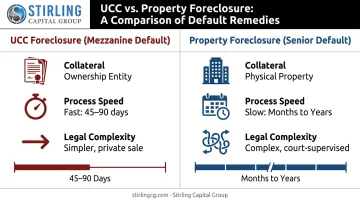
Foreclosure Risk: Unlike a second mortgage, defaulting on mezzanine debt triggers a UCC foreclosure on your ownership stake in the property's LLC—not on the property itself.
This process is much faster than a typical property foreclosure, often taking 45-90 days, and can result in the lender taking complete control of the project.
Legal Complexity: Mezzanine loan documents and intercreditor agreements are highly complex. Without proper legal advice, you could face future conflicts between lenders that put the project at risk.
A Powerful Tool for Strategic Developers
Mezzanine debt is a powerful and flexible tool for experienced real estate developers. It can bridge critical financing gaps, help you win deals by maximizing leverage, and allow you to retain more ownership and control over your projects.
While it comes with higher costs and greater complexity, its strategic use can unlock a project’s full potential and drive higher returns. Success hinges on pairing the right project with the right team—including an experienced capital advisor who can access a broad network of private lenders to structure a deal that aligns with your goals.
Frequently Asked Questions
What is senior debt vs mezzanine debt?
Senior debt is the primary mortgage with the first lien position, making it the lowest-risk and lowest-cost financing. Mezzanine debt is a subordinate loan secured by ownership equity in the property-owning company, not the property itself, making it higher-risk and higher-cost.
What is an example of a mezzanine financing?
A developer is buying a $10 million property. A bank offers a $6.5 million senior loan (65% LTV), and the developer contributes $1.5 million in equity (15%). A mezzanine lender provides the remaining $2 million, bridging the gap to complete the purchase.
How is mezzanine debt secured in a real estate deal?
It is not secured by a mortgage on the property. Instead, the borrower pledges their ownership interests (e.g., shares of the LLC) in the entity that owns the real estate as collateral for the loan.
What are typical interest rates for mezzanine debt?
Rates are significantly higher than senior debt and vary by project risk. For example, a recent large deal had a total rate of 14.5%, which combined a 10% cash-pay rate with a 4.5% payment-in-kind (PIK) component.
How does mezzanine debt differ from preferred equity?
Mezzanine debt is a loan, and the default remedy is foreclosing on company ownership (a UCC foreclosure). Preferred equity is an ownership stake with a priority return, where the remedy for non-payment is often taking control of the project's management.
Can mezzanine financing be used for any type of real estate project?
It’s most common for value-add or opportunistic projects like ground-up development, major redevelopments, or transitional properties. The potential for high returns in these projects is needed to justify the higher cost of the capital.