
Introduction
LP expectations for meaningful "skin in the game" have grown sharply alongside fund sizes — and the math is unforgiving. A 2% commitment to a $500M fund means $10M out of pocket. For a $1B fund, that's $20M. Even successful managers can find that kind of capital draw strains personal liquidity, particularly when managing multiple active funds simultaneously.
GP commitment financing resolves this tension directly. Rather than liquidating personal assets or selling equity in the management company, fund managers can borrow against their most predictable future asset: the management fee stream and carried interest their firm will generate as the fund matures.
This guide covers:
- What GP commitments are and why they create liquidity pressure
- Why managers seek financing instead of funding commitments out of pocket
- How GP commitment financing structures work
- What solutions are available in the market
- What lenders evaluate when underwriting these facilities
Key Takeaways
- GP commitments typically range from 2–5% of fund size, per ILPA's standard-practice guidelines — with the average clustering around 3.5%
- Structured borrowing covers these commitments while preserving personal liquidity and management company ownership
- Management fee cash flows and carried interest distributions serve as the primary collateral
- Solutions range from management company loans to preferred equity and specialty lenders
- Lenders underwrite on AUM stability, fee predictability, and track record rather than traditional balance sheet metrics
What Is a GP Commitment?
A GP commitment is the capital a General Partner pledges to invest in its own fund alongside Limited Partners. The GP participates on identical terms to LPs — sharing proportionally in gains and losses, subject to the same distribution waterfall, and drawn down at each LP capital call.
ILPA Principles 3.0 identifies the GP commitment as "a critical aspect of alignment of interest" and states that alignment is best achieved when GP wealth creation comes primarily from profits generated after LP return requirements are met — not from fee income alone.
What's the Standard Commitment Level?
ILPA's standard-practice range is 2–5% of total fund capital. Research from the UNC Institute for Private Capital puts the reported range in sharper focus:
- 25th percentile: 2.2%
- Average: 3.5% (3.9% for buyout; 2.7% for VC/growth)
- 75th percentile: 4.4%
GP commitments have also trended upward over time. UNC IPC data shows VC and growth equity GP commitments rose from 1.0% in 2005 to 2.5% in 2019 — reflecting both growing LP expectations and larger absolute fund sizes.
GP vs. LP Commitments
The distinction matters structurally. LP commitments constitute the vast majority of fund capital — LPs are the external investors seeking returns. The GP commitment is the manager's own stake, smaller in dollar terms but carrying outsized signaling weight.
Both are drawn down through capital calls and participate in the same return structure. The key difference is the source of capital: LPs deploy external investor funds; the GP puts its own balance sheet on the line.
Why GPs Need Financing for Their Fund Commitments
Bain's 2025 Global Private Equity Report puts the average 2024 PE fund size at $843M, with 40% of capital flowing to funds of $5B or larger. On a $1B fund, a 3.5% GP commitment equals $35M — capital that few managers can deploy from current income without disrupting personal or firm liquidity.
The pressure compounds across fund vintages. A manager raising Fund III while still drawing capital calls for Fund II faces overlapping obligations that stretch liquidity well past what management fee income supports — particularly during early investment periods when fees haven't fully scaled. That squeeze is why many GPs turn to financing rather than scaling back their commitment.
The Performance Incentive
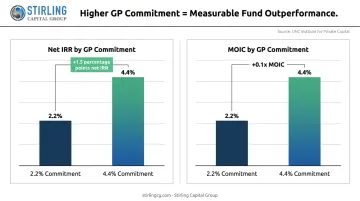
Liquidity isn't the only driver. There's a direct performance case for committing more. Research from the UNC Institute for Private Capital finds a positive association between GP commitment levels and fund performance up to approximately 10% commitment:
- Moving from 2.2% to 4.4% GP commitment is associated with approximately 1.5 percentage points higher net IRR
- The same move correlates with 0.1x higher MOIC
At fund scale, 1.5 percentage points of net IRR is a material outcome for LPs — and a compelling reason for GPs to commit at or above market standard even when it strains available capital. Financing makes that possible without forcing a tradeoff between commitment size and firm operations.
How GP Commitment Financing Works
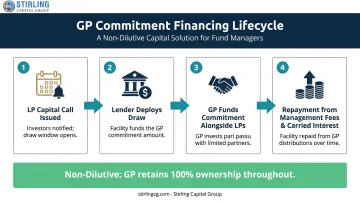
The basic structure: the GP or management company borrows capital to fund its proportional commitment alongside LP capital calls. Repayment flows from the management company's future economics — primarily management fees and, as the fund matures and exits positions, carried interest distributions.
The Two Collateral Assets
Management fees are the more liquid and predictable of the two. Lenders assess them based on total AUM, LP base composition, fee rate, and remaining investment period. As described by Mayer Brown's fund finance analysis, security typically involves the right to receive fees under the LPA or management agreement, plus a lien on the deposit account receiving fee payments.
Carried interest is less certain and valued accordingly. Lenders discount projected carry based on:
- Current IRR and DPI trajectory
- Fund strategy and typical realization timeline
- Ratio of unrealized to realized assets
- Market comparables for similar strategies
Early-stage funds with limited DPI receive considerably less carry credit than mature funds with clear exit pipelines.
Draw Schedule and Repayment
Most GP commitment financing deploys in sync with LP capital calls, not as a single upfront lump sum. This reduces carrying costs and aligns draws with actual fund activity.
Repayment is event-driven: as portfolio companies are realized and distributions flow to the GP, proceeds reduce the outstanding loan balance. Management fees may also be pledged as a current-pay income stream to service interest in the interim.
Non-Dilutive by Design
The repayment structure above also reflects a broader ownership principle: unlike selling a minority stake in the management company, most GP commitment financing is non-dilutive. The GP retains 100% ownership and all future earnings. The lender's return comes from interest and fees on the loan — not from a share of future fund economics. For managers building toward a multi-fund platform, keeping that equity intact is often the primary reason they choose financing over a strategic sale.
Types of GP Commitment Financing Solutions
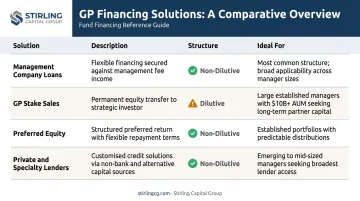
Management Company Loans
Term loans and revolving credit facilities made directly to the management company represent the most common GP financing structure. Secured by a lien on management fee revenues — and in some cases carried interest or the GP's LP interest in the fund — these facilities are flexible in size, tenor, and collateral composition. That flexibility makes them accessible to managers at different stages of growth. The facility can be sized to cover a single fund commitment or structured across multiple vintage obligations.
GP Stake Sales (Dilutive Alternative)
In a GP stake sale, a third-party investor acquires a minority ownership position in the management company in exchange for capital. Proceeds can fund GP commitments, but the structure permanently dilutes the GP's economics. Access is also limited: market commentary from PEI indicates that traditional GP stake vehicles have historically targeted managers with $10B–$25B in AUM, creating meaningful barriers for emerging or mid-sized managers.
For managers who don't want to trade equity for liquidity, stake sales are a last resort — not a first option.
Preferred Equity Structures
For managers who want capital without giving up ownership, preferred equity offers a middle path. The lender receives a preferred return on capital deployed, repaid from a combination of management fee income and fund distributions. These structures can be designed without hard maturity dates or traditional financial covenants, making them well-suited for GPs with established portfolios who need flexibility in repayment timing.
Private and Specialty Lenders
Traditional banks are often constrained in this space. Unfamiliarity with fund-level collateral and regulatory capital requirements limit their appetite for management fee-backed or carry-backed structures, leaving most GPs underserved by conventional credit channels.
Private and specialty lenders step in where banks cannot. Working with a commercial finance advisory firm like Stirling Capital Group — which maintains relationships with more than 60 private lending sources across multiple commercial lending categories — gives GPs the ability to compare structures across lenders with direct experience in fund manager financing, rather than fitting into a single credit box. Stirling's fund financing practice provides access to debt funds, specialty finance groups, and institutional capital providers who understand the collateral and cash flow dynamics specific to investment management firms.
What Lenders Evaluate When Underwriting GP Commitment Financing
GP commitment financing is underwritten on fundamentally different terms than a traditional business loan. Lenders aren't reviewing inventory or equipment values — they're evaluating the durability of a management fee stream and the probability of carried interest realization.
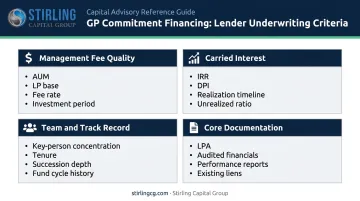
Management Fee Quality
Lenders assess the reliability and longevity of management fee income across several dimensions:
- Total AUM and trajectory
- LP base composition (institutional vs. retail concentration)
- Fee rate and any LPA provisions that reduce net cash flows
- Remaining investment period and likelihood of LP re-up in subsequent funds
- Historical consistency of fee receipts — Mayer Brown identifies a "proven track record of receiving management fees" as a key underwriting factor
Carried Interest Underwriting
Because carried interest is contingent and illiquid, lenders scrutinize the fund's performance trajectory carefully:
- Current fund IRR and DPI relative to vintage and strategy benchmarks
- Ratio of unrealized to realized portfolio value
- Expected realization timeline based on strategy type
- Market comparables for similar fund strategies at similar stages
Team and Track Record
Lender confidence hinges heavily on the stability of the team behind the fund:
- Key-person concentration — degree of LP relationship dependence on specific individuals
- ILPA Model LPA provisions treat key persons holding less than 75% of carried interest as a change-of-control trigger, which directly affects lender security
- Team tenure and whether the firm has performed through at least one full fund cycle
- Succession depth and organizational stability
Core Documentation Required
Lenders typically require the following before underwriting a GP facility:
- Limited Partnership Agreement (fee terms, carry economics, key-person provisions)
- Audited management company financials
- Fund-level performance reports and capital account statements
- Existing debt obligations or liens on management company cash flows
- GP commitment amounts across all active funds
A strong underwriting package presents each of these clearly — demonstrating both the quality of the fee stream today and the structural protections that protect it going forward.
Benefits and Risks to Consider
Benefits for GPs
- Liquidity preservation: Commit at or above market standard without depleting personal capital
- Platform continuity: Fund sequential commitments across vintages without compressing management company operations
- Ownership retention: No dilution — the management company and its future economics remain fully with the GP
- LP relationship strength: A larger commitment signals conviction; ILPA explicitly ties meaningful GP commitment to alignment of interest
Benefits That Flow to LPs
The UNC IPC data discussed earlier applies directly to LP interests as well. Higher GP commitment levels are associated with better net IRR outcomes, and the alignment mechanism works because the GP's financial interest in fund performance increases when their own capital is at risk. By enabling GPs to commit more without depleting operational capital, financing can indirectly support the LP outcomes it's designed to align with.
Risks to Weigh Carefully
- Carry shortfall exposure: Borrowing against future carried interest creates real risk if fund performance disappoints or exit timelines extend — the loan obligation doesn't shrink with the portfolio
- Reduced net carry economics: Interest and lender fees reduce the effective return on carry, which matters most in scenarios where carry is the manager's primary wealth-creation vehicle
- LPA pledge restrictions: ILPA model forms restrict pledging or transferring partnership interests without LP consent — some thresholds require 85% in-interest approval, making LPA review essential before structuring any pledge
- Over-leverage across vintages: Committing financed capital to multiple simultaneous funds compounds liquidity risk if AUM contracts or fee income declines
Frequently Asked Questions
What is GP commitment financing?
GP commitment financing lets a fund's General Partner borrow against future management fee income and carried interest to fund its capital commitment to the fund. The GP accesses capital now and repays from fund economics as they materialize — no personal assets required.
What is a typical GP commitment?
Per ILPA's standard-practice guidance, GP commitments typically range from 2–5% of a fund's total committed capital. UNC IPC data puts the empirical average at 3.5%, with buyout managers slightly higher and VC/growth managers slightly lower. Emerging managers may commit above this range to compensate for shorter track records.
Do GP commitments matter?
Yes, as both an alignment signal and a performance driver. UNC IPC research finds that moving from a 2.2% to a 4.4% GP commitment is associated with approximately 1.5 percentage points higher net IRR — a direct, quantified link between commitment size and fund returns.
What is the difference between a GP and LP commitment?
LP commitments represent external investor capital and constitute the majority of fund capital. The GP commitment is the fund manager's own capital pledged alongside LPs under identical terms. Both participate in the same distribution waterfall — the difference is scale and source.
What can be used as collateral for GP commitment financing?
The two primary collateral types are management fee cash flows and carried interest — the latter discounted based on fund performance, DPI, and realization timeline. Some lenders also accept co-investment rights or a pledge over the GP's LP interest in the fund.
How does GP commitment financing affect LP returns?
Financing lets GPs make larger commitments without depleting operating capital, strengthening GP-LP alignment. Since higher commitment levels historically correlate with better fund performance, LP returns can benefit indirectly — though outcomes still depend on fund execution.