
This guide is written specifically from the lender's perspective. Understanding the nuances of this agreement is not just a matter of due diligence; it's fundamental to protecting your capital and succeeding in the fast-paced world of mortgage banking. We will deconstruct the warehouse line of credit agreement, covering its core components, the business case for offering these lines, key risk factors, and best practices for underwriting and monitoring.
Key Takeaways for Lenders
- A warehouse line of credit is a short-term, secured credit facility allowing a mortgage originator to fund home loans before their sale on the secondary market.
- For lenders, it's a significant revenue opportunity through fees and interest but carries risks related to collateral integrity, borrower fraud, and market changes.
- The agreement is your main defense, defining covenants, reporting rules, collateral custody, and what happens in a default.
- Thorough due diligence on the mortgage originator’s financial health, operational capacity, and their approved take-out investors is non-negotiable.
What Is a Warehouse Line of Credit Agreement?
A warehouse line of credit agreement is a formal contract between a warehouse lender and a mortgage originator. It establishes the terms for a revolving line of credit used to provide temporary liquidity to the originator.
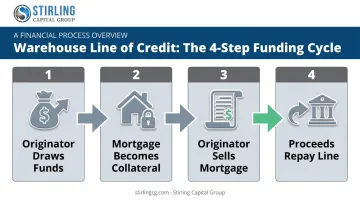
The funding cycle typically follows these steps:
- An originator draws on the line to fund a home loan for a borrower.
- The newly created mortgage immediately becomes the collateral securing the funds.
- The originator sells the mortgage to an investor on the secondary market (like Fannie Mae).
- Proceeds from the sale pay down the warehouse line, freeing up capital for the next loan.
This structure differentiates warehouse financing from other forms of commercial lending. It is short-term, asset-backed, and directly tied to the health and efficiency of the secondary mortgage market.
The Lender's Business Case: Why Offer Warehouse Financing?
Offering warehouse lines of credit is a strategic decision that can yield significant returns when managed properly. The business case for lenders is built on strong revenue potential and opportunities for deeper client relationships.
The Mortgage Bankers Association (MBA) estimates that warehouse lenders and independent mortgage bankers facilitate the movement of more than $1 trillion of capital annually. This isn't a niche market; bank warehouse commitments support over 60% of all single-family mortgage originations, making it a cornerstone of the housing finance system.
Key benefits for lenders include:
- Generate diverse revenue from origination fees, non-usage fees on undrawn capital, and the interest spread on advanced funds.
- Deepen client relationships by opening the door to cross-selling treasury management, deposit accounts, and other banking services.
- Offer a secured lending product where advances are backed by saleable mortgages, creating a predictable risk profile and consistent returns.
Anatomy of the Agreement: Key Provisions and Covenants for Lenders
The agreement itself is your primary tool for risk mitigation. A well-crafted document protects your interests by clearly defining the rules of the relationship.
The Funding Mechanism and Collateral
The core of the agreement specifies how funds are advanced and secured. A key term here is the "haircut," where the lender advances a percentage of the mortgage's face value—typically between 97% and 100%—requiring the originator to fund the remaining 1-3% with their own capital. This ensures the originator has "skin in the game" for every loan.
The process of collateral perfection is also critical to ensure your security interest in the mortgage note and deed of trust is legally sound.
The agreement must detail the flow of funds to the closing agent. It should also outline the requirements for transferring documents to a third-party custodian, who holds them on your behalf until the loan is sold.
Critical Covenants and Reporting Requirements
Financial covenants and reporting are your early warning system for borrower distress. They allow you to monitor the originator's health continuously.
Essential financial covenants include:
- Minimum Tangible Net Worth: A baseline requirement for the originator’s financial solvency.
- Liquidity Requirements: Ensures the originator has enough cash on hand to cover their haircut obligations and operational expenses.
- Maximum Leverage Ratio: Restricts the originator's total debt relative to its equity.
- Profitability: Covenants may require the originator to maintain profitability over a certain period.
Mandatory reporting requirements should include:
- Regular submission of funding schedules and loan pipeline reports.
- Quality control (QC) reports on underwritten loans.
- Audited annual and reviewed quarterly financial statements.
Managing Risk: A Lender's Guide to Due Diligence and Monitoring
Success in warehouse lending depends entirely on rigorous underwriting and perpetual monitoring. Your due diligence process must go far beyond a simple credit check.
Initial Borrower Underwriting
Before extending a line of credit, your underwriting must scrutinize the mortgage originator’s entire operation.
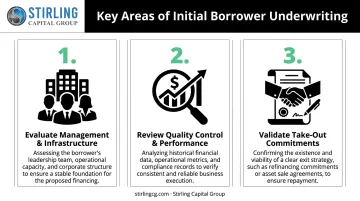
- Evaluate Management and Infrastructure: Assess the experience of the management team. Do they have a proven track record? Do they have the operational infrastructure—underwriting, compliance, and closing teams—to produce high-quality, compliant loans?
- Review Quality Control and Performance: Examine their QC plan and historical performance with secondary market investors. A high loan repurchase rate is a major red flag. For context, Freddie Mac reported an observed repurchase demand rate of 0.11% of funded loans in Q1 2024.
- Validate Take-Out Commitments: The originator's ability to repay the line depends on selling their loans. You must confirm they have reliable, pre-approved take-out investors ready to purchase the assets. A weak exit strategy is a direct risk to you.
Ongoing Risk Monitoring and Fraud Prevention
Once the line is active, your work has just begun. Continuous monitoring is essential to protect your capital.
- Track Dwell Time: Monitor how long loans sit on your warehouse line. The MBA notes a recent industry average of 15-18 days, and extended dwell times can signal problems with the originator's sales process that require immediate investigation.
- Conduct Collateral Audits: Periodically audit the physical loan files held by the custodian to ensure they are complete and accurate.
- Prevent Common Fraud Schemes: Be vigilant against sophisticated fraud. The FFIEC highlights common schemes like double funding (pledging the same loan to multiple lenders), fictitious loans, and inflated appraisals. One federal case involved 53 fraudulent requests that led to $17.9 million in improper advances.
For many lenders, the burden of sourcing and underwriting new mortgage originator relationships can be substantial. Partnering with a specialized capital advisory firm can streamline this process.
A firm like Stirling Capital Group, for instance, provides lenders with access to a network of pre-vetted mortgage originators. They handle much of the initial due diligence, allowing you to focus your resources on final underwriting and portfolio management.
Conclusion
A warehouse line of credit agreement is a complex but highly effective instrument for lenders prepared to manage its intricacies. For banks and private capital providers, it offers a secured, high-turnover lending product that can generate consistent returns and build valuable client relationships.
Ultimately, success in this field doesn't just come from having capital to deploy. It hinges on a meticulously crafted agreement, rigorous due diligence, and active borrower oversight. This is why many lenders partner with capital advisors to source and structure these complex facilities, ensuring a steady flow of high-quality, pre-vetted opportunities.
Frequently Asked Questions
How does a warehouse line of credit work?
A lender extends a credit line to a mortgage originator to fund home loans. These new loans serve as collateral until they are sold on the secondary market, and the sale proceeds are used to repay the credit line.
What is the 3-7-3 rule?
This TILA rule dictates timing for mortgage originators: provide the Loan Estimate within 3 days of application, wait 7 business days to close, and give the Closing Disclosure 3 days before consummation. Lenders enforce this to protect collateral quality.
What is a typical "haircut" in a warehouse lending agreement?
A haircut is the difference between a loan's face value and the amount advanced by the lender. For example, a 2% haircut on a $300,000 loan means the lender advances $294,000 (98%), which serves as a protective margin.
What are the primary collateral documents a lender holds?
The primary collateral includes the original promissory note and the mortgage or deed of trust. These documents are held by a third-party custodian to perfect the lender's security interest.
How can lenders mitigate fraud risk in warehouse lending?
Mitigation requires stringent initial due diligence, third-party verifications, regular collateral audits, and using technology to track loan data. These systems help prevent common schemes like the double funding of a single asset.
What happens if the mortgage originator defaults on the line of credit?
If an originator defaults, the agreement gives the lender the right to seize the collateral (the mortgage loans). The lender can then sell those loans directly to the secondary market or another investor to recover the outstanding funds.