

This guide is written for entrepreneurs, business buyers, and sellers navigating transactions under $50 million. If you've seen the term "seller note" in a letter of intent and aren't sure what it means for your side of the table, this is where to start.
Key Takeaways
- A seller note is a fixed debt obligation—the buyer owes repayment regardless of how the business performs post-closing
- Seller financing is most common in small business acquisitions; IBBA/M&A Source Market Pulse Q2 2024 shows seller financing typically represents 3%–13% of consideration by deal size band
- Sellers benefit from potential tax deferral, interest income, and a broader buyer pool; buyers benefit from lower upfront capital requirements
- Default risk is the primary seller concern; UCC-1 liens, large down payments, and acceleration clauses reduce exposure
- Seller notes work best as one layer in a broader capital stack, often paired with SBA or private debt
What Is Seller Financing in M&A?
Seller financing (also called owner financing) is an arrangement where the seller extends a loan to the buyer for a portion of the purchase price. The loan is formalized through a promissory note and repaid over an agreed term with interest—typically 5–7 years at 8%–10%, according to BizBuySell's seller financing data.
The structure exists to solve a specific problem: buyers who cannot, or prefer not to, fund 100% of the purchase price through cash or third-party lenders. Seller financing gives them a path forward while giving sellers a structured way to receive full proceeds over time.
Seller Notes vs. Earnouts: A Critical Distinction
These two structures are frequently confused — and mixing them up leads to mismatched expectations before the deal even closes.
- Seller note: A fixed debt obligation. The buyer owes repayment regardless of how the business performs after closing.
- Earnout: Contingent consideration. Payment only occurs if the business hits specified performance targets (revenue, EBITDA, etc.).
An earnout is not seller financing in the traditional sense. It's a valuation-gap tool, not a loan. As SRS Acquiom's earnout research shows, earnouts are contested at least 28% of the time — which is precisely why nailing down these definitions before negotiations begin is non-negotiable.
How Seller Financing Works in M&A Transactions
The basic structure is straightforward. The buyer makes a down payment at closing (typically at least one-third of the purchase price), and the remaining financed portion is repaid in regular installments, usually monthly, over the note's term.
The Seller Note
The promissory note is the central legal instrument. It specifies:
- Principal amount financed
- Interest rate and payment schedule
- Maturity date
- Collateral securing the loan
- Any subordination clause (critical when a bank or SBA lender holds senior claim on assets)
If a third-party lender is also involved, expect them to require the seller note to sit in a subordinated position—meaning the bank gets paid first in any default or liquidation scenario.
Seller as Lender: Due Diligence Before Committing
When a seller agrees to carry a note, they're acting as a bank. They should vet the buyer accordingly.
Before agreeing to seller financing, sellers should request:
- Personal and business financial statements
- Credit report
- Professional background and references
- Evidence of operational experience in the relevant industry
Post-closing, sellers commonly require buyers to maintain minimum financial benchmarks—working capital floors, maximum leverage ratios—and provide periodic financial reporting. These provisions serve as early warning systems, giving sellers visibility into the business's health before a default becomes a crisis.
Step-by-Step: From Term Agreement to Final Repayment
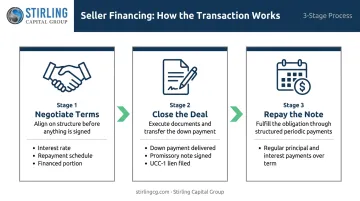
- Negotiate terms — Buyer and seller agree on the financed portion, interest rate, and repayment schedule during deal negotiations. Terms should be grounded in the business's projected cash flow, with market rates serving as a reference point rather than the sole driver.
- Close the deal — At closing, the buyer delivers the down payment; the seller signs the promissory note and security agreement; a UCC-1 lien is filed against the business assets to establish the seller's priority claim.
- Repay the note — The buyer makes regular principal and interest payments over the note term. Early payments are weighted toward interest; principal paydown accelerates as the loan matures.
Common Seller Financing Structures in M&A
The basic seller note is the most widely used structure, but several variations exist depending on deal complexity, risk tolerance, and how wide the valuation gap is.
Seller Notes (Promissory Notes)
The simplest and most common form: a fixed loan from seller to buyer, repaid over 5–7 years at 8%–10% interest. The rate reflects the risk profile of lending against a small business—limited hard collateral, no institutional oversight—not current treasury or mortgage rates.
BizBuySell reports seller financing appears in 60%–90% of small business acquisitions. The amount financed, however, is often smaller than many assume. Recent Market Pulse data breaks it down by deal size:
- Under $500K: seller financing averaged 11% of consideration
- $500K–$2M: 6%–7% of consideration
- $2M–$5M: 13% of consideration
- $5M–$50M: just 3% of consideration
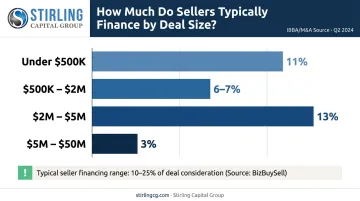
BizBuySell suggests most sellers finance 10%–25% of the purchase price, with some deals reaching 50% in less common cases.
Earnouts
An earnout makes a portion of the purchase price contingent on the business hitting future performance targets—revenue thresholds, EBITDA milestones, client retention rates. Unlike a seller note, payment is conditional, not guaranteed.
Earnouts are useful for bridging valuation gaps when a buyer and seller disagree on what the business is worth today versus what it could be worth. The catch: if metrics aren't precisely defined, disputes follow. The 28% contest rate cited by SRS Acquiom isn't a fringe problem—it's a predictable outcome of loosely drafted contingent consideration language.
Equity Rollovers and Hybrid Structures
In sponsor-led and private equity deals, sellers sometimes retain a minority stake in the acquiring entity rather than (or in addition to) receiving a note. This signals confidence in the business and allows the seller to participate in future upside. Preferred equity arrangements—where the seller receives structured equity rather than pure debt—also appear in this space.
Per Market Pulse Q2 2024, retained equity represented about 5% of the financing structure in the $5M–$50M segment. These structures are less typical in main street business sales and more common where a PE sponsor is driving the transaction.
In larger transactions, a seller note alone rarely covers the full gap between buyer capital and purchase price. Buyers in the $5M–$50M range often need to layer in additional financing sources—private credit, mezzanine capital, or SBA lending—to complete the capital stack. A capital advisory firm like Stirling Capital Group, with relationships across 60+ private lending sources, can help structure that layered financing and identify the right mix for a specific deal.
Benefits and Risks: What Buyers and Sellers Need to Know
Benefits for Buyers
- Lower upfront capital requirement: Preserving cash at closing leaves working capital available for post-acquisition operations—inventory, payroll, and the inevitable surprises of a business transition.
- Simpler qualification: The seller has direct knowledge of the business and isn't bound by rigid bank underwriting criteria. Qualification is based on relationship and judgment, not a standardized credit box.
- Faster timelines: Reducing reliance on third-party lenders can shorten due diligence timelines, though exact speed advantages vary by deal.
Benefits for Sellers
- Tax deferral through installment sales: Under IRS rules (covered in IRS Publication 537), sellers may be able to spread capital gains recognition across multiple tax years—potentially keeping annual income in a lower bracket each year. Sellers should confirm their specific situation with a tax advisor, as limitations apply (including depreciation recapture, which may be recognized in the year of sale).
- Interest income: Sellers earn ongoing interest on the unpaid balance at 8%–10%—above and beyond the purchase price itself.
- Broader buyer pool: Seller financing can attract buyers who are qualified operators but don't have access to full third-party funding, potentially supporting a faster sale and stronger price.
Key Risks for Sellers—and How to Mitigate Them
The core risks:
- Default: The buyer stops making payments. The seller may need to repossess a business that has declined in value.
- Illiquidity: Proceeds are tied up for years, not available to reinvest or deploy elsewhere.
- Ongoing entanglement: If the buyer struggles, the seller may be pulled back into operational decisions they intended to exit.
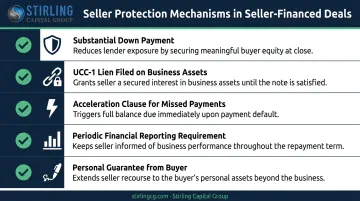
Protection mechanisms that matter:
- Require a substantial down payment (at least one-third) to reduce the financed amount and demonstrate buyer commitment
- File a UCC-1 lien on business assets to establish priority claim
- Include an acceleration clause allowing the seller to demand full repayment if the buyer misses payments
- Require periodic financial reporting post-closing
- For larger transactions, require a personal guarantee from the buyer
Key Risks for Buyers
Seller protections above exist precisely because buyer-side failure is the primary deal risk. The core issue is debt service strain: if seller note payments combined with other acquisition debt exceed what the business generates, the deal fails regardless of how strong the underlying business is.
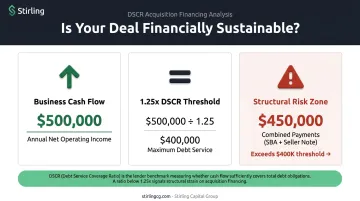
A common lender benchmark for acquisition financing is a minimum 1.25x debt service coverage ratio (DSCR)—meaning the business should generate at least $1.25 in cash flow for every $1.00 in annual debt service. A practical example:
- Business generates $500,000 in annual cash flow
- At 1.25x DSCR, maximum supportable annual debt service = $400,000
- If SBA loan payments + seller note payments = $450,000 annually, the deal is structurally strained from day one
Before committing to a capital structure, buyers should model total debt service across every tranche—SBA, seller note, and any mezzanine layer—and stress-test it against a revenue scenario 15–20% below projections.
When Seller Financing Works—and When It Doesn't
Where It Works Well
- Financing gap deals: Bank financing covers 60%–70% of the purchase price; the seller note bridges the rest without requiring the buyer to raise additional equity
- Qualified-but-capital-constrained buyers: The buyer has operational experience and creditworthiness, but limited liquidity
- Transition-dependent businesses: When post-sale seller involvement matters for customer retention or knowledge transfer, a seller note gives the seller a financial incentive to support a smooth handoff
Where It Breaks Down
- If the seller is financing retirement or another immediate obligation, tying up 20%–30% of proceeds in a note for five-plus years creates real hardship
- Accepting a note without verifying the buyer's ability to service it is not deal flexibility—it's deferred risk
- A seven-year note on a business with volatile or declining cash flows is a structurally fragile arrangement
- Sellers who offer financing because a deal would otherwise fall apart—without vetting the buyer or building in protections—are trading a failed deal today for a default problem in eighteen months
When each of those conditions is present, seller financing accelerates deals that would otherwise stall. When they aren't, it converts a clean failed deal into a drawn-out collection problem.
Seller financing should be the product of deliberate analysis: the buyer's repayment capacity is verifiable, business cash flow supports total debt service, and the note is protected by proper documentation.
Conclusion
Seller financing is one of the most practical tools in small and mid-market M&A. It enables deals that cash or bank financing alone can't support, and when structured properly, it creates aligned incentives for both parties through the transition period. But it carries real financial and legal obligations—for buyers who have to service the debt and for sellers who are acting as creditors with real default exposure.
Getting the capital structure right requires more than agreeing on a note percentage and an interest rate. Buyers who need to layer additional financing on top of a seller note—whether SBA debt, private credit, or mezzanine capital—benefit from working with an advisor who can assess the full stack and actively place each tranche.
Stirling Capital Group specializes in exactly this: advising on capital structure and placing the additional financing needed to close the gap. The firm draws on a network of over 60 private lending sources across SBA lenders, private credit funds, and specialty finance providers. A free initial consultation is available at 614-470-4716 or info@stirlingcg.com.
Frequently Asked Questions
What is seller financing in M&A?
Seller financing in M&A is when the seller extends a loan—typically documented as a promissory note—to cover a portion of the business purchase price. The buyer repays that amount over time with interest rather than paying the full price at closing. It functions as a structured debt obligation with defined repayment terms, interest, and legal documentation.
What is M&A financing?
M&A financing refers to the full range of funding sources used to complete a business acquisition—including bank loans, SBA loans, private equity, seller notes, and earnouts. Most deals in the sub-$50M range involve a combination of these sources rather than any single mechanism.
What is an example of seller financing in M&A?
A buyer purchases a business for $5 million, puts $2.5 million down at closing, and the seller carries a $2.5 million note at 7% interest over five years, with monthly payments beginning the month after closing. The seller receives the remaining $2.5 million (plus interest) over the note term.
How much do sellers typically finance in an M&A deal?
BizBuySell data suggests sellers most often finance 10%–25% of the purchase price, with some deals reaching 50%. Recent Market Pulse data shows actual seller financing averaged 3%–13% of total consideration depending on deal size—often a narrower slice than buyers anticipate.
What are the risks of seller financing for the seller?
The primary risks are buyer default (potentially requiring repossession of a distressed business), illiquidity of note proceeds for years, and ongoing entanglement if the buyer underperforms. Mitigation depends on strong down payments, UCC-1 liens, acceleration clauses, and financial reporting requirements built into the note.
Can seller financing be combined with SBA or bank loans?
Yes—seller notes are frequently layered alongside SBA 7(a) loans or conventional bank financing. Lenders typically require the seller note to be subordinated to senior debt, and SBA rules require seller debt used toward equity injection to be on full standby for at least 24 months. Confirm total debt service is covered by business cash flow before finalizing any layered structure.