

A Developer's Guide to Mezzanine Loans in Commercial Real Estate
You’ve found the perfect site. The plans are drawn, the pro forma looks solid, and the demand is there. There’s just one problem: the senior construction loan only covers 65% of the cost, and you don’t have the remaining 35% in cash. This is the classic capital gap scenario that stalls countless commercial real estate projects.
For developers, this gap often presents a tough choice: either bring in an equity partner and give up a significant piece of the upside, or shelve the project entirely. But there’s a third option. Mezzanine financing is a powerful tool designed specifically to bridge this gap, allowing you to secure the necessary capital while retaining more ownership and control.
This guide breaks down the essentials of mezzanine loans, from their place in the capital stack to the strategic benefits, risks, and qualification requirements.
Key Takeaways
- Bridge the capital gap between a senior loan and your required equity contribution.
- Combine debt and equity features, with the loan secured by ownership shares instead of the property.
- Maintain greater project control and financial upside compared to traditional equity partners.
- Increase total project leverage, often raising the loan-to-cost (LTC) from 65% to 85% or more.
- Understand the risks, including higher interest rates and the potential loss of control upon default.
What is a Mezzanine Loan in Commercial Real Estate?
A mezzanine loan is a hybrid form of financing that blends features of both debt and equity. In the world of commercial real estate, it’s subordinate to the senior mortgage provided by a bank or primary lender but senior to the developer's own cash investment (common equity).
Think of it like the "mezzanine" level in a theater—it’s not the main floor (senior debt) and it’s not the top balcony (equity), but it sits strategically in between.
Its primary purpose is to help developers increase leverage beyond what a traditional lender will offer. This reduces the amount of cash equity a developer needs to contribute, making it possible to take on larger projects or run multiple projects simultaneously.
The "hybrid" nature of these loans is key:
- As debt: It has a fixed term and requires regular interest payments, which can include a Payment-In-Kind (PIK) option where interest accrues instead of being paid in cash.
- As equity: It is secured by your ownership interest in the company, not the property itself. In a default, the lender can take over your ownership stake.
How Mezzanine Financing Works: A Look at the CRE Capital Stack
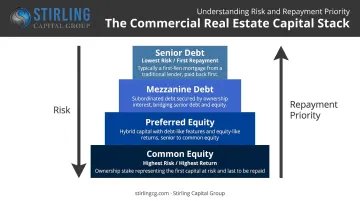
To understand mezzanine debt, you have to understand where it fits. The capital stack is simply the organization of all the capital sources used to fund a real estate project, ranked by priority of repayment.
Here’s a typical CRE capital stack, from most secure (paid back first) to least secure (paid back last):
- Senior Debt: This is the first mortgage on the property. It holds the first-lien position, meaning the senior lender is the first to be repaid from the property's income or sale proceeds. It has the lowest risk and therefore the lowest interest rate.
- Mezzanine Debt: Sitting directly below the senior debt, this loan is secured by a pledge of the ownership interests in the property-owning entity (e.g., the LLC). It is paid back after the senior loan but before any equity holders.
- Preferred Equity: This is an equity investment, not a loan. It has a priority return over common equity but is subordinate to all debt.
- Common Equity: This is the developer's own cash in the deal. It’s the highest-risk position and is the first to absorb losses, but it also reaps the greatest rewards if the project is successful.
The Security Behind the Loan
The crucial difference lies in the collateral. A senior lender takes a mortgage on the physical real estate. A mezzanine lender, on the other hand, takes a pledge of your membership interests in the LLC or partnership that owns the property.
This distinction changes the dynamic in a default scenario. Instead of a lengthy and costly judicial foreclosure, a mezzanine lender can foreclose on your ownership interests through a much faster Uniform Commercial Code (UCC) foreclosure.
This process allows them to take control of the property-owning entity, effectively becoming the new "owner" of the project while remaining subject to the existing senior loan.
Because two lenders have different rights, an Intercreditor Agreement is essential. This legal document governs the relationship between the senior and mezzanine lenders, defining their rights and remedies to prevent conflicts, especially in a default.
Strategic Advantages of Mezzanine Loans for Developers
While more expensive than senior debt, mezzanine financing offers several powerful advantages that can make a good project possible.
Increased Leverage and Reduced Equity Contribution
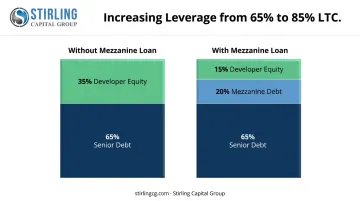
Senior lenders have become more conservative. Most first mortgages today will only finance 60% to 65% of a project's cost, according to recent data from Northmarq. A mezzanine loan can fill a large portion of the remaining gap, pushing the total loan-to-cost (LTC) ratio up to 75% or even 85%. This significantly reduces the amount of out-of-pocket cash you need to close the deal.
Retention of Ownership and Control
The alternative to filling the capital gap is often finding an equity partner, which means giving up a substantial percentage of ownership and future profits.
A mezzanine loan, on the other hand, is simply debt. You make your payments, and at the end of the term, the lender is gone—allowing you to retain a much larger share of the project's upside.
Flexibility and Customization
Mezzanine lenders are typically private capital sources, not traditional banks. This often translates into more flexible and creative loan structures. They can offer features like:
- Offer Payment-In-Kind (PIK) interest, letting payments accrue to improve cash flow during development or stabilization.
- Provide customized repayment schedules that are tailored to the project’s specific business plan.
- Align the loan’s maturity date with the senior loan to simplify the project's exit strategy (sale or refinance).
Key Risks and Considerations Developers Must Mitigate
While mezzanine debt can bridge critical funding gaps, developers must weigh its advantages against three significant risks.
Higher Cost of Capital
Because it sits in a riskier, subordinate position, mezzanine debt is much more expensive than senior debt. According to Northmarq's 2025 analysis, interest rates for fixed-rate mezzanine loans are typically in the low- to mid-teens. Floating-rate deals are often priced at a significant spread over a benchmark like SOFR, leading to similar all-in rates. This higher cost must be factored into your pro forma to ensure the project can still deliver a strong return.
The Risk of Foreclosure on Equity
This is the most critical risk. A default on a mezzanine loan isn't like missing a few mortgage payments, as the lender's remedy—a UCC foreclosure on your ownership stake—is swift and severe.
If a foreclosure happens, you can lose your entire equity investment and all control over the asset. The mezzanine lender steps into your shoes as the owner, inheriting both the property and the senior debt.
Complex Legal Structure
Mezzanine financing involves sophisticated legal agreements. Beyond the loan and pledge documents, the Intercreditor Agreement between the senior and mezzanine lender is a heavily negotiated document. This complexity increases legal costs and requires experienced counsel to protect your interests.
How to Qualify and Secure a Mezzanine Loan
Mezzanine lenders are betting on both the project and the developer. To get approved, you’ll need to present a compelling case.
Lenders are looking for:
- A proven track record of successfully completing similar projects.
- A well-vetted business plan with realistic financial projections and a clear exit strategy, such as a sale or refinance.
- Commitment from a reputable senior lender, which adds significant credibility to the project.
- A significant equity contribution to show you have "skin in the game."
Even with a strong proposal, finding the right mezzanine lender can be a challenge. The market is fragmented, and each private lender has a different appetite for risk, property types, and deal sizes.
This is where a specialist capital advisory firm like Stirling Capital Group proves invaluable.
Instead of approaching lenders one by one, Stirling Capital Group acts as your consultative partner. With a network of over 60 private lenders, we can match your project with the right capital source. Our team pre-underwrites the deal to ensure it meets lender criteria, navigates the complex negotiations, and guides you through the entire process to secure timely, competitive financing.
Mezzanine Debt vs. Key Alternatives for Developers
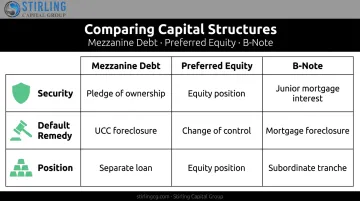
Mezzanine debt is just one tool in the capital stack. It’s often compared to preferred equity and B-notes, but there are critical differences.
Mezzanine Debt vs. Preferred Equity
Both sit between senior debt and common equity, but they are fundamentally different. Preferred equity is an equity investment in your company, not a loan. In a default, a "pref equity" partner typically has a "change of control" right written into the operating agreement, allowing them to take over management of the project. A mezzanine lender forecloses on the ownership entity.
Mezzanine Debt vs. A B-Note
A B-Note is not a separate loan. In an A/B structure, a single, larger senior loan is split into two tranches: the senior A-Note and the subordinate B-Note. Both are secured by the same mortgage on the real estate.
A B-Note holder is therefore still a mortgage lender. In contrast, a mezzanine lender is secured by ownership shares, which dictates a different remedy process in a default.
Comparison Table
| Feature | Mezzanine Debt | Preferred Equity | B-Note |
|---|---|---|---|
| Security | Pledge of ownership equity | None (equity position) | Junior interest in senior mortgage |
| Default Remedy | UCC foreclosure on equity | Contractual change of control | Mortgage foreclosure |
| Position | Separate loan below senior debt | Equity position above common | Subordinate tranche of senior loan |
Frequently Asked Questions
What is a mezzanine loan in commercial real estate?
It's a form of subordinate financing secured by a pledge of ownership interests in the property-owning entity. Developers use it to bridge the gap between a senior loan and their own equity contribution.
What are the benefits of a mezzanine loan in commercial real estate?
The main benefits are achieving higher leverage (up to 85% LTC), reducing the required cash equity from the developer, and retaining greater ownership and control compared to bringing in an equity partner.
What is the interest rate for a mezzanine loan in commercial real estate?
Rates are significantly higher than senior debt, typically ranging from the high-single-digits to the mid-teens (9% to 15%+). The rate structure can include both current-pay interest and accrued (PIK) interest.
What is the difference between a B-note and a mezzanine loan?
A mezzanine loan is a separate loan secured by ownership equity. A B-note is a junior piece of the senior mortgage loan and is secured by the real estate itself, alongside the senior A-note.
What happens if a developer defaults on a mezzanine loan?
The mezzanine lender can execute a UCC foreclosure on the pledged ownership interests. This allows them to quickly take control of the property-owning company and the entire project, subject to the senior loan.
What is a typical term length for a mezzanine loan?
Mezzanine loan terms are typically co-terminus with the senior construction or bridge loan they support. This means maturity dates align, usually for one to five years, with repayment expected upon the property's sale or refinance.