Securing a loan for raw land is fundamentally different and far more challenging than for a property with a house on it. Traditional lenders view it as a high-risk, speculative investment, and their underwriting processes reflect that caution.
This guide will demystify the process for savvy investors. We'll break down the unique challenges of land financing, explore your best options—from seller financing to private capital—and show you how to evaluate lenders to find the right fit for your project.
Key Takeaways
- Traditional lenders consider raw land a high-risk, speculative asset, making loans more difficult to secure than standard mortgages.
- Financing options include seller financing, conventional bank loans, and specialized solutions from private and hard money lenders.
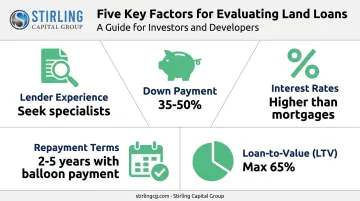
- Key evaluation factors are down payments (typically 35-50%), interest rates, loan terms, and the lender's experience with land deals.
- A commercial finance consultant can be invaluable for navigating the complex lender landscape and accessing a wider range of capital sources.
Why Raw Land Financing is a Unique Challenge
Before diving into your options, it's crucial to understand why lenders treat land so differently. The hesitation comes down to risk, which is shaped by three core factors.
Lack of Tangible Collateral. A house secures a traditional mortgage, but raw land offers no structure for a bank to seize and sell easily if a borrower defaults. This absence of an easily liquidated asset makes the loan inherently riskier for the lender.
Speculative Value. The future worth of land depends on zoning, development, and market trends, making it far more uncertain than an existing home. Federal guidelines reflect this risk, capping the loan-to-value (LTV) at 65% for raw land, compared to 85% for developed property.
No Standardized Process. Unlike the highly regulated residential mortgage market, land loans lack uniform guidelines. This results in more rigorous, subjective, and varied underwriting processes from one lender to the next.
Exploring Your Raw Land Financing Options
The best financing path depends on your financial situation, project timeline, and the property itself. While challenging, several viable routes are available to investors who know where to look.
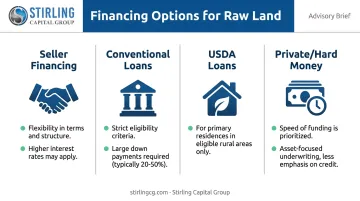
Seller Financing
In a seller financing arrangement, the landowner acts as the lender. Instead of you securing a loan from a bank, the seller provides the financing, and you make payments directly to them. This is a common and often highly effective option for raw land.
- You can often find greater flexibility on terms, down payments, and credit requirements, along with lower closing costs.
- Sellers may charge higher interest rates to compensate for their risk, and you should be cautious of loans with large "balloon" payments.
Conventional Loans from Banks and Credit Unions
While difficult, it's not impossible to get a land loan from a traditional bank or credit union. However, you need to present a very strong case. These institutions are highly selective and will scrutinize your application.
To improve your chances, you’ll need:
- An excellent credit score and a strong financial history.
- A large down payment, often 40% or more.
- A detailed plan for the land, including architectural drawings, budgets, and timelines. Lenders are much more receptive to a clear project than a speculative purchase.
USDA Loans
The United States Department of Agriculture (USDA) offers government-backed loans that can include the purchase of land. However, this option has very specific requirements and is not suitable for most investment scenarios. A USDA loan can only be used to buy a lot and build a primary residence in a designated rural area. It is not available for commercial development or investment properties.
Private and Hard Money Lenders
When banks say no, private capital is often the answer. Private and hard money lenders are non-institutional lenders who focus more on the asset's value and potential rather than just the borrower's credit profile.
This sector is a growing force in real estate. For instance, a recent CBRE report noted that alternative lenders supplied 40% of non-agency loan closing volume, a significant jump from 23% a year earlier.
For land investors, these lenders offer two critical advantages: speed and flexibility. They are ideal for entrepreneurs who need to close quickly or who don't meet rigid bank criteria. A capital advisory firm like Stirling Capital Group can connect you with a network of these specialized lenders for your project.
Key Factors in Evaluating Lenders and Loan Offers
Once you have potential offers, you need a framework for comparing them. Look beyond the interest rate to ensure the loan structure aligns with your investment strategy.
Down Payment Requirement
Be prepared for a substantial down payment. While a home mortgage might require 5-20% down, raw land loans are much higher. Lenders typically require at least 35% down, and it's common to see requirements as high as 50%. This large equity injection reduces the lender's risk and demonstrates your commitment to the project.
Interest Rates and Fees
Interest rates on land loans are almost always higher than on traditional mortgages. While banks and credit unions offer the most competitive rates, their strict requirements disqualify many raw land deals. In contrast, private and hard money lenders have higher rates but provide the flexibility and access to capital needed to close these transactions.
Also, be sure to account for other costs like origination fees, appraisal fees, and closing costs, which can add several percentage points to the total cost of the loan.
Loan-to-Value (LTV) Ratio
Loan-to-Value compares the loan amount to the appraised value of the property. As mentioned, federal guidelines suggest a 65% supervisory LTV for raw land. This means lenders are guided to finance no more than 65% of the land's value, leaving the borrower to cover the remaining 35% as a down payment. This lower LTV is a direct reflection of the higher collateral risk.
Repayment Terms and Amortization
Forget the 30-year fixed-rate mortgage. Land loans have much shorter repayment schedules, often with terms of 2-5 years.
These are typically structured as interest-only payments followed by a large balloon payment where the entire principal is due. This structure requires a clear exit strategy—like refinancing into a construction loan or selling the property—before the term ends.
Lender Experience and Specialization
This may be the most important factor: does the lender actually understand raw land deals? A specialized lender with a proven track record in land financing will understand the details of zoning, entitlements, and development timelines.
A generalist mortgage broker may lack the expertise to handle these complexities, increasing the chances your deal falls through. This is where working with a capital advisor can be invaluable, as they connect you directly with lenders who specialize in these exact types of projects.
How Stirling Capital Group Simplifies Land Financing
Navigating the complex and fragmented lending landscape on your own can be frustrating and time-consuming. This is where a strategic commercial finance consultant becomes a critical partner.
Stirling Capital Group is not a direct lender. We are a capital advisory firm that connects investors and developers with the right funding solutions for their unique projects. Instead of being limited to one bank's narrow credit box, we provide access to a network of over 60 private lending sources, including debt funds, family offices, and specialty finance groups.
Our consultative approach saves you time and significantly improves your chances of securing capital. We:
- Analyze your project to understand its unique goals and potential roadblocks.
- Pre-qualify and pre-underwrite the deal to position it for success.
- Match your project with the most suitable lender—one who understands your vision.
For investors looking to seize a competitive land acquisition opportunity, our ability to facilitate fast-moving execution provides a key advantage, connecting your project with the funding it needs to succeed.
Frequently Asked Questions
How do I get money to buy raw land?
Your primary options are seller financing, traditional banks (if you have a strong financial profile and plan), or private lenders. A commercial finance consultant like Stirling Capital Group can connect you to a wide network of specialized private lenders.
Is it a good investment to buy raw land?
It can be highly profitable if you have a clear strategy, such as development or holding for appreciation in a growing area. Success depends entirely on thorough due diligence and having a viable plan for the property's use.
What is the typical down payment for a raw land loan?
The down payment is significantly higher than for a home. Expect to need between 35% and 50% of the purchase price, depending on the lender, the property's location, and your financial profile.
How does my intended use of the land affect financing?
Having a detailed and viable plan for the land makes a huge difference. Lenders view an application for a well-researched commercial development or a future primary home far more favorably than a purely speculative purchase with no clear goal.
What’s the difference between a private lender and a hard money lender for land?
Hard money is a type of private lending focused on short-term, asset-based loans where the property is the main collateral. The broader private lending category includes a wider variety of lenders who may offer more flexible terms and consider the borrower’s full financial profile.