You might have heard of an uncommitted revolving credit facility as a potential solution. It sounds simple enough: a line of credit you can draw on when needed. However, the word "uncommitted" is the most important part of that phrase, and it’s a detail that can make or break your business if misunderstood. It offers flexibility but comes with a major catch.
This guide will demystify the uncommitted revolving credit facility. We'll break down what it is, how it stacks up against a committed facility, its real-world advantages, and the critical risks you must consider before relying on one.
Key Takeaways
- An uncommitted revolving credit facility is a credit line where the lender can approve or deny any funding request at their discretion.
- Unlike a committed facility, the lender has no legal obligation to provide funds, even if you are within your credit limit.
- These lines are typically cheaper to maintain as they often lack commitment fees on the undrawn balance.
- They are best suited for non-essential, highly flexible capital needs, not for mission-critical operations or time-sensitive acquisitions.
What Is an Uncommitted Revolving Credit Facility?
An uncommitted revolving credit facility is a type of loan agreement that allows a business to borrow funds up to a pre-agreed limit, repay them, and borrow again. Think of it as a standby pool of liquidity.
The defining feature is that the lender is not legally obligated to advance funds when you request them. Each draw request is a new decision for the lender, who can say "no" for any reason.
This facility provides a low-cost, standby source of cash for businesses with fluctuating, short-term capital needs. It differs from other common financing options:
- Standard Business Loan: Provides a one-time lump sum of cash paid back over a set term.
- Committed Line of Credit: The lender is contractually required to provide funds if you meet the terms.
Uncommitted vs. Committed Facilities: A Head-to-Head Comparison
Choosing between an uncommitted and a committed facility is a critical financing decision. It forces a business to balance the need for cost savings against the demand for certainty. The right choice depends entirely on what you plan to use the capital for.
Here’s a direct comparison:
| Feature | Uncommitted Facility | Committed Facility |
|---|---|---|
| Lender's Obligation | Lending is discretionary; the lender can approve or deny each funding request. | Funding is mandatory as long as the borrower meets the agreed-upon terms. |
| Certainty of Funding | Certainty is low, as access to funds is not guaranteed. | Certainty is high, providing reliable and predictable access to capital. |
| Cost Structure | Typically interest-only on drawn funds, with no commitment fee on the undrawn portion. | Interest on drawn funds plus a commitment or facility fee on the undrawn amount. |
| Arrangement Process | Simpler and often faster to arrange with less documentation. | More complex, involving detailed underwriting, covenants, and legal review. |
| Typical Use Case | Overdraft protection, minor working capital fluctuations. | Funding acquisitions, critical operational needs, seasonal inventory builds. |
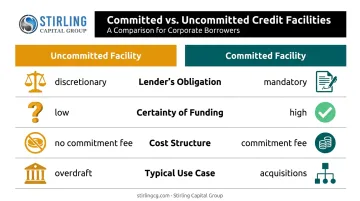
The commitment fee on a committed facility is the price you pay for a guarantee. You're paying the bank a small percentage to keep that capital on reserve and make it available the moment you ask for it.
Think of it like a phone plan. An uncommitted facility is "pay-as-you-go"—it costs nothing to have, but service isn't guaranteed. A committed facility is a monthly contract—you pay a fee for the certainty that you can make a call whenever you need to.
The Strategic Advantages and Common Use Cases
Despite the uncertainty, uncommitted facilities have a place in a company's financial toolkit. When used correctly, they offer distinct advantages.
Lower Cost of Capital
The most significant benefit is cost savings. Unlike committed facilities, banks are not required to set aside capital reserves for uncommitted lines, so they don't charge a commitment fee.
This structure helps banks manage their own regulatory capital requirements, a saving they can pass on to the borrower, as noted in analysis from Mayer Brown. If you only need a backup line for occasional use, avoiding this fee significantly lowers financing costs.
Flexibility and Simplicity
Uncommitted facilities are often less formal and can be established more quickly than fully underwritten committed lines. The approval process is typically less rigorous, making them an accessible option for businesses needing a simple liquidity buffer without navigating complex loan covenants and extensive legal documentation.
Appropriate Use Cases
Given the trade-offs, these facilities are best for specific, non-critical situations:
- Act as overdraft protection for a primary business account to prevent bounced payments during minor, unexpected shortfalls.
- Manage short-term working capital gaps, such as brief mismatches between accounts receivable and payable.
- Fund small, opportunistic purchases without the expense of maintaining a fully committed credit facility.
Key Risks and Common Misconceptions
The low cost of an uncommitted facility comes with a very high price: uncertainty. Understanding this risk is essential to avoid a potential cash-flow crisis.
The Core Risk: Funding Uncertainty
A lender can refuse to fund a draw request for any reason, at any time. This decision may have nothing to do with your company's performance. Even if your business is profitable and meeting all its obligations, the bank can still say no.
According to Cornell Law School's Legal Information Institute, the lender can reassess factors like general credit-market conditions with each request. A "no" could be triggered by:
- A change in the bank's internal risk policies.
- A downturn in the broader economy or your specific industry.
- The bank's own liquidity or capital adequacy concerns.
For example, imagine you need to draw on your line to make payroll on Friday. You submit the request on Wednesday, but the bank denies it due to a sudden shift in their lending strategy.
Your company is healthy, but you still can't pay your employees. This is the central risk of relying on an uncommitted facility for anything critical.

Misconception 1: "It's just like a business credit card."
This is a dangerous assumption. While both are revolving lines of credit, a commercial uncommitted facility lacks the consumer protections that govern personal credit cards.
Business-to-business financing is generally exempt from regulations like the Truth in Lending Act (Regulation Z). A bank has far more contractual freedom to deny a draw, change terms, or cancel the line on a commercial facility.
Misconception 2: "If my business is performing well, the bank will always lend."
This is false. The "uncommitted" nature of the facility means the funding decision is entirely at the lender's discretion and can be based on factors completely outside your control.
A healthy balance sheet does not convert an uncommitted line into a committed one. The decision to lend is always made on a case-by-case basis, and the bank’s priorities come first.
Making the Right Financing Choice for Your Business
Ultimately, an uncommitted revolving credit facility is a tool built on a trade-off between capital certainty and cost. Its value depends entirely on your business's specific situation and risk tolerance.
While it can be a smart choice for managing non-critical cash flow bumps, it's the wrong tool for essential operations. If you need guaranteed funding for payroll or acquisitions, a committed facility is necessary.
Making that distinction correctly is crucial. Navigating the complexities of commercial finance—from uncommitted lines to structured debt—requires deep expertise to identify the most reliable capital solutions.
At Stirling Capital Group, we act as your consultative partner. We connect you with an extensive network of over sixty private lenders to ensure you get the right funding for your specific goals.
Frequently Asked Questions
What is an uncommitted revolving credit facility?
An uncommitted revolving credit facility is a flexible line of credit where the lender can approve or deny each funding request at their discretion. The bank has no legal obligation to lend, even if the borrower is within the credit limit.
What is the difference between committed and uncommitted facilities?
The primary difference is the lender's legal obligation. In a committed facility, the lender must provide funds if you meet the terms. In an uncommitted one, they can refuse to lend at any time.
What is an example of an uncommitted facility?
Common examples include business overdraft protection or an informal working capital line from a bank. Both are designed to cover very short-term cash flow gaps.
Are uncommitted facilities cheaper than committed ones?
Yes, they are generally cheaper because they lack the annual "commitment fee" charged on the undrawn balance of committed lines. This cost saving is offset by the risk of funding uncertainty.
Can a lender cancel an uncommitted credit line without notice?
Yes, depending on the agreement. Many uncommitted facility contracts allow the lender to reduce or cancel the credit line at any time without notice, which is the primary risk to the borrower.