The gap between knowing M&A exists and knowing how to execute it is where most business owners and investors get into trouble. They overpay, underestimate integration complexity, or scramble for financing after committing to a price—costly mistakes that better preparation prevents.
This guide covers what M&A actually is, the six main transaction types, how deals are valued, what financing options acquirers have, and why most deals that fail do so for avoidable reasons.
Key Takeaways
- M&A covers every transaction where companies combine, absorb, or acquire other businesses or assets
- The six main transaction types are horizontal mergers, vertical mergers, conglomerate mergers, friendly acquisitions, hostile takeovers, and asset acquisitions
- Valuation typically relies on P/E ratios, EV/Sales multiples, DCF analysis, and replacement cost, often used together
- Acquirers can finance deals using cash, debt, equity, or a mix—each with different cost, speed, and control trade-offs
- Most deal failures trace back to cultural clashes, overpayment, or unrealized synergies rather than a flawed deal concept
What Are Mergers and Acquisitions?
M&A refers to financial transactions in which companies combine with or acquire other businesses or their assets. The deals range from negotiated buyouts between willing partners to hostile takeovers to targeted asset purchases during bankruptcy proceedings.
Companies pursue M&A for reasons that organic growth simply cannot match in speed:
- Market entry — acquiring a company with an established customer base rather than building one
- Technology or talent acquisition — buying capability instead of developing it
- Competitive elimination — removing a direct competitor from the market
- Operational restructuring — divesting non-core units or consolidating overlapping functions
- Revenue diversification — adding new product lines or geographies
McKinsey research found that more than half of new S&P 500 CEOs launch some form of transaction within their first two years, reflecting how consistently M&A is used to deliver results fast.
Mergers vs. Acquisitions: Key Differences
The terms are often used interchangeably, but they mean different things structurally.
In an acquisition, one company absorbs another. The acquiring firm continues as the surviving legal entity; the target ceases to exist independently. In a merger, two roughly equal companies combine to form an entirely new entity.
In practice, most deals contain elements of both, and classification often reflects how the parties choose to frame it publicly. One consistent rule applies: hostile deals, where the target's board does not consent, are always classified as acquisitions.
Types of M&A Transactions
Horizontal, Vertical, and Conglomerate Mergers
Horizontal mergers combine two companies competing in the same industry. The strategic logic is straightforward: gain market share, achieve economies of scale, and reduce direct competition. ExxonMobil's $60 billion acquisition of Pioneer Natural Resources in 2024 is a recent example—two oil and gas producers combining to dominate the Permian Basin.
Vertical mergers bring together companies at different stages of the same supply chain. AT&T's $85 billion acquisition of Time Warner combined a wireless carrier with a media content company, giving AT&T control over both distribution and content. The goal is greater control over inputs or channels—and often meaningfully lower costs.
Conglomerate mergers pair companies in unrelated industries. Berkshire Hathaway's acquisition of Precision Castparts—an aerospace and industrial parts manufacturer—for approximately $37 billion is a textbook example. Motivation is typically risk diversification and access to new revenue streams, though these deals are harder to manage and have a weaker synergy case than horizontal or vertical combinations.
Acquisitions: Friendly, Hostile, and Asset-Based
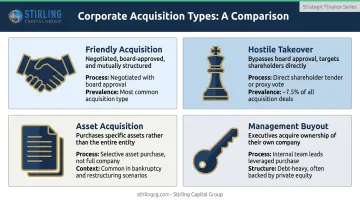
Friendly acquisitions are negotiated cooperatively. The target's board and shareholders agree to terms, and the acquirer often commits to maintaining operations. Most M&A falls into this category.
Hostile takeovers bypass a resistant board—the acquirer goes directly to shareholders or purchases shares on the open market to accumulate a controlling stake. These are far less common than most people assume: Harvard Law School Forum data shows hostile and unsolicited transactions represented only about 7.5% of global M&A activity in 2025, down from roughly 11% in 2024.
Asset acquisitions involve purchasing specific assets rather than the entire company—common in bankruptcy proceedings where only certain operations hold value. Verizon's $4.48 billion purchase of Yahoo's core internet business in 2017 followed this structure; Verizon acquired specified transferred assets rather than the whole Yahoo corporate entity.
Management buyouts (MBOs) occur when executives acquire a controlling stake in their own company using heavy debt financing. The structure aligns incentives sharply but also loads the business with repayment pressure from day one.
The M&A Process: Step by Step
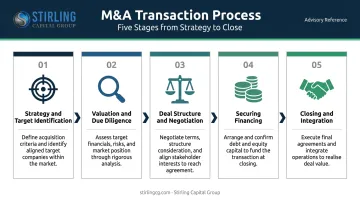
Step 1: Strategy and Target Identification
Every successful acquisition starts with a clearly defined thesis before a target is named. What gap does this deal fill? Market entry? Technology access? Competitive consolidation? Targets should be screened against strategic fit, market position, and financial health, not just availability.
Step 2: Valuation and Due Diligence
Once a target is identified, the acquirer conducts a thorough investigation of financials, operations, legal standing, and liabilities. Due diligence is what separates a defensible acquisition price from an expensive guess. PwC's 2023 M&A Integration Survey found that only 14% of respondents reported significant success across strategic, operational, and financial measures. That statistic alone makes rigorous diligence non-negotiable.
Step 3: Deal Structure and Negotiation
Price, payment method, and conditions (earnouts, escrow provisions, representations and warranties) are all negotiated here. Both sides are optimizing value, and investment banks or M&A advisors typically facilitate the process. Structure decisions made here directly affect how risk is allocated post-close.
Step 4: Securing Financing
Acquirers need committed financing before (or at minimum during) negotiation, not after. In competitive processes, sellers and their advisors treat unfinanced buyers as deal risk.
For middle-market acquirers who can't access traditional bank debt quickly enough, private lenders offer a meaningful alternative. Stirling Capital Group works with a network of 60+ specialized lenders and is authorized to pre-qualify and pre-underwrite transactions on their behalf. That network spans:
- Private credit funds and non-bank asset-based lenders
- Specialty finance providers and debt funds
- Family offices and institutional capital sources
That pre-existing infrastructure compresses timelines significantly compared to starting from scratch with a single institution.
Step 5: Closing and Integration
Regulatory approval, final documentation, and closing are the formal finish line. But integration (combining operations, systems, teams, and cultures) is where the anticipated value is actually won or lost. Most integration failures trace back to planning that started too late. Building the integration roadmap during due diligence, not after signing, gives acquirers a meaningful head start.
How M&A Deals Are Valued
Valuation is where buyers and sellers most often disagree. Buyers push for the lowest defensible price; sellers want to capture full value. Objective methods give both sides a credible range to negotiate from, which is why buyers typically run multiple approaches in parallel rather than relying on any single number.
Key Valuation Methods
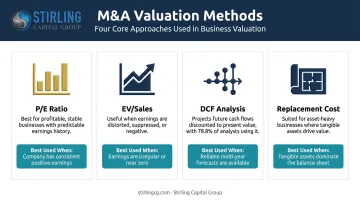
Price-to-Earnings (P/E) Ratio P/E multiples from comparable companies in the same sector set a market-based benchmark for what a reasonable offer looks like relative to earnings. This works best for profitable businesses with consistent earnings history — it loses reliability for early-stage or cyclical companies where earnings swing sharply or turn negative.
Enterprise Value-to-Sales (EV/Sales) EV/Sales values the target as a multiple of total revenues, adjusted for debt and cash. The CFA Institute notes EV/Sales is preferable to price-to-sales because it allows comparisons across companies with different capital structures — making it the go-to metric when earnings-based methods produce distorted results.
Discounted Cash Flow (DCF) Analysis DCF values a company by projecting future free cash flows and discounting them back to present value using the weighted average cost of capital (WACC). It builds valuation from first principles rather than market comparisons. CFA Institute data shows 78.8% of professional analysts use DCF, compared to 92.8% who use market multiples — most practitioners use both to cross-check their conclusions.
The catch with DCF: small changes in growth assumptions or discount rate can significantly shift the output. The quality of the underlying projections matters enormously.
Replacement Cost Some acquisitions are benchmarked against what it would cost to build an equivalent business from scratch: equipment, staffing, intellectual property, and customer relationships. This approach works well for asset-heavy businesses but loses accuracy for service or IP-driven companies, where the most valuable assets can't be easily priced or replicated.
Financing an Acquisition: Your Options
Cash Financing
Paying with balance sheet cash is the simplest approach. It moves quickly, carries no interest cost, and avoids the covenant restrictions that come with debt. The downside is liquidity depletion and the opportunity cost of capital deployed elsewhere. It's most viable for companies with substantial reserves.
All-cash deals are also less common than many assume. SRS Acquiom's 2026 study of 2,300+ private-target acquisitions found all-cash consideration fell to 51% in 2025, down from 59% in 2023.
Debt Financing
Borrowing to fund an acquisition—through bank loans, private credit, or leveraged buyout structures—preserves cash and generates tax benefits through deductible interest. The trade-off is increased financial risk and covenant restrictions post-close.
Private credit has become the dominant channel for buyout financing. S&P Global reported private debt accounted for 77% of global LBO financing in 2024, reaching a decade-high share. For middle-market acquirers who can't access traditional bank debt fast enough, private lenders fill that gap directly.
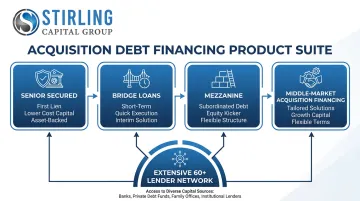
Stirling Capital Group structures acquisition debt financing across multiple formats:
- Senior secured debt — asset-based lending revolvers collateralized by receivables, inventory, or equipment
- Bridge loans — fast-close structures for time-sensitive deals where permanent financing comes later
- Mezzanine financing — subordinated debt that fills the gap between senior debt and equity in the capital stack
- Middle market acquisition financing — purpose-built for growth, acquisition, and recapitalization transactions
Equity and Mixed Financing
When debt alone won't cover a deal, equity enters the structure. Issuing new shares dilutes existing shareholders but preserves cash and debt capacity. Most large acquisitions use a combination of all three—cash, debt, and equity layered to balance risk and optimize the capital structure.
Through a January 2023 strategic alliance, Stirling Capital Group extended its capabilities to include equity capital alongside debt. The equity partner works across joint venture equity, preferred equity, and combined debt-and-equity structures—giving middle-market acquirers access to the full capital stack.
Why M&A Deals Fail—and How to Avoid It
Cultural and Operational Integration Failures
Merging two companies means merging two distinct cultures, management philosophies, and operational systems. Bain's research identifies cultural clashes and talent loss as among the most common reasons expected synergies are never realized. Integration planning is a strategic discipline, not an administrative afterthought—and it needs to start before the deal closes.
Overpaying and Synergy Overestimation
Acquirers routinely overestimate what a deal will actually produce. Revenue synergies are almost always harder to capture than projected; cost savings take longer and cost more to achieve. Bain has documented that across most industries, companies announce higher synergy estimates than the increased scale can realistically support.
The discipline is applying conservative assumptions in your valuation models and maintaining financial rigor even when competitive bidding creates pressure to stretch. Excitement about a deal is one of the most reliable predictors of overpayment.
Inadequate Due Diligence and Financing Preparation
Post-close surprises destroy value fast. The most common culprits include:
- Undisclosed liabilities that surface after closing
- Regulatory issues that stall integration or require costly remediation
- Operational gaps that inflate the true cost of ownership
- Financing uncertainty that forces buyers to close on unfavorable terms
The practical implication: have capital partners and advisors engaged before the target search begins, not after a letter of intent is signed. Stirling Capital Group's consultative model (pre-qualifying and pre-underwriting deals across 60+ lenders before approaching capital sources) is specifically designed to compress this timeline and give acquirers credible financing certainty when it matters most.
Frequently Asked Questions
What is M&A in finance?
M&A (mergers and acquisitions) refers to corporate finance transactions through which companies combine, absorb, or acquire other businesses or assets. Companies use M&A to drive growth, expand into new markets, or strengthen their competitive position — across industries and deal sizes.
What is the difference between a merger and an acquisition?
In an acquisition, one company absorbs another and continues as the surviving legal entity. In a merger, two roughly equal companies combine to create an entirely new business. In practice, classification often depends on how the deal is structured and announced.
What are the most common methods used to value a company in M&A?
The four primary methods are P/E ratio multiples, EV/Sales multiples, discounted cash flow (DCF) analysis, and replacement cost. Most buyers apply more than one method to establish a justified price range rather than relying on any single figure.
How long does a typical M&A deal take to close?
Most transactions take less than a year from initial approach to close. KPMG's acquisition process benchmarks show strategic investors average seven months from first contact to signing, with a range of five to fourteen months depending on deal complexity, regulatory requirements, and financing readiness.
How do companies finance an acquisition when they don't have enough cash?
Companies can use debt financing (bank loans or private credit), equity issuance, or a combination of both. Private lending sources — such as those in Stirling Capital Group's network across the continental US — often move faster and offer more flexibility than traditional banks, making them a practical option for middle-market acquirers facing complex collateral or tight timelines.