A subscription line of credit is a financing tool used by private funds, essentially a loan secured by the capital commitments of the fund's investors. For fund managers (GPs), investors (LPs), and entrepreneurs seeking private capital, understanding this instrument is critical. It’s a key to optimizing fund operations, accelerating investments, and managing cash flow in a demanding market.
This article will break down exactly what subscription lines are, why they’ve become a standard tool, how they work step-by-step, and the crucial benefits and risks involved for everyone at the table.
Key Takeaways
- Subscription lines are credit facilities for private funds backed by investor capital commitments.
- They allow fund managers (GPs) to deploy capital quickly, avoiding capital call delays.
- These facilities can boost IRR but also add leverage, costs, and potential GP/LP misalignment.
- Both GPs and LPs must understand the mechanics and risks before using or investing in funds with them.
What Is a Subscription Line of Credit?
A subscription line of credit is a short-term, revolving loan provided to a private fund, such as a private equity, venture capital, or real estate fund. It bridges the time gap between when a fund needs to deploy capital for an investment and when it actually receives that capital from its Limited Partners (LPs).
Think of it as a fund-level credit card backed by the legally-binding promises of its investors. When a deal needs to close fast, the fund manager can draw on the credit line instantly instead of initiating a formal capital call, which can be a slow, administrative process.
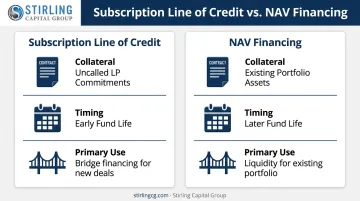
These credit lines shouldn't be confused with Net Asset Value (NAV) financing, as the two are secured by different collateral.
A subscription line is secured by the uncalled capital commitments LPs have legally pledged. It’s used early in a fund's life when there are plenty of unfunded commitments available as collateral.
In contrast, NAV financing is secured by the value of the fund's existing portfolio of assets. This tool is typically used later in a fund's life after it has already made several investments.
Why Private Funds Use Subscription Lines: The GP and LP Perspectives
The adoption of sub lines has grown rapidly, with one Preqin report noting that 47% of surveyed private capital managers had used them. The benefits extend to both sides of the partnership.
For the General Partner (GP) / Fund Manager
For GPs, the advantages are primarily operational and strategic.
- Gain a competitive edge by accessing capital on one business day's notice, bypassing the 10-15 day wait for traditional capital calls.
- Streamline treasury functions by bundling frequent expenses into fewer, larger capital calls, reducing administrative work.
- Boost reported IRR by delaying capital calls and shortening the calculation window; one ILPA-cited analysis found this added a median 2.06% to IRR by year three.
For the Limited Partners (LPs) / Investors
While LPs ultimately bear the costs of the facility, they also see direct and indirect benefits.
- Simplifies cash flow planning with fewer, more predictable capital call notices to manage.
- Reduces the administrative burden of processing numerous small transactions for fees and expenses.
- Allows participation in enhanced returns from the IRR boost, though savvy LPs now analyze performance with and without the facility's impact.
How a Subscription Line of Credit Works: A Step-by-Step Guide
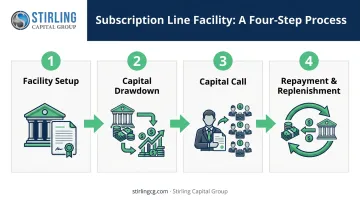
A fund establishes a credit facility with a bank, draws on it for investments, and calls capital from investors to repay the bank. The process typically unfolds in four key steps.
Step 1: Fund Formation and Facility Setup
During the fund's initial setup, the GP negotiates a subscription facility with a lender, typically a large commercial bank with a specialized fund finance team. The lender underwrites the facility based on the creditworthiness of the fund's LPs. The subscription agreements, which are the LPs' legally binding contracts to provide capital, serve as the primary collateral.
Step 2: Capital Drawdown for an Investment
Imagine the fund identifies a $20 million acquisition target that needs to close in five days. The standard capital call process would be too slow. Instead, the GP simply notifies the bank and draws $20 million from its subscription line to fund the purchase instantly, securing the deal.
Step 3: The Capital Call Process
After a period—for example, at the end of the quarter—the GP will have accumulated several draws on the credit line for various investments and expenses. The GP then issues a single, consolidated capital call to its LPs to cover the total amount drawn, plus any accrued interest. LPs then wire their pro-rata share of the capital to the fund.
Step 4: Repayment and Replenishment
The fund uses the capital received from the LPs to pay down the balance on the subscription line. Because it’s a revolving facility, the available credit is immediately replenished. The fund can then draw on it again for the next investment opportunity, repeating the cycle throughout the fund's investment period.
The Double-Edged Sword: Benefits and Risks of Sub Lines
While they offer clear operational upsides, subscription lines are not without risks and criticisms. Both GPs and LPs must understand this trade-off.
Key Benefits Summarized
- Allows GPs to close deals faster than competitors who must wait on traditional capital calls.
- Reduces the administrative burden of managing capital flows for both General Partners (GPs) and their Limited Partners (LPs).
- Avoids the cost and effort of calling capital for a transaction that ultimately may not close (a "broken deal").
- Can mechanically increase the fund's reported Internal Rate of Return (IRR) due to the timing of cash flows.
Potential Risks and Criticisms
- Can artificially inflate the fund's IRR by shortening the calculated investment period, potentially masking mediocre performance and making manager comparisons difficult for LPs.
- Adds leverage and interest expense to the fund, reducing net returns for LPs, while also introducing a remote risk of default if an LP fails to meet a capital call.
- May misalign GP and LP interests, as a GP could use an inflated IRR to earn carried interest on a fund that would not have otherwise met its performance hurdle.
- Incurs direct costs passed on to LPs, including setup fees, legal expenses, and commitment fees on the undrawn portion of the line (often 0.25% to 0.50%).
Conclusion: Navigating Fund Finance with an Expert Partner
Subscription lines of credit are no longer a niche product; they are a standard, powerful tool in the private fund management toolkit. They offer significant operational benefits for fund managers and administrative ease for investors. However, they also demand careful management of the associated risks, costs, and performance-reporting implications.
For both fund managers and the investors who back them, understanding the mechanics of these facilities is no longer optional—it’s essential for making informed decisions.
Navigating the complex world of private capital requires a knowledgeable partner, especially as innovative structures like subscription lines become commonplace.
Stirling Capital Group's consultative approach and network of over 65 private lenders can help fund managers and investors secure the right capital solutions. Whether for fund-level financing or direct business needs, an expert guide is key to structuring a successful deal.
Frequently Asked Questions
What are subscriptions in private equity?
A subscription is the legally binding agreement an investor (LP) makes to commit a specific amount of capital to a private equity fund. The fund manager (GP) can then "call" on this committed capital as investment opportunities arise.
What is the difference between a Private Placement Memorandum (PPM) and a subscription agreement?
A PPM is a disclosure document detailing the fund's strategy, risks, and terms (the "offer"). The subscription agreement is the investor's legal contract to invest in that fund and commit capital (the "acceptance").
What is the difference between subscription lines of credit and NAV financing?
Subscription lines are secured by investor commitments and used early in a fund's life. In contrast, NAV financing is based on the value of a fund's existing assets and is used later for liquidity.
How do subscription lines of credit affect a fund's IRR?
They can boost a fund's IRR by delaying capital calls from investors. Using the credit line first makes the investment period appear shorter, which can artificially inflate the final return calculation.
Who are the typical lenders for subscription lines of credit?
The primary lenders are large commercial banks with specialized fund finance divisions. Alternative lenders and other specialty finance groups also actively participate in this market.