
For management teams exploring an ownership transition, business owners evaluating succession options, or investors navigating the small-to-middle market, understanding how MBOs are structured matters. The mechanics of financing one — especially at the sub-institutional level — are frequently oversimplified or misunderstood.
This post breaks down exactly how MBOs work, how they're funded, and what separates a deal that closes from one that doesn't.
Key Takeaways
- An MBO lets the management team become the owners, offering business continuity and a structured exit for the seller
- MBO financing stacks multiple capital sources — management equity, senior debt, seller notes, mezzanine, and private equity
- Traditional banks often view MBOs as elevated risk — private and alternative lenders are frequently essential
- A credible valuation and complete financing plan must come before any lender conversations
- MBOs succeed when management brings operational depth, financial skin in the game, and realistic access to capital
What Is a Management Buyout (MBO)?
An MBO occurs when the people running a company — its senior managers or leadership team — buy out the current owner and take on full ownership and financial responsibility for the business. As OakNorth Bank describes it, it's the purchase of a business by its existing management team, typically with external financing.
What separates an MBO from other acquisitions is who's buying. The buyers are insiders — they already know the financials, the customer relationships, and the operational risks. That reduces transition friction compared to bringing in an outside acquirer.
MBO vs. LBO vs. MBI: Key Differences
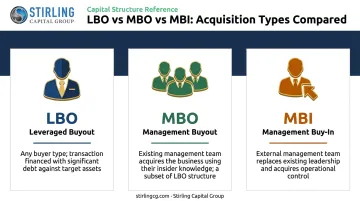
These three terms are commonly confused. Here's how they actually differ:
| Term | Who's Buying | Key Characteristic |
|---|---|---|
| LBO (Leveraged Buyout) | Any buyer | Uses significant debt to fund the acquisition |
| MBO (Management Buyout) | Internal management team | A specific type of LBO where buyers are insiders |
| MBI (Management Buy-In) | External management team | Outsiders acquire the business and replace existing leadership |
That insider knowledge can build lender confidence, though the deal still carries the same debt-service obligations as any leveraged transaction. Lenders weigh both factors when structuring MBO financing.
How a Management Buyout Works: Step-by-Step
An MBO follows a structured sequence. Timelines vary widely by company size and deal complexity, but most transactions take six months to over a year from initial discussions to closing. Throughout the process, normal business operations continue until ownership officially transfers.
Step 1: Assess and Align the Management Team
The process starts with internal alignment. Which members of management will participate? Do they have the financial readiness and personal commitment? Is there a shared vision for the business under new ownership?
This step is often underestimated. Internal disagreements among team members are a leading cause of MBO failures — getting alignment on roles, equity splits, and decision-making authority before approaching any external party prevents costly renegotiations later, when the stakes are much higher.
Step 2: Determine the Company's Fair Market Value
An independent business valuation is the foundation of any MBO. It establishes the purchase price, forms the basis for financing requests, and protects both parties from disputes. Common valuation methods include:
- Comparable company multiples
- Precedent transaction multiples
- Discounted cash flow (DCF) analysis
- Net asset valuation
Lenders will require a defensible valuation before approving financing. Approaching them without one is one of the most common reasons MBO requests stall before they start.
Step 3: Structure the Deal and Secure Financing
Funding the acquisition requires assembling the right combination of capital sources — and the structure has to work both at closing and after. Most MBOs draw from several layers:
- Personal equity contributed by the management team
- Senior debt financing from banks or private lenders
- Seller financing (where the outgoing owner carries a portion of the note)
- Outside investors such as private equity or mezzanine lenders
The resulting capital structure must support the purchase price without overloading the business with debt it can't service from operating cash flow.
Step 4: Complete Due Diligence and Finalize Agreements
Due diligence in an MBO covers financial records, contracts, liabilities, legal obligations, and operational risks. Even when management already works inside the business, formal due diligence routinely surfaces hidden liabilities, undisclosed contracts, or legal issues that change deal terms entirely.
As Doyle Clayton's MBO guide notes, inadequate due diligence is a primary cause of deal failures. This step concludes with a signed, legally binding purchase agreement.
Step 5: Close the Deal and Manage the Transition
Funds transfer, legal ownership changes execute, and the transition is communicated to employees, customers, and key stakeholders. The seller may remain in an advisory role for a defined period to support a smooth handover — this is common in small-to-mid-market MBOs where institutional knowledge is concentrated in the outgoing owner.
How to Finance a Management Buyout
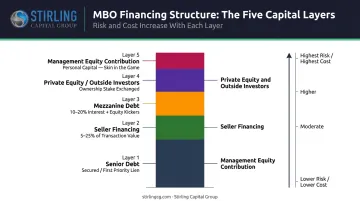
MBO financing rarely comes from a single source. Most transactions use a layered capital stack where each layer carries different risk, cost, and repayment terms. Here are the five primary components:
Management Equity Contribution
The management team is expected to invest meaningful personal capital. This isn't just a formality — it signals commitment to lenders and investors, and it aligns the new owners' incentives with the business's long-term performance.
The amount varies by deal, lender, and capital structure. Most lenders look for a contribution meaningful enough to confirm the team has real financial exposure — not a token amount. Common deal-specific factors that shape the requirement include:
- Leverage ratio and overall deal size
- Industry risk profile and cash flow predictability
- Whether outside equity investors are participating
Senior Debt Financing
Senior debt is typically the largest financing component. It's secured against company assets, carries first-priority repayment rights, and is most commonly provided by a bank or private lender.
Traditional banks do participate in MBO lending — but they often treat these transactions as elevated risk due to the leveraged structure and reliance on projected cash flow. That's why many management teams turn to non-bank and private lenders who specialize in acquisition financing.
Working with a commercial finance advisor — like Stirling Capital Group, which maintains relationships with more than 60 private lending sources — puts more lender options on the table. Rather than fitting into one institution's credit box, the advisory approach matches the deal's specific structure and industry to the right lender.
Seller Financing
Seller financing means the outgoing owner provides part of the purchase price directly to the management team, repaid over several years from the business's future profits. It's common in small-to-mid-market MBOs and often signals the seller's confidence in the deal's viability. According to Saratoga Investment Corp, sellers tend to finance roughly 5% to 25% of total MBO value, though this varies by transaction.
Mezzanine Financing
Mezzanine debt sits between senior debt and equity in the capital stack. It carries higher interest rates — the Development Bank of Wales notes rates can range from 10% to 20% annually in MBO contexts — and often includes equity-like features such as warrants.
It fills the gap when senior debt and seller financing fall short, but the management team doesn't yet have enough equity to close. The CAIA's analysis of mezzanine debt confirms that this structure is unsecured, lower priority than senior debt, and typically includes equity kickers to compensate lenders for the additional risk.
Private Equity and Outside Investors
PE firms provide equity capital in exchange for an ownership stake, often bringing strategic expertise alongside funding. Stirling Capital Group expanded into equity capital solutions in January 2023 through a strategic alliance with a private lending group that can provide both debt and equity — making it possible to address both sides of the capital stack for qualified transactions.
PE involvement reduces the management team's ownership percentage, but it can unlock deals that would otherwise be too large to finance through debt alone. Understanding how each of these layers interacts — and which combination fits a specific deal — is where an experienced capital advisor makes a measurable difference.
Advantages and Disadvantages of Management Buyouts
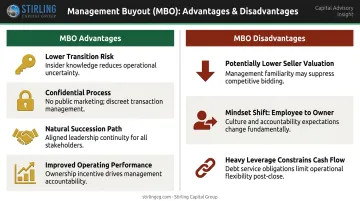
Advantages of an MBO
- Lower transition risk — buyers already understand the operations, culture, and customer base, reducing disruption for employees and clients
- Confidential process — unlike a competitive open-market sale, MBOs don't require public disclosure or broad marketing of the business
- Natural succession path — for owners who want to protect culture and legacy, selling to management is often the preferred exit
- Performance potential — research by Steven Kaplan in the Journal of Financial Economics found that operating income and cash flow generally increased following management buyouts of public companies
These advantages make MBOs attractive — but they come with real trade-offs that both sides should weigh carefully.
Disadvantages and Risks
- Without competing bidders, the seller often accepts a lower valuation than an open-market process would generate
- The shift from employee to owner-operator requires a mindset change most managers aren't fully prepared for
- Heavy leverage creates cash flow constraints that can limit reinvestment and growth flexibility in the early post-acquisition years
Beyond the general risks, certain conditions make an MBO the wrong move entirely.
When an MBO May Not Be the Right Choice
An MBO is a poor fit when:
- The management team lacks the financial resources or entrepreneurial readiness for ownership
- The business has insufficient or unpredictable cash flow to service acquisition debt
- The seller can achieve significantly better terms through a competitive sale to a strategic outside buyer
Common MBO Mistakes to Avoid
Three mistakes consistently derail otherwise sound MBO transactions:
- Incomplete capital structure going into lender conversations. Management teams that approach lenders without a credible valuation or clear financing plan face delays, rejected applications, and unfavorable terms. Engage a financing advisor and finalize your valuation before the first lender call.
- Skipping formal due diligence. Working at a company doesn't mean you know everything about it. Formal due diligence routinely surfaces hidden liabilities, undisclosed contracts, and legal obligations that materially change deal economics.
- No post-close transition plan. Without a clear communication strategy for employees, customers, and suppliers, even a well-structured MBO can bleed talent and lose accounts during the handover period.
Frequently Asked Questions
How do you finance a management buyout?
MBOs are typically financed through a layered capital stack: management equity, senior debt, seller financing, and potentially mezzanine debt or private equity. Because traditional banks often view MBOs as elevated risk, many management teams rely on alternative or private lenders to close the deal.
What's the difference between an LBO and an MBO?
An MBO is a specific type of LBO. Both transactions use significant debt to finance an acquisition, but in an MBO, the buyers are the company's own internal management team rather than an outside investor or private equity firm.
Is a management buyout a good thing?
Done well, an MBO benefits all sides — management gains ownership, the seller gets a smooth and confidential exit, and the business maintains continuity. That said, it carries real financial risk for the management team and may not deliver the highest sale price for the seller.
What's the difference between an MBO and a management buy-in (MBI)?
In an MBO, the existing internal leadership team buys the company. In an MBI, an external management team acquires and takes over the business. MBOs typically involve less transition risk because the buyers already know the operations, customers, and culture.
How long does a management buyout take?
MBO timelines typically range from six months to over a year, depending on company size, financing complexity, and the pace of due diligence and legal documentation.
What do lenders look for when financing an MBO?
Lenders prioritize the company's historical cash flow, management team quality, an independent business valuation, and a viable capital structure. Private lenders tend to have more flexibility than traditional banks in evaluating these factors, making them a go-to resource for many MBO transactions.