Introduction
Financing land and building on it sounds straightforward — until a lender asks for architectural plans, a licensed contractor contract, and a full draw schedule before agreeing to discuss terms.
Construction loans to buy land are fundamentally different from standard mortgages. They finance something that doesn't exist yet, which means lenders evaluate both the borrower and the project.
Requirements vary significantly by loan program. Government-backed options like USDA and VA offer zero-down structures for eligible borrowers, while conventional and private construction loans carry their own credit, equity, and documentation thresholds.
According to the FDIC's 2024 Risk Review, bank construction and development loans reached $502 billion in Q4 2023 — a substantial market that still catches many borrowers off guard with its complexity. This guide covers what a construction loan to buy land actually is, how it works, what lenders require, and how to choose the right structure for your project.
Key Takeaways
- Construction loans can cover both land acquisition and building costs — structured as one combined loan or two sequential loans
- Requirements vary by program: government-backed options offer low or zero down, while conventional loans typically require 20–25%
- Funds are released in stages through a draw schedule, not as a lump sum at closing
- The loan is sized based on an "as-completed" appraisal, not the current land value
- Bank-declined borrowers can still qualify through private lenders with flexible underwriting criteria
What Is a Construction Loan to Buy Land?
A construction loan to buy land is a short-term financing product designed to fund both a land purchase and the cost of building a structure on it. Unlike a standard mortgage — which finances an existing property — a construction loan finances something that hasn't been built yet. Once construction wraps up, the loan either converts to a permanent mortgage or is paid off through separate financing.
Single-Close vs. Two-Close Structures
Two primary structures exist, and the difference matters for closing costs, rate locks, and qualification:
- Construction-to-permanent loan (single close): One loan covers land acquisition, construction financing, and the permanent mortgage. There's one closing, one set of closing costs, and the loan converts automatically at project completion. Fannie Mae and Freddie Mac both recognize this structure, with Freddie Mac explicitly allowing interim proceeds to cover lot purchase, lot payoff, site preparation, and construction.
- Two-close loan: A stand-alone construction loan closes first, followed by a separate permanent mortgage at project completion. More closing costs, but it lets borrowers shop for the best permanent rate once construction is done.
How It Differs from a Land Loan
A land loan finances only the property purchase — it does not include construction funding. When you're ready to build, you'll need separate financing arranged entirely.
A construction loan to buy land combines both phases into one product: one draw schedule, one lender relationship, and no gap financing to arrange between acquisition and groundbreaking. For developers and investors planning to build immediately after purchase, that consolidation directly reduces cost and execution risk.
Construction Loan Requirements to Buy Land
Requirements vary considerably by loan program, but every lender evaluates two things: the borrower's financial profile and the project itself.
Borrower Financial Profile
Most conventional and private lenders apply credit score minimums in the range of 680–700+, though these are lender overlays rather than universal standards. FHA construction-to-permanent loans, for instance, allow minimum decision credit scores as low as 580 for maximum financing under HUD Handbook 4000.1.
Income stability matters more here than in a standard purchase mortgage — the project timeline is longer, cost overruns are possible, and lenders want confidence you can carry the loan through completion. FHA manual underwriting uses DTI ratios of 31/43 without compensating factors and 37/47 with one compensating factor.
Down Payment by Program
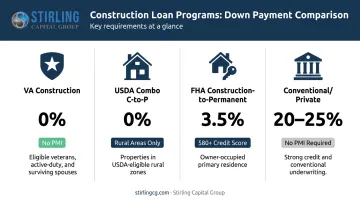
| Program | Down Payment |
|---|---|
| VA Construction | No down payment required; no PMI |
| USDA Combo C-to-P | 100% financing (zero down) for eligible rural areas |
| FHA Construction-to-Permanent | 3.5% minimum (580+ credit score) |
| Conventional / Private | Typically 20–25% of total project cost |
If you already own the land outright, existing equity can count toward the down payment requirement. FHA explicitly allows land equity to satisfy its Minimum Required Investment for construction-to-permanent loans. VA allows owned land to count toward the down payment for funding-fee reduction purposes, subject to appraisal and notice-of-value conditions.
Project Documentation Requirements
Lenders are approving both the borrower and the project. Expect to provide:
- Signed construction contract with a licensed, insured general contractor
- Detailed architectural blueprints and specifications
- Line-item project budget
- Draw schedule tied to construction milestones
- Realistic build timeline
- Evidence of cash reserves
Most programs require a licensed general contractor — owner-builders are generally not permitted unless the borrower holds a GC license themselves (FHA and VA both verify this).
As-Completed Appraisal
Instead of appraising an existing property, lenders order a future-value appraisal — an estimate of what the finished structure will be worth based on the plans, the land, and comparable completed builds nearby.
Agency guidelines differ on how this figure applies. Fannie Mae ties the loan's LTV directly to the as-completed value. Freddie Mac uses the lesser of land purchase price plus total construction costs or the as-completed appraised value. Either way, this number sets your maximum loan amount.
Land-Specific Factors
Lenders examine the land itself — not just the borrower. Key evaluation points include:
- Zoning compliance for the intended use
- Utility access (water, sewer, electricity)
- Road access and infrastructure
- Environmental restrictions (wetlands, floodplains)
- Soil conditions and buildability
Raw, unimproved land generally presents more complexity than improved or entitled parcels, and some conventional lenders won't touch it. Borrowers in this situation often find more traction through private lending channels. Stirling Capital Group's network of 60+ specialty lending sources includes private lenders, debt funds, and bridge lenders experienced specifically in undeveloped land scenarios.
How a Construction Loan to Buy Land Works
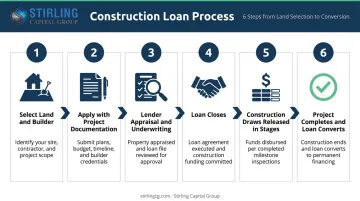
Here's the end-to-end flow:
- Borrower selects land and builder — identify the property and engage a licensed general contractor
- Apply with full project documentation — plans, budget, draw schedule, builder contract
- Lender orders appraisal and underwrites — both the borrower profile and the project are evaluated
- Loan closes — funds are not disbursed in full at closing
- Construction draws are released in stages — tied to completed milestones with lender-required inspections
- Project completes — loan converts to permanent financing or is paid off
Loan Closing and Draw Schedule
At closing, the full loan amount is held in reserve. Funds are released incrementally as the builder completes defined phases of construction. During this period, most loans require only interest-only payments on the amount drawn — not the full loan balance.
Key payment details to know:
- Interest accrues only on the drawn balance, not the full loan amount
- USDA permits payment reserves covering up to 12 months of interest-only payments for eligible borrowers
- Draw amounts and timing are locked in at closing via the approved draw schedule
Inspections and Milestone Approvals
Before each draw is released, the lender sends an independent inspector to verify that completed work matches the approved plans and budget. USDA and VA both require written borrower approval before funds are released to the builder. This structure ensures the builder gets paid for verified work while preventing the lender from advancing funds against unfinished construction. If inspections lag or contractor work stalls, draw releases pause until issues are resolved — so timeline management matters.
Loan Conversion or Payoff
At project completion:
- Single-close construction-to-permanent loan: Converts automatically to a standard fixed or adjustable-rate mortgage — no second closing required
- Stand-alone construction loan: Borrower applies for and closes a separate permanent mortgage to pay off the construction balance; some borrowers use this moment to shop for more competitive long-term terms
Types of Construction Loans for Land Purchases
Government-Backed Programs
These suit owner-occupants building primary residences in eligible locations:
- USDA Combination Construction-to-Permanent: Zero down payment for eligible rural properties; includes a contingency reserve up to 10% of construction costs; income and property eligibility restrictions apply
- FHA One-Time Close: 3.5% down for 580+ credit scores; broader location eligibility than USDA; applies strict property and contractor standards
- VA One-Time Close: No down payment, no mortgage insurance for eligible veterans; builder must be VA-registered; land costs can be included in the loan
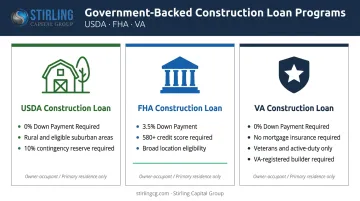
Government programs carry one hard limitation: they're built for single-family, owner-occupant use. Investors and developers building income-producing or commercial properties cannot use FHA, USDA, or VA construction financing.
Conventional and Private Construction Loans
Investors, developers, and borrowers in non-rural markets have two primary options:
- Conventional construction-to-permanent: Strong credit, full documentation, flexible location; Regions Bank, for example, offers construction loans up to $2 million at up to 90% LTV
- Private/non-bank construction loans: Broader eligibility, faster timelines, and more flexibility on collateral type and borrower profile; rates and terms are less favorable than conventional, but access is significantly wider
For developers and investors building income-producing properties, ground-up commercial projects, or multifamily assets, private lending is the primary path forward. Stirling Capital Group works with private lenders, debt funds, and institutional capital sources covering construction projects from $5 million to $500 million and beyond, including deals that fall outside traditional bank underwriting parameters.
Common Mistakes and Misconceptions
Treating Land Loans and Construction Loans as Interchangeable
Many borrowers purchase land with a stand-alone land loan expecting a smooth path to construction financing. The reality is messier: some lenders will fold an existing land balance into a new construction loan, but others require the land to be owned free and clear or the original loan paid off first. Discovering this after closing a land loan can derail timelines and add unexpected costs.
Underestimating Documentation Requirements
Borrowers often walk into construction loan discussions expecting something close to a home purchase process. The documentation requirements are significantly heavier. Before approaching any lender, you should have:
- A builder selected and under contract
- Architectural plans finalized
- A line-item budget prepared
- A draw schedule in place
Arriving without these materials doesn't just slow down approval — it signals to lenders that the project isn't ready to finance.
Assuming the Loan Covers Cost Overruns
The loan is sized based on the submitted budget and as-completed appraisal. If construction costs exceed the budget, the difference comes out of your pocket. A 2023 KPMG global survey of 267 respondents found 45% experienced project underperformance — cost overruns are common, not exceptional.
USDA allows a contingency reserve up to 10% of construction costs specifically to buffer against this. Most lenders require documented cash reserves before approving the loan — if your reserve account runs dry mid-build, you risk a stalled project with no lender obligation to cover the gap.
Frequently Asked Questions
Can I purchase land with a construction loan?
Yes: most construction loans are specifically designed to finance both the land purchase and construction costs in a single combined loan. Freddie Mac explicitly permits interim proceeds to cover lot purchases. The land must meet the lender's criteria for zoning, access, and buildability.
Do I have to put 20% down on a construction loan?
Not always. Conventional lenders typically require 20–25% of total project cost, but USDA and VA programs offer zero-down options for qualified borrowers. FHA requires as little as 3.5%. If you already own the land, that equity often counts toward the down payment, reducing cash needed at closing.
What credit score do I need for a construction loan to buy land?
It depends on the program. FHA allows minimum scores as low as 580 for maximum financing. Most conventional lenders apply overlays in the 680–700+ range based on the higher risk profile of construction lending; private and specialty lenders often have more flexibility.
What is the difference between a construction loan and a land loan?
A land loan finances only the purchase of the property. A construction loan finances both the land and the cost of building a structure on it.
How long does a construction loan last?
Construction loans are short-term. USDA describes the construction phase as typically 12 months; U.S. Bank cites 12 to 18 months as the common range. At completion, the loan converts to a permanent mortgage (single-close structure) or is paid off through separately obtained permanent financing.
Can I use land I already own as a down payment for a construction loan?
In many cases, yes. Lenders appraise the land to determine its current value, and existing equity can reduce or eliminate the cash down payment required. FHA explicitly allows this for construction-to-permanent loans, and VA permits owned land to count toward the down payment under qualifying conditions.