
Private debt AUM reached $1.226 trillion as of September 2021, growing at a 14% CAGR since 2017 — and unitranche structures have driven much of that growth. In 2021 alone, 20 unitranche loans exceeded $1 billion in size, compared to just 4 in 2020.
Yet many borrowers still don't fully understand what they're signing up for. This guide explains what unitranche debt is, how it works mechanically, who uses it, what it costs, and when a different structure would serve you better.
Key Takeaways
- Unitranche debt combines senior and subordinated debt into one facility with a single blended interest rate and one credit agreement
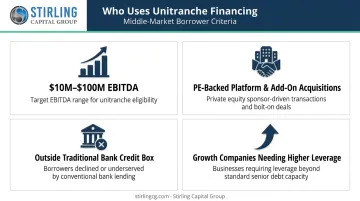
- Primary users are middle-market companies funding leveraged buyouts, acquisitions, or growth — typically with $10M–$100M of annual EBITDA
- Behind a single borrower interface, lenders may split the loan into first-out and last-out tranches via a private Agreement Among Lenders (AAL)
- The main advantages are faster closing, simplified documentation, and access to higher leverage — not a lower interest rate
- Bifurcated structures can reduce the overall cost of capital for borrowers who qualify for a meaningful senior debt tranche
What Is Unitranche Debt?
Unitranche debt is a single credit facility that wraps senior (first lien) and subordinated (junior) debt into one unified loan under one set of contractual terms. Instead of negotiating separately with a senior bank lender and a junior or mezzanine lender, the borrower signs one credit agreement — with a blended interest rate that sits between what each component would carry on its own.
The structure emerged in 2004–2005 as a middle-market product and gained significant momentum after the 2008 financial crisis, as private credit markets expanded to fill the gap left by retreating banks. Preqin forecasts global private debt AUM to reach $2.8 trillion by 2028, with direct lending accounting for $1.4 trillion of that total.
Two Structures Worth Knowing
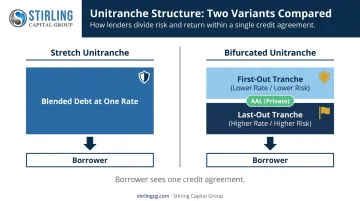
Stretch unitranche blends all debt into one package, often used in LBOs to push the leverage multiple higher than a traditional senior lender would allow.
Bifurcated unitranche divides the loan internally into two portions among the lenders:
- First-out tranche — lower risk, lower rate, paid first in a default
- Last-out tranche — higher risk, higher rate; these lenders absorb losses before the first-out holders see any shortfall
Both appear as a single facility to the borrower. The split happens behind the scenes in a contract the borrower typically doesn't see.
That internal complexity is worth understanding before comparing unitranche to other structures.
What unitranche is not: It's not a standard senior term loan, not a standalone mezzanine loan, and not the same as a syndicated bank loan. The key distinction is documentation — one credit agreement versus multiple independent creditor relationships.
How Unitranche Debt Works
The Single Credit Agreement
The borrower signs one loan document covering interest rate, amortization, maturity, and covenants. According to Jones Day's analysis of unitranche financing, most unitranche deals are "covenant loose" — typically a single net leverage covenant tested quarterly. Maturity generally runs 5–7 years, mandatory amortization is very low (often around 1% annually), and prepayment provisions are flexible.
This single-document structure is where much of the execution efficiency comes from. Fewer parties, fewer agreements, and one due diligence process mean faster closings.
The Blended Interest Rate
The unitranche rate is a weighted average that falls between the lower senior debt rate and the higher subordinated rate. As a directional benchmark, Golub Capital's direct lending research shows return ranges of 7%–9% for senior debt, 9%–11% for unitranche, and 10%–12% for junior debt.
Current spreads in the middle market run approximately S+4.75% to S+5.50% for deals in the $40M–$100M EBITDA range, according to Lincoln International's Q1 2026 private market data.
The Agreement Among Lenders (AAL)
In bifurcated structures, multiple lenders divide the facility into first-out and last-out tranches through an AAL — a private inter-lender contract the borrower is typically not a party to. The AAL governs:
- Repayment priority and waterfall mechanics
- Fee allocation between lenders
- Creditor rights and voting thresholds in a distressed scenario
- Control rights over enforcement actions
The borrower sees one clean credit agreement; what happens among lenders remains a separate arrangement entirely.
A Simplified Example
To see how this plays out in practice, consider a company needing $50M in total debt:
| Structure | Senior Component | Junior Component | Agreements |
|---|---|---|---|
| Traditional | $30M senior loan | $20M mezzanine | Two separate credit agreements |
| Unitranche | $50M single facility | Built into blended rate | One credit agreement |
The unitranche rate sits between what each tranche would cost independently — the borrower pays slightly more than a pure senior rate, but gets more total capital with far less documentation complexity.
Who Provides Unitranche Loans
That lender profile matters for where borrowers search. Unitranche loans come almost exclusively from non-bank private lenders: Business Development Companies (BDCs), direct lending funds, and private credit platforms. As of Q4 2024, SBIA's BDC Council reports 156 BDCs managing more than $434 billion in assets focused on small and medium-sized businesses — the same segment unitranche serves.
Traditional commercial banks don't offer this structure, which is why sourcing the right lender requires access to private credit networks. Firms like Stirling Capital Group work across 65+ private lending relationships, matching specific transactions to lenders whose credit parameters and return targets actually fit — rather than fitting a deal into whichever box happens to be available.
Why Middle-Market Companies Use Unitranche Financing
Speed and Execution
Unitranche deals close faster than bifurcated structures — one lender, one credit agreement, one diligence process. For time-sensitive acquisitions, that compression can be the difference between closing and losing the deal.
Advisors who pre-qualify and pre-underwrite transactions before approaching lenders can compress the timeline further — a meaningful edge when a deal window is narrow.
Higher Leverage Capacity
Unitranche lenders underwrite more leverage than traditional senior lenders. GF Data tracked unitranche leverage multiples rising from 2.6x in 2011 to 4.8x by mid-2014 — a trajectory that continued as the market matured. Today, middle-market unitranche facilities routinely support leverage levels that would be unavailable through conventional bank financing.
Who Fits This Structure
The primary borrower profile includes:
- Middle-market companies with $10M–$100M of annual EBITDA, per Golub Capital's direct lending definition
- Private equity-backed companies executing platform acquisitions or add-on deals
- Companies that can't access cash-flow-based loans from traditional banks due to size or profile constraints
- Growth-oriented businesses that need more capital than conventional senior lenders will provide
Operational Advantages
Beyond leverage and speed, unitranche structures offer practical day-to-day benefits:
- Manages one lender relationship with no competing creditor agendas
- Typically includes just one maintenance covenant, tested quarterly
- Minimal mandatory amortization preserves cash flow for operations and growth
- Cash flow recapture provisions accommodate businesses with variable earnings cycles
These structural efficiencies help explain why unitranche has become the default financing tool for PE-backed middle-market deals — but the structure does come with tradeoffs worth understanding.
Unitranche Debt vs. Traditional Loan Structures
Unitranche vs. Bifurcated (1L/2L)
Unitranche offers simplicity and speed. A bifurcated 1L/2L structure can lower your overall cost of capital — particularly for companies that carry significant senior debt capacity and can borrow incrementally at cheaper first-lien rates rather than a blended unitranche rate.
The right choice depends on what your situation demands:
- Choose unitranche when speed, simplicity, or lender flexibility is the priority
- Choose bifurcated when you have stable cash flows, time to negotiate, and want to minimize interest expense
- Choose bifurcated when maximizing senior debt capacity materially changes your blended borrowing cost
Unitranche vs. Syndicated Bank Loans
| Criteria | Unitranche | Traditional Bank / Syndicated |
|---|---|---|
| Speed | Faster (one lender) | Slower (multiple banks, syndication) |
| Cost of Capital | Higher blended rate | Lower, but tighter credit box |
| Leverage | Higher (private credit appetite) | Lower (bank regulatory limits) |
| Lender Type | Private credit funds, BDCs | Commercial banks |
| Complexity | Low (for borrower) | Moderate |
| Covenant Flexibility | More flexible | More standardized |
| Accessibility | Available to more borrowers | Requires strong bank credit profile |
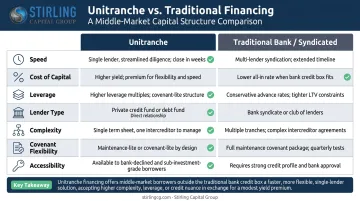
Syndicated loans can deliver lower rates for borrowers with strong investment-grade profiles. For middle-market borrowers who fall outside the bank credit box — or need capital faster than syndication allows — unitranche is often the only practical path to closing.
Risks and Misconceptions of Unitranche Debt
The "Simple Structure" Misconception
A single credit agreement doesn't mean a simple capital structure. Bifurcated unitranche deals carry real complexity via the AAL — complexity the borrower can't see. In a distressed scenario, the priority waterfall among lenders, voting thresholds for enforcement, and control rights directly shape how a workout or restructuring unfolds — including who controls enforcement timing and whether the borrower has any seat at the table.
Borrowers who assume "one document = simple deal" may be caught off guard when those inter-lender dynamics surface during a covenant breach or default. That risk is sharpest in bankruptcy — which is exactly where AAL enforceability becomes a live question.

AAL Enforceability in Bankruptcy
The enforceability of AALs in bankruptcy court remains an unsettled area of law. Mayer Brown's 2023 analysis identifies the general consensus that courts will treat AALs as subordination agreements enforceable under Bankruptcy Code Section 510(a) — but flags unresolved issues around bankruptcy jurisdiction, claims classification, waterfall treatment, and postpetition interest. The RadioShack Chapter 11 case touched these questions without fully resolving them.
The practical takeaway: legal counsel should review AAL mechanics before closing, not after a covenant breach forces the issue.
The Rate Misconception
Unitranche debt is not cheaper than traditional bank debt. The blended rate is higher than a pure senior loan. That premium reflects the additional leverage, flexibility, and execution speed built into the structure. Borrowers who choose unitranche primarily for convenience, without accounting for the rate premium, may be misallocating capital.
The right question isn't whether unitranche is fast or familiar — it's whether the all-in cost is justified by the deal's specific leverage requirements and timeline.
When Unitranche Financing May Not Be the Right Fit
Unitranche isn't a universal answer. There are specific scenarios where a different structure delivers better outcomes:
A bifurcated 1L/2L structure is likely better when:
- Cash flows are stable and predictable
- Senior debt capacity is strong and can be maximized
- You have time to negotiate with multiple lenders
- Cost of capital is the primary optimization target
Unitranche may be the wrong default when:
- The primary reason for choosing it is sponsor familiarity, not time pressure or leverage need
- You're paying a meaningful rate premium without getting the leverage or speed benefits in return
- A bifurcated structure would give you cov-lite features not available under your unitranche offer
Very large transactions and investment-grade borrowers may find better terms through syndicated facilities or bond markets. Unitranche has scaled dramatically — Golub Capital led or co-led 38 transactions above $500M in 2021 alone — but the structure still delivers the most relative value in the middle market.
Before committing to a structure, it's worth modeling total cost of capital across alternatives. Stirling Capital Group works with middle-market borrowers to compare unitranche and bifurcated structures across its network of 65+ lenders, so the choice reflects actual deal economics — not just the fastest path to closing.
Frequently Asked Questions
What is the unitranche debt model?
The unitranche model combines senior and subordinated debt into a single credit facility under one agreement, offering a blended interest rate. Borrowers deal with one lender interface rather than managing multiple separate creditor relationships.
Is unitranche debt the same as senior debt?
No. Unitranche blends senior and subordinated components, so it carries a higher rate than pure senior debt but provides more total leverage. Senior debt sits at the top of the repayment priority waterfall; unitranche covers both senior and junior positions within a single facility.
What is the Agreement Among Lenders (AAL) in a unitranche deal?
The AAL is a private contract between lenders (not the borrower) in a bifurcated unitranche structure. It governs how repayments, fees, and creditor rights are allocated between first-out and last-out tranches. Borrowers typically have no visibility into its specific terms.
What interest rate does unitranche debt typically carry?
The rate is a blended figure that falls between the senior and subordinated components. Current middle-market unitranche spreads run approximately S+4.75% to S+5.50% for mid-sized deals, per Lincoln International's Q1 2026 data , though all-in rates vary by deal size, credit quality, and market conditions.
Who typically provides unitranche loans?
Unitranche loans come almost exclusively from non-bank private lenders: BDCs, direct lending funds, and private credit platforms. Traditional commercial banks don't offer this structure, so borrowers generally need established private credit relationships to access this market.
What is the difference between a stretch unitranche and a bifurcated unitranche?
A stretch unitranche blends all debt into one package at a higher leverage multiple (common in LBO financing). A bifurcated unitranche splits the loan internally into first-out (lower risk, lower rate) and last-out (higher risk, higher rate) portions governed by an AAL. Both appear as a single facility to the borrower.
Unitranche debt is a practical tool for middle-market borrowers who need more leverage, faster execution, and less documentation complexity than traditional bank financing can provide. The trade-off is a higher blended interest rate — worth making when speed and capital access matter more than minimizing interest cost.
Because unitranche loans live entirely in the private credit market, accessing the right lenders requires established relationships that most borrowers don't have on their own. Stirling Capital Group's network of 60+ private lending sources (including private credit funds and specialty finance providers) connects middle-market borrowers with unitranche lenders suited to their specific deal. Contact Stirling Capital Group for a free consultation to evaluate whether unitranche financing fits your capital needs.