
Introduction
Structuring a forward flow purchase agreement incorrectly exposes both parties to real financial and operational risk. Misclassified receivables, broken pricing mechanics, or poorly defined eligibility criteria can unravel a deal that looked straightforward on paper — yet many originators enter these arrangements without fully understanding the structural components that make them work.
A forward flow purchase agreement is a contractual arrangement where a funder commits to purchase newly originated receivables on a rolling basis at pre-agreed prices and eligibility standards. The originator doesn't hold those receivables on its balance sheet.
The purchaser does — along with the credit risk that comes with them.
This article covers the core structural elements that originators and institutional investors must understand before entering an agreement: party roles, accounting treatment, eligibility criteria, credit risk allocation, funding mechanics, and how forward flow compares to warehouse financing and credit facilities.
Key Takeaways
- Credit risk transfers fully to the purchaser at origination — unlike warehouse facilities, where the originator keeps junior exposure
- Balance sheet de-recognition hinges on three auditor-reviewed factors that protective funder terms can quietly unravel
- Eligibility criteria, repurchase obligations, and liability caps are central negotiation points in every transaction
- Pre-funding accounts shield purchasers from originator insolvency and keep capital staged for each origination cycle
- For off-balance-sheet treatment without a full securitization, forward flow is the leaner alternative
What Is a Forward Flow Purchase Agreement?
Hogan Lovells describes a forward flow transaction as an arrangement where a corporate originator of receivables sells the beneficial interest in those receivables to a third-party purchaser on an ongoing basis — either immediately upon origination or periodically — based on pre-determined eligibility criteria. The purchaser, not the originator, receives all future collections.
The economic appeal differs by side of the table:
- For the originator: reliable liquidity, potential off-balance-sheet treatment, and capital recycling without diluting equity
- For the purchaser: direct exposure to the full economic interest in the assets — including interest income — without building in-house origination infrastructure
Why Forward Flow Has Grown
Weil attributes recent growth to four converging forces:
- A mature fintech ecosystem lowering origination costs
- The rise of non-bank specialist lenders seeking capital-efficient funding
- Technology-enabled underwriting accelerating deal volume
- Bank retrenchment from certain lending markets, opening space for private buyers
The scale these structures can reach is significant. Upstart reported that 70% of loans originated through its platform in 2019 were sold immediately to third parties via forward flow arrangements. Klarna's 2025 deal with Nelnet (committing to purchase up to $26 billion in US Pay in 4 receivables) illustrates just how large a single program can become.
Forward flow agreements are generally lighter on documentation than traditional securitizations. That makes them faster to close and more accessible to small and mid-sized originators — a key reason non-bank and specialty lenders have adopted them widely.
Key Parties in a Forward Flow Transaction
Understanding who does what — and what happens when someone fails to do it — is foundational to structuring the arrangement correctly.
Originator/Seller
The originator creates the underlying receivables (loans, trade receivables, BNPL obligations) and sells them to the purchaser. A critical nuance: the originator typically continues servicing those receivables on the purchaser's behalf after sale. Borrowers generally see no change — there's no notification unless specific perfection events are triggered.
Purchaser/Funder and SPV
The purchaser — typically a non-bank lender, credit fund, or institutional investor — commits to buying eligible receivables during the revolving period. Depending on the structure, the purchaser often takes title through a special purpose vehicle (SPV) for tax, regulatory, or leverage purposes. The SPV may also bring in a senior lender to provide back-leverage against the purchased pool.
For originators working to identify the right purchaser match, lender network breadth matters considerably. Stirling Capital Group maintains relationships with over sixty private lending sources across private credit funds, non-bank asset-based lenders, senior secured lenders, and specialty finance providers — enabling placement advisory that aligns purchaser appetite to specific asset types and originator profiles.
Servicer and Backup Servicer
The servicer manages collections, default handling, and reporting after the sale. Because the purchaser is entirely dependent on servicer performance, most agreements require appointment of a backup servicer — an entity ready to step in if the originator becomes insolvent or fails to perform. Per DLA Piper, issues with primary or backup servicing arrangements typically trigger a stop-purchase event, halting new originations into the facility.
Core Structural Elements
Accounting Treatment and Balance Sheet De-recognition
Accounting treatment is often the first structural decision. Originators seeking off-balance-sheet treatment must demonstrate a true sale — meaning the transfer genuinely moves the receivables out of the originator's estate.
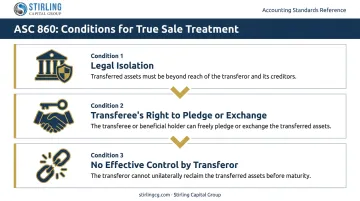
Under ASC 860 (US GAAP), PwC identifies three conditions for sale accounting:
- Legal isolation — transferred assets must be beyond the reach of the originator, even in bankruptcy
- Transferee's right to pledge or exchange — the purchaser must be able to deal freely with the assets
- No effective control by the transferor — the originator cannot maintain the practical ability to retrieve the assets
Under IFRS 9, the analysis evaluates whether contractual cash-flow rights transfer and whether substantially all risks and rewards pass to the purchaser.
What can undermine de-recognition:
- Mandatory repurchase obligations that give the originator effective control
- Profit-sharing arrangements that preserve ongoing economic exposure
- Broad recourse provisions that leave credit risk with the originator
Getting auditor input early (before terms are finalized) avoids the scenario where commercially attractive funder protections conflict with the originator's accounting objectives.
Exclusivity, Allocation Volumes, and Stop Events
Purchasers typically require either exclusivity provisions or minimum allocation volumes (expressed as a percentage of monthly originations or an absolute dollar floor) to ensure they receive sufficient deal flow.
Two types of origination stop events are standard:
- Soft stop: temporarily pauses sales while performance issues or portfolio limit breaches are resolved
- Hard stop: permanently terminates the forward flow following material originator default or servicer failure
The scope and triggers for these events are heavily negotiated, since they define when the purchaser can walk away entirely.
Aligning Originator and Purchaser Interests
These volume and stop-event mechanics address deal flow, but they don't resolve a deeper structural tension: once receivables are sold, the originator no longer bears the consequences if those assets default. This creates a theoretical incentive to let underwriting quality erode over time — the core alignment problem in forward flow.
Profit-sharing arrangements — where the originator shares in excess spread once the purchaser achieves a target return — counteract this misalignment by preserving the originator's economic stake in performance. The structural tension to manage:
- Profit-sharing creates ongoing economic exposure that can compromise balance sheet de-recognition under ASC 860 and IFRS 9
- Recourse carve-outs designed to protect the purchaser can trigger the same accounting problem
- Drafting that satisfies both commercial and accounting objectives simultaneously requires careful coordination between legal and audit counsel
Eligibility Criteria, Warranties, and Credit Risk Allocation
Eligibility Criteria
Eligibility criteria are the pre-agreed standards each receivable must meet to qualify for purchase. Common parameters include:
- Minimum and maximum loan balance
- Borrower credit score thresholds
- Maximum delinquency age at purchase
- Collateral type and loan-to-value limits
- Geographic concentration limits
- Exclusions for bankrupt, deceased, or fraud-originated accounts
These criteria protect the purchaser from acquiring assets inconsistent with its investment mandate. An SEC-filed forward flow agreement between Jefferson Capital Systems and Encore Capital provides a real-world example — excluding accounts more than 270 days delinquent at charge-off and accounts with specific fraud markers.
Warranties and Repurchase Remedies
The originator warrants that each sold receivable satisfies eligibility criteria at the time of sale. If a breach is discovered post-sale, the purchaser's recourse is typically a repurchase obligation — the originator must buy back the defective asset — or an indemnity.
Originators on a capital-light model often push for:
- Liability caps on warranty exposure
- Sunset clauses that limit the look-back period
- Indemnification ceilings
Purchasers — particularly those with senior leverage from a back facility — typically resist these limitations. Recourse provisions are a central negotiation point in most deals.
Credit Risk Allocation vs. Warehouse Financing
The credit risk allocation in a forward flow differs from a warehouse facility in one defining way: in a forward flow, the entire economic interest transfers to the purchaser, who bears full credit risk on the purchased pool. The originator retains no residual or junior interest.
In a warehouse structure, the originator typically holds subordinated exposure and retains ongoing economic interest. That structural difference shapes the due diligence the purchaser must perform before and throughout the arrangement, including:
- Origination policies and underwriting standards
- Servicing procedures and operational controls
- Audit rights
- Consumer protection compliance
Funding Certainty, Pre-Funding Accounts, and Future-Proofing
Sale Frequency and Pre-Funding Mechanics
Sale frequency — daily, weekly, or monthly — directly affects the originator's liquidity. Shorter cycles replenish capital faster, which matters for high-volume originators. Bank purchasers and leveraged credit funds may support daily sales; others require longer lead times.
Pre-funding accounts solve the gap between when the originator needs capital and when assets are formally sold. As Hogan Lovells describes, these accounts hold purchaser funds pending their use to buy additional receivables during the revolving period.
The structural requirement: if the pre-funding account is held with the originator, funds must be held in trust or subject to appropriate security arrangements to protect against originator insolvency. Funds cannot commingle with the originator's general assets.
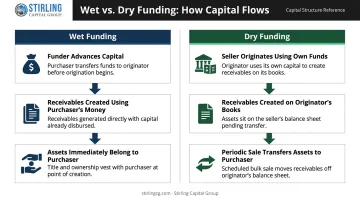
Weil distinguishes two approaches:
- Wet funding: the funder advances capital before origination, so receivables are created using the purchaser's money from the start
- Dry funding: the seller originates using its own funds first, then sells the resulting receivables periodically to the purchaser
Revolving Products and Product Switches
Fixed-term loans are straightforward. Revolving products — credit cards, home equity lines — complicate forward flow terms because they carry indefinite duration and ongoing drawdowns. The forward flow must specify upfront:
- Whether the purchaser is obligated to fund further advances
- What happens to those assets at the end of the forward flow period
Product switch scenarios require separate drafting attention. When regulatory or competitive pressures force the originator to offer borrowers modified terms (rate changes, term adjustments), the agreement must address:
- Whether the originator can repurchase the affected receivable
- Whether a modified, post-switch receivable can be resold to the purchaser
- How eligibility compliance is maintained through the switch process
Forward Flow vs. Warehouse Financing vs. Credit Facility
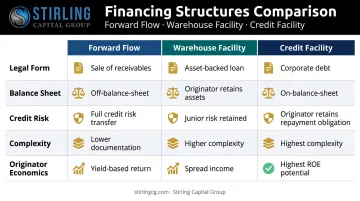
These three structures serve different originator profiles with distinct risk and return characteristics.
| Feature | Forward Flow | Warehouse Facility | Credit Facility |
|---|---|---|---|
| Legal form | Sale of eligible receivables | Asset-backed loan secured by receivables | Corporate debt obligation |
| Balance sheet | Off-balance-sheet if true sale criteria met | Originator retains assets | Debt remains on borrower's books |
| Credit risk | Transfers fully to purchaser | Originator retains junior/first-loss risk | Originator retains repayment obligation |
| Execution complexity | Lower — lighter documentation | Higher — borrowing base, advance rates, covenants | General corporate credit analysis |
| Originator economics | Primarily origination fees; capital recycling speed | Net interest margin retained; higher ROE potential | Highest ROE potential if spread exceeds cost |
When forward flow is the right choice:
- Originators seeking off-balance-sheet treatment without securitization complexity
- Companies without the scale or regulatory infrastructure to access traditional ABS markets
- Non-bank purchasers wanting direct asset exposure without origination capability
- Originators where capital recycling speed matters more than maximizing net interest margin
The trade-off is real: because the purchaser assumes all credit risk in a forward flow, the cost of funding tends to be higher than under a warehouse line, where the originator retains first-loss exposure. A credit facility allows the originator to lever up its own capital and retain the upside, but it requires carrying the balance sheet weight that comes with it.
Originators and investors working through these structure-first decisions often benefit from an advisor with direct relationships across private lenders, credit funds, and specialty finance sources — which is where Stirling Capital Group's network of 65+ capital sources becomes relevant, whether the client is an originator seeking a purchaser or a fund evaluating asset-backed exposure.
Frequently Asked Questions
What is a forward flow buyer?
A forward flow buyer (or purchaser) is the entity — typically a non-bank lender, credit fund, insurer, or institutional investor — that commits to purchase newly originated receivables from an originator on a rolling basis. The buyer assumes full ownership of the assets and receives all future collections on the purchased pool.
How does a forward purchase agreement work?
The originator and purchaser pre-agree on eligibility criteria, purchase price, and sale frequency. During the revolving period, the originator continuously sells qualifying receivables to the purchaser, who funds those purchases — often through an SPV — and receives all subsequent collections. Neither the sold assets nor their credit risk remain with the originator.
Do debt collectors have to provide a forward flow agreement?
No. Forward flow agreements are commercial contracts between originators and institutional purchasers — not consumer-facing disclosure requirements. The FTC's debt-buying industry research confirms that forward flow contracts are common in charged-off debt markets, where sellers commit to supply debt portfolios at regular intervals at a pre-negotiated unit price.
What is the difference between a forward flow agreement and a warehouse line of credit?
In a warehouse line, the originator retains subordinated risk in the asset pool, borrows against those assets, and holds ongoing economic exposure — typically requiring capital to be held against the portfolio. In a forward flow, the originator sells the entire economic interest to the purchaser, who bears full credit risk with no retained exposure.
What are typical eligibility criteria in a forward flow agreement?
Eligibility criteria vary by asset type but commonly include minimum and maximum loan balance, borrower credit score thresholds, maximum delinquency status, collateral type, geographic concentration limits, and maximum loan-to-value ratios. These parameters ensure the purchaser acquires only assets consistent with its investment policy.
Who services the loans after they are sold in a forward flow transaction?
The originator typically continues servicing the sold receivables under a separate servicing agreement, with no visible change to underlying borrowers. A backup servicer is often appointed contractually to step in if the originator becomes insolvent or fails to meet its servicing obligations.