
This scenario is incredibly common for savvy investors and business owners. Fortunately, there’s a powerful financing tool designed for exactly these situations: Special Purpose Vehicle (SPV) lending. It’s a structured approach that isolates risk and opens doors to capital sources beyond the high street bank.
This article breaks down everything you need to know. We’ll cover what an SPV is, the step-by-step process of using one for a commercial deal, and the core benefits that make it an indispensable tool for complex projects.
Key Takeaways
- SPV lending uses a new, separate legal entity (the SPV) created solely to hold an asset and secure a loan against it.
- Its primary advantage is “bankruptcy remoteness,” which isolates the lender’s risk to the single asset, protecting the parent company’s other holdings.
- This structure is ideal for high-value commercial real estate, project finance, and complex joint ventures.
- The process involves forming the SPV, legally transferring the asset, securing a non-recourse or limited-recourse loan, and managing the asset’s cash flow to service the debt.
What Is a Special Purpose Vehicle (SPV) in Commercial Lending?
A Special Purpose Vehicle (SPV) is a distinct legal entity—often a Limited Liability Company (LLC)—created by a parent company for one specific, narrow purpose. In commercial finance, that purpose is typically to own, operate, and finance a single asset, like an office building, a development project, or a portfolio of leases.
The core function of an SPV is to isolate financial risk. Think of it as a secure, watertight container for a single project where its assets, liabilities, and obligations are legally separate from the parent company.
If the project fails, creditors can only make a claim against the assets held by the SPV. The parent company’s other operations and assets remain shielded from that project's risk.
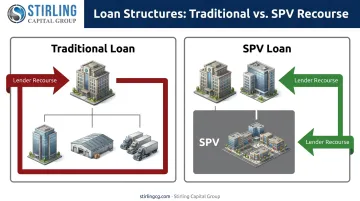
This structure differs fundamentally from a traditional commercial loan:
- Traditional Loan: The borrowing company is fully liable. Lenders underwrite the deal based on the entire company's financial health and have recourse to all its assets.
- SPV Loan: The focus shifts almost entirely to the viability of the single asset it holds, limiting the lender's recourse to that specific asset.
Why Use an SPV for Commercial Financing? The Core Benefits
An SPV structure offers powerful advantages for sophisticated commercial deals, with benefits that go far beyond simple liability protection.
Achieve "Bankruptcy Remoteness" and Mitigate Risk
The most important benefit of an SPV is achieving “bankruptcy remoteness.” This means the SPV is structured to be unaffected by the financial fortunes of its parent company. If the parent company were to file for bankruptcy, the SPV and its asset are legally ring-fenced and shielded from the parent’s creditors.
This risk isolation is highly attractive to lenders. Their investment is secured by a specific, predictable asset, not a sprawling corporate entity with unknown contingent liabilities.
As noted in an analysis by the American Bar Association, this structural separation is achieved through carefully drafted legal documents and covenants. This reduced risk profile often allows lenders to offer more favorable terms than they could on a traditional corporate loan.
Unlock Access to Specialized Capital and Investors
Many institutional investors, private debt funds, and family offices are specifically structured to lend to SPVs. They prefer the clean, asset-focused nature of these deals. By using an SPV, you open your project up to a much wider universe of capital providers who may have more appetite for your project’s specific risk profile than a conventional bank.
Furthermore, an SPV allows for creative capital stacking. You can bring in different types of investors for a single project—for example, securing a senior loan from a debt fund while offering equity stakes in the SPV to other partners.
Facilitate Complex Joint Ventures and Partnerships
When multiple partners or companies team up to acquire a commercial asset, an SPV provides a clean and transparent legal framework. It creates a single entity to manage ownership percentages, define roles and responsibilities, and streamline the distribution of profits. This avoids commingling funds with each partner’s primary business and simplifies governance for the specific project.
Improve Balance Sheet Management
In some cases, moving an asset and its related debt into an SPV can be used for off-balance-sheet financing. This helps a parent company improve its financial ratios, such as its debt-to-equity ratio.
However, this is a complex accounting matter governed by strict standards (like ASC 810 in the U.S.). Achieving this treatment is not automatic and requires careful structuring in compliance with accounting regulations.
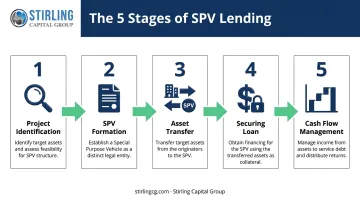
How SPV Lending Works: A Step-by-Step Guide
Securing financing through a Special Purpose Vehicle follows a structured, multi-stage process. Each step is critical to ensuring the legal and financial integrity of the deal.
Step 1: Project Identification and Initial Structuring
The process begins when a sponsor—the parent company or investor—identifies a commercial asset or project. The sponsor then conducts due diligence and financial modeling to determine if an SPV structure is the best path forward. This phase includes projecting the asset’s potential cash flow, which will be the primary source of loan repayment.
Step 2: Formation of the SPV Entity
Next, the sponsor legally creates the new entity. This usually involves establishing an LLC with a narrowly defined business purpose in its founding documents, for example, "to acquire, own, and operate the commercial property located at 123 Main Street." The limited purpose is a key feature that prevents the SPV from engaging in other business activities, further isolating risk.
Step 3: The "True Sale" Asset Transfer
The parent company formally sells the asset to the newly formed SPV in an "arm's-length" transaction. This "true sale" legally establishes the SPV as the new, rightful owner of the asset. This step ensures that if the parent company later faces financial distress, the asset cannot be pulled back into the parent’s bankruptcy estate.
Step 4: Securing the Loan
Now that the SPV legally owns the asset, it applies for the loan. The underwriting process focuses almost exclusively on the asset itself. Lenders analyze:
- The asset’s value, based on a thorough appraisal.
- Its projected cash flow and ability to cover debt service and operating expenses.
- The overall quality of the asset, including its physical condition, location, and tenant strength.
The loan is secured solely by the asset, making it a "non-recourse" or "limited-recourse" loan. The sponsor’s credit is a secondary consideration.
Step 5: Loan Servicing and Cash Flow Management
Once the deal is funded, the revenue generated by the asset (e.g., rent from tenants) flows directly into the SPV’s bank account. This cash is used in a specific order, often called a "cash flow waterfall":
- Pay the loan’s principal and interest.
- Cover the property’s operating expenses.
- Fund any required capital reserves.
- Distribute the remaining profits to the SPV’s owners.
Key Factors That Influence an SPV Lending Deal
Because the lender's security is tied to a single asset, the underwriting is intensely focused. Success hinges on a few critical elements.
- Asset Quality: Lenders scrutinize the property’s location, condition, and tenant creditworthiness. A stable, predictable cash flow is the bedrock of a successful deal, according to the Comptroller's Handbook on CRE Lending.
- Legal Structure: The SPV must be truly bankruptcy-remote, with strict "separateness covenants" requiring it to maintain separate books, records, and bank accounts from the parent company, as noted by the Bank for International Settlements.
- Sponsor Credibility: Lenders need confidence in the sponsor's track record. A proven history of successfully managing similar commercial properties provides a significant level of comfort and reduces perceived risk.
Partnering with an Expert to Secure SPV Financing
Structuring an SPV and securing the right financing is significantly more complex than applying for a standard commercial loan. It requires careful coordination between legal counsel, accountants, and finance professionals to execute correctly. Any misstep in the legal structure can jeopardize the entire purpose of the vehicle.
This is why many investors partner with a commercial finance consultant. An expert advisor can help structure the deal, prepare a compelling financial package, and, most importantly, connect you with the right capital sources for your specific project. Not all lenders understand or participate in SPV financing.
At Stirling Capital Group, we specialize in navigating these complex transactions. As a consultative capital placement firm, we don't work for one bank; we work for you.
Our deep network and hands-on approach allow us to:
- Connect you with over 60 private lenders, debt funds, and institutional investors.
- Structure a compelling financial package tailored to SPV requirements.
- Guide you through the entire process, from initial strategy to closing the deal.
- Match you with a capital partner who understands your project’s unique goals.
Frequently Asked Questions
What is an SPV in lending?
An SPV is a separate legal entity created for the sole purpose of holding a specific asset and securing a loan against it. This structure isolates the financial risk of the project from the parent company and other assets.
Who owns an SPV company?
An SPV is typically owned by the company that creates it (the "sponsor"). However, in a joint venture, ownership can be shared among multiple partners or equity investors who contribute capital to the project.
Is an SPV the same as an LLC?
No. An SPV describes the entity's purpose—to be a single-purpose vehicle. An LLC (Limited Liability Company) is a common legal structure used to create an SPV because it offers liability protection and operational flexibility.
What are the main risks of using an SPV for a commercial deal?
Key risks include higher initial setup costs and administrative complexity. SPVs also require diligent ongoing management to maintain legal separation from the parent company and avoid regulatory issues.
Can small businesses use SPV lending?
Yes, while historically used for large projects, SPVs are increasingly accessible for significant middle-market deals. They are particularly useful for projects that don't fit the rigid criteria of traditional banks.