
Introduction
You found the perfect acquisition target or a time-sensitive real estate opportunity, but your bank’s loan committee moves at a glacial pace. Or maybe your business model is solid but doesn't fit neatly into their rigid credit box. This is a common frustration for commercial borrowers.
In fact, 34% of small employer firms that applied for financing at large banks in 2024 received none of what they asked for, according to the Federal Reserve's Small Business Credit Survey.
This is where non-bank lending comes in. It’s a powerful and increasingly popular alternative that provides the flexibility, speed, and customized capital that modern businesses need to thrive. These private lenders operate outside the strict regulations of traditional banks, giving them the freedom to fund deals that others can't.
This guide breaks down the main types of non-bank lending, explains how they differ, and gives you a clear framework for choosing the right option for your commercial financing needs.
Key Takeaways
- Non-bank lenders provide flexible, fast commercial financing from private sources.
- Options range from Private Debt Funds and Hard Money Lenders to Asset-Based Lending.
- Choosing the right lender depends on your loan purpose, speed, collateral, and risk.
- Expect higher costs and different terms, making total cost evaluation essential.
What Is Non-Bank Lending?
Non-bank lending refers to commercial financing from private sources, operating outside the traditional, government-regulated banking system. This creates a parallel financial ecosystem for businesses and real estate investors.
Instead of using customer deposits, these lenders raise capital from private investors—like investment funds, wealthy individuals, and other institutions—to fund their loans. This structure allows them to operate with more agility and a different set of rules. The global private credit market has grown substantially, with assets under management reaching nearly $1.7 trillion as of mid-2023, according to the Federal Reserve.
For borrowers, non-bank lending is a practical alternative for situations that don't fit the standard "credit box" of a conventional bank. This makes it an essential solution for borrowers needing customized terms, faster funding, or creative approaches to complex financing scenarios.
Why Consider Non-Bank Lenders for Commercial Loans?
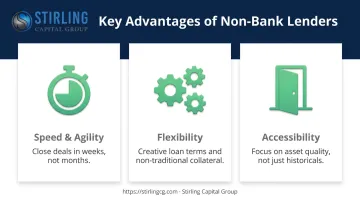
The primary reason businesses turn to non-bank lenders is to overcome the limitations of traditional banking. While banks play a critical role, their rigid structures and slow processes can be a deal-killer in a competitive environment. Non-bank lenders fill this gap by offering three key advantages.
Speed and Agility
When a valuable opportunity arises, time is money. Non-bank lenders understand this and have built their operations around speed. Their streamlined underwriting processes and internal decision-making allow them to close deals in weeks, or sometimes even days, not the months it can take a traditional bank. This agility is a significant competitive advantage for borrowers trying to secure an acquisition or time-sensitive real estate deal.
Flexibility
Non-bank lenders aren't bound by the same strict federal regulations as depository banks. This gives them the freedom to structure creative loan terms that meet a borrower's specific needs.
This flexibility allows them to:
- Accept non-traditional assets as collateral that a bank might overlook.
- Finance complex projects, such as business turnarounds or management buyouts.
- Offer creative repayment schedules, like interest-only periods, to help manage cash flow.
Accessibility
Many otherwise healthy businesses and solid real estate projects get declined by banks due to factors like historical cash flow dips, low personal credit scores, or an industry that's temporarily out of favor. Non-bank lenders often take a more holistic view, focusing on the quality of the asset or the business's future potential rather than relying solely on historical performance. This opens doors for borrowers who need capital but don't check every single box on a bank's application.
Types of Non-Bank Lending Options for Commercial Borrowers
"Non-bank lending" is a broad category, and the right solution depends entirely on your specific situation. Understanding the different types of lenders is the first step to finding the right capital partner. Here is a breakdown of four common options.
Private Debt Funds / Direct Lenders
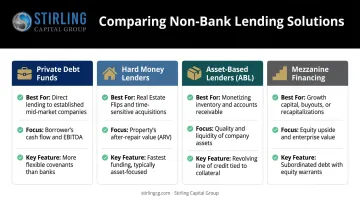
These are sophisticated investment funds that raise capital from accredited investors to lend directly to businesses. They function like a private banking system, offering structured and customized loan products for the middle market.
- Serves established companies seeking capital for growth, acquisitions, recapitalizations, or leveraged buyouts.
- Offers larger, more complex loans (averaging over $80 million since 2022) than other non-bank lenders and focuses on building long-term relationships.
- Provides the ability to fund large and complex deals, offer highly flexible terms, and act as a strategic capital partner.
- Requires a thorough due diligence process (though still faster than a bank) and typically has high minimum loan amounts.
Hard Money Lenders
Hard money lenders are private companies or individuals providing short-term, asset-backed loans, primarily for real estate. The loan is secured by the "hard" asset—the property itself.
- Primarily serves real estate investors executing short-term strategies like fix-and-flips, bridge loans, or construction financing.
- Focuses on the property's value (especially its after-repair value) instead of the borrower's credit, enabling some of the fastest funding speeds available.
- Offers exceptional speed, lenient borrower requirements, and a laser focus on the asset's potential.
- Comes with higher interest rates and fees, and loan terms are short (typically 6-24 months), making it unsuitable for long-term holds.
Asset-Based Lenders (ABL)
These lenders provide revolving lines of credit or term loans secured by a company's balance sheet assets, most commonly accounts receivable and inventory.
- Supports manufacturers, distributors, and wholesalers who need flexible working capital by leveraging company assets.
- Ties the loan amount directly to the value of pledged assets, allowing the credit facility to grow with the asset base. Typical advance rates are 75%-80% on receivables and 40%-50% on inventory.
- Provides scalable and immediate access to working capital, often with less restrictive covenants than bank loans.
- Requires regular monitoring and reporting of asset values, meaning the available capital can fluctuate as your borrowing base changes.
Mezzanine Financing Providers
Mezzanine financing is a hybrid form of capital that blends debt and equity. It's a subordinated loan (ranking behind senior bank debt) that often includes an equity component, known as an "equity kicker," which gives the lender the right to convert to an ownership stake if the loan isn't repaid.
- Aids mature companies undertaking major initiatives like a management buyout, a large acquisition, or a significant expansion where senior debt is not enough.
- Fills the gap between senior debt and owner's equity, making it one of the most complex and highly customized forms of non-bank lending.
- Allows borrowers to secure significant capital with minimal upfront ownership dilution compared to a pure equity raise.
- Represents the most expensive form of debt, with interest rates often in the 10%-14% range and total lender returns reaching 12%-17% due to the equity component.
How to Choose the Right Non-Bank Lending Option
The "best" lender is simply the one that aligns with the specific needs of your deal. To find the right fit, start by asking these five questions:
What is the purpose of the loan? Are you executing a short-term real estate flip (Hard Money), managing ongoing working capital (ABL), acquiring a competitor (Private Debt Fund), or funding a major strategic expansion (Mezzanine)? The use of funds is the most important filter.
How quickly do you need the capital? If you need to close on a property in two weeks, a hard money lender is likely your only option. If you have a few months to plan a strategic acquisition, a private debt fund becomes a viable and more structured choice.
What is your primary collateral? Is the loan secured by a specific piece of real estate (Hard Money), your business's operating assets like inventory and receivables (ABL), or the overall cash flow and enterprise value of your company (Private Debt Fund/Mezzanine)?
What is your tolerance for cost and risk? Are you willing to pay higher interest rates for maximum speed and flexibility? Are you comfortable with a lender potentially taking an equity stake in your business to secure growth capital?
What is the complexity of your situation? A straightforward bridge loan is very different from a multi-layered acquisition financing package. Ensure your lender has the sophistication and experience to match your needs.
While these questions provide clarity, navigating the options and negotiating terms can still be overwhelming. This is where a commercial finance consultant can provide significant value.
A firm like Stirling Capital Group specializes in analyzing your unique needs to connect you with the right capital source from its extensive lender network. This approach saves time, reduces complexity, and helps you secure a more favorable financing outcome.
Common Pitfalls to Avoid When Choosing a Non-Bank Lender
While non-bank lending offers powerful solutions, navigating this market requires a different approach than traditional banking. Avoiding a few common pitfalls is key to a successful partnership.
Focusing Only on the Interest Rate
Non-bank loans often have various fees that contribute to the total cost. The lowest rate doesn't always mean the cheapest loan. Always look beyond the rate and ask about:
- Origination fees or points
- Prepayment penalties or call premiums
- Exit fees
- Amendment or waiver fees
A 2023 analysis by S&P Global found that for a group of riskier corporate borrowers moving from public to private credit, the interest rate spread was nearly 200 basis points (2%) higher on average.
Always evaluate the all-in cost of capital, not just the headline interest rate.
Ignoring the Lender's Expertise
Choose a lender who understands your industry or asset class. A lender specializing in industrial real estate will be a much better partner for a warehouse acquisition than one who primarily funds retail businesses. An experienced lender brings valuable insight, a smoother underwriting process, and a better understanding of your project's potential.
Failing to Plan Your Exit Strategy
This is especially critical for short-term financing like hard money or bridge loans. Before you sign any documents, you need a clear and realistic plan for how the loan will be repaid.
Lenders will require a credible exit strategy, whether it's through the sale of the asset or a refinance into a more permanent, lower-cost loan.
Conclusion
Non-bank lenders play a vital role in the commercial finance ecosystem. They offer the speed, flexibility, and creative solutions that businesses and investors need to seize opportunities in a market where traditional banks often can't keep pace.
Understanding the key differences between private debt funds, hard money lenders, ABL providers, and mezzanine funds is the first step to securing the right capital. By matching the lender's strengths to your specific goals, you can unlock financing that propels your business forward.
If your financing needs are complex or time-sensitive, an experienced commercial finance advisor can provide the expertise and market access to secure the best outcome. The team at Stirling Capital Group is ready to help you navigate these options and find the right capital solution.
Frequently Asked Questions
What is a non-bank lender?
A non-bank lender is a private company or fund that provides loans using private capital. They operate outside the regulations of traditional depository banks, which allows them to offer more flexible and faster financing solutions.
What are examples of non-bank lenders?
Common examples include private debt funds, hard money lenders, asset-based lenders, and mezzanine funds. Each type of lender specializes in different kinds of commercial borrowing needs, from real estate to corporate growth.
Are non-bank loans more expensive than traditional bank loans?
Yes, they often are. The higher cost reflects the lender's increased risk and covers the value provided through faster funding, flexible underwriting, and customized structures that banks can't offer.
How fast can you get funding from a non-bank lender?
Funding is much faster than with banks. Timelines vary, but some real estate loans can close in under two weeks, while more complex private debt deals may take 30-60 days.
What kind of collateral is needed for non-bank commercial loans?
The required collateral depends on the loan type. It can range from specific assets like real estate, inventory, and equipment to the overall enterprise value and cash flow of your business.
When should a business consider a non-bank lender over a traditional bank?
Consider a non-bank lender when speed is critical, the deal is too complex for a bank, you have already been declined for a traditional loan, or you require more flexible terms to achieve your goals.