

This funding gap is one of the most common hurdles developers face. Senior construction loans typically cover only 60% to 75% of a project's total cost, leaving a substantial shortfall that can stall a promising development. How do you bridge this divide without diluting your ownership by bringing in expensive equity partners?
The answer for many savvy developers is a construction mezzanine loan. This powerful and flexible financing tool is specifically designed to fill that gap, providing the crucial capital needed to get your project off the ground while allowing you to maintain control. This guide will walk you through what mezzanine loans are, how they work, and how to secure one for your next project.
Key Takeaways
- Construction mezzanine loans are subordinate financing that sits between senior debt and developer equity in the capital stack.
- The primary benefit is achieving higher leverage (up to 85% LTC), which reduces your required cash contribution.
- This financing allows you to retain greater ownership and control compared to bringing on a joint venture equity partner.
- Mezzanine debt is more expensive than senior loans and carries the risk of a swift foreclosure on your ownership entity in a default.
- Securing this type of loan requires a strong project plan, a proven track record, and access to a network of specialized private lenders.
What Exactly is a Construction Mezzanine Loan?
A construction mezzanine loan is a hybrid financing instrument that blends features of both debt and equity. It’s used specifically to provide supplementary capital for real estate development projects, slotting in right above the developer's equity and below the primary construction loan.
Unique Structural Characteristics
The most critical feature of a mezzanine loan is its collateral. Instead of placing a second mortgage on the property itself, a mezzanine loan is secured by a pledge of the ownership interests in the entity that owns the real estate (typically an LLC).
This distinction has significant implications. If the loan defaults, the lender doesn't need to go through a lengthy judicial mortgage foreclosure.
Instead, they can foreclose on the pledged ownership stake under the Uniform Commercial Code (UCC). This process allows them to take control of the property-owning LLC and effectively become the new project owner.
The Cost Structure
This unique position in the capital stack—riskier than senior debt but safer than pure equity—is reflected in its cost. The pricing for a mezzanine loan typically includes several components:
- High Current-Pay Interest Rate: A fixed or floating rate paid monthly, similar to a traditional loan but significantly higher than the senior debt.
- Deferred Interest (PIK): A portion of the interest may be "Payment-in-Kind" (PIK), which accrues and is added to the loan balance. This structure eases the cash flow burden during construction.
- Equity Kicker: Lenders may require an "equity kicker," giving them a percentage of the project's future profits to compensate for taking on additional risk.
Unlike a standard business loan, construction mezzanine funds are tied directly to project milestones. Capital is released in draws as construction progresses and specific targets are met, ensuring the funds are used as intended.
Visualizing the Capital Stack: Where Mezzanine Debt Fits In
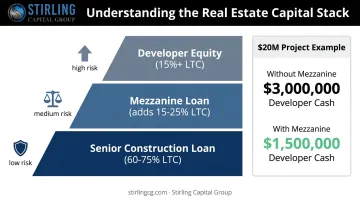
To understand the role of a mezzanine loan, you have to understand the "capital stack." Think of it as a diagram of all the money used to fund a project, organized by risk from bottom to top. The lower a layer is in the stack, the lower its risk and the first it gets paid back.
Here’s a typical capital stack for a construction project that includes mezzanine financing:
- Senior Construction Loan (Bottom Layer): This is the largest and safest piece of the financing, typically covering 60% to 75% of the project cost. It's secured by a first-position mortgage on the property, making it the least risky for the lender and therefore carrying the lowest interest rate.
- Mezzanine Loan (Middle Layer): This loan sits directly on top of the senior debt, bridging the gap. It might take the total financing from 65% of the cost up to 85%. It's subordinate to the senior loan but has priority over the developer's equity, placing it in the middle for risk and return.
- Developer Equity (Top Layer): This is the developer's own cash contribution, representing the final 15% or more of the project cost. It's the riskiest position—if the project fails, the equity is the first to be lost. However, it also holds the highest potential for returns.
Let’s use a hypothetical $20 million project to see this in action:
- Without Mezzanine: A senior lender offers 65% LTC, which is $13 million. The developer must contribute the remaining $7 million (35%) in cash.
- With Mezzanine: The same senior loan provides $13 million (65%). A mezzanine lender adds $4 million (20%), bringing total debt to $17 million, or 85% of the total cost. The developer now only needs to contribute $3 million (15%) in cash.
As you can see, the mezzanine loan cut the developer's required cash contribution by more than half.
The Top Benefits of Mezzanine Loans for Your Construction Project
While more expensive than senior debt, mezzanine financing offers strategic advantages that can make it the perfect tool for the right project.
Achieve Higher Leverage and Reduce Equity Contribution
This is the primary reason developers turn to mezzanine debt. By layering this subordinate financing on top of a senior loan, you can dramatically reduce the amount of cash you need to bring to the table.
This frees up your capital, allowing you to pursue multiple projects simultaneously or take on larger developments than your liquid equity would otherwise permit. With less of your own money tied up in a single deal, you can diversify risk and amplify your potential for growth.
Retain Greater Ownership and Control
The alternative to bridging the funding gap is often to bring in a joint venture (JV) equity partner. While this also reduces your cash requirement, it comes at a steep price: a significant portion of your ownership and control. A JV partner will demand a large share of the profits and will likely want a say in major project decisions.
A mezzanine loan, on the other hand, is a debt instrument, not an equity partnership. The lender is a creditor, not a co-owner.
As long as you meet your loan obligations, you retain full ownership of your project and maintain day-to-day control. You get the capital you need without giving up a significant slice of the upside you’re working to create.
Faster and More Flexible Than Traditional Capital
Mezzanine lenders are typically private, non-bank institutions. This means they aren't bound by the same rigid regulations and internal bureaucracy as traditional banks. As a result, they can often move much faster, closing deals in a fraction of the time. This speed can be a decisive advantage when competing for a property or facing tight deadlines.
Furthermore, these lenders are known for their ability to offer more customized and flexible loan structures. They can tailor terms, draw schedules, and repayment plans to the specific needs of your project in a way that a conventional bank simply can't.
Understanding the Costs and Risks of Mezzanine Debt
The flexibility and high leverage of mezzanine financing come with a higher price tag and unique risks that every developer must carefully consider.
The High Cost of Capital
Mezzanine debt is significantly more expensive than a senior construction loan. Because the mezzanine lender is in a subordinate position, they take on more risk, and they demand to be compensated for it. The costs can be broken down into a few key areas:
- Interest Rates: Expect rates well into the double digits. Lender-published indications often place rates in the 12% to 20% range, with riskier ground-up construction projects trending toward the higher end of that spectrum.
- Origination Fees: Upfront fees, or "points," are standard. It’s common to see origination fees of 2-3 points on a construction mezzanine loan.
- Equity Kickers: As mentioned earlier, the lender may also negotiate for a share of the project's profits upon sale or refinance. This can dramatically increase the all-in cost of capital but may be a worthwhile trade-off to get a deal done.
The Risk of Foreclosure and Loss of Control
This is the most significant risk associated with mezzanine debt. If you default, the lender can execute a UCC foreclosure on the pledged ownership interests of your LLC. This process is alarmingly fast compared to a traditional mortgage foreclosure.
While a judicial foreclosure on real property can take many months or even years to wind through the courts, a UCC sale of equity can often be completed in as little as 45 to 90 days. In a default scenario, you could lose control of your entire project in a matter of weeks, wiping out your equity completely.
Complex Documentation and Intercreditor Agreements
Mezzanine financing involves a web of complex legal documents. Chief among them is the Intercreditor Agreement, a heavily negotiated contract between the senior lender and the mezzanine lender.
This document outlines the rights and responsibilities of each party, defining who can act in various scenarios, especially during a default. Navigating these agreements requires sophisticated legal counsel and a skilled capital advisor to ensure your interests are protected.
How to Secure a Construction Mezzanine Loan
Securing a construction mezzanine loan requires more than just a good project idea. Lenders in this space are highly sophisticated and scrutinize every aspect of a deal before committing capital.
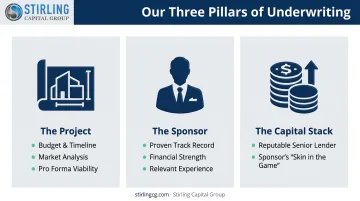
Lenders focus their underwriting on three core pillars:
- The Project: They will analyze the viability of the development itself. This includes a deep dive into the budget (which should include a 5%-10% contingency), construction timeline, location, market analysis, and the credibility of your pro forma profitability.
- The Sponsor (You): Your track record is paramount. Lenders need to see that you have successfully completed similar projects in the past. They will also assess your personal financial strength, liquidity, and overall experience.
- The Capital Stack: The quality of your senior lender matters. Mezzanine providers want to see a reputable institution in the first position. They will also evaluate the amount of your own equity in the deal—they want you to have significant "skin in the game."
Finding the right lender can be a major challenge. The market is fragmented, consisting of private debt funds, family offices, and specialty finance companies, each with its own niche, risk appetite, and lending criteria.
This is where working with an experienced commercial finance advisor provides a clear advantage. A consultative intermediary can navigate this fragmented market, connecting your project with the right capital provider from a network of specialized lenders.
As an advisory firm, Stirling Capital Group uses our network of over 60 private lending sources to find the ideal match. Our process involves pre-underwriting your deal to address potential red flags early, increasing your probability of success and helping you secure the most favorable terms.
Frequently Asked Questions
What is a mezzanine construction loan?
It is a hybrid financing tool that fills the funding gap between a senior construction loan and the developer's equity. It is secured by a pledge of ownership in the project entity, not a direct mortgage on the property.
What is the interest rate for a mezzanine loan?
Rates are much higher than senior debt and vary based on risk, often falling in the low-to-mid double-digits (12%-20%). The rate structure can include both a current-pay component and a PIK (Payment-in-Kind) component that accrues.
How does mezzanine financing differ from preferred equity?
Mezzanine financing is structured as debt with a fixed maturity date and foreclosure remedies. In contrast, preferred equity is an equity investment that earns a preferred return but has no strict repayment deadline and is governed by the LLC agreement.
What happens if I default on a construction mezzanine loan?
The lender can execute a UCC foreclosure on the ownership interests of the company that owns the real estate. This allows them to take control of the entire project relatively quickly, often in just a few months.
What is a typical loan-to-cost (LTC) ratio with a mezzanine loan?
By adding a mezzanine piece to the capital stack, developers can often increase their total leverage from the typical 60%-75% LTC offered by senior lenders to a combined total of 80%-90% LTC.