
M&A financing is not one-size-fits-all. Deal size, buyer creditworthiness, seller expectations, and post-closing cash flow needs all shape which structure works — and what it ultimately costs. A buyer with strong liquidity faces entirely different tradeoffs than one relying on leveraged debt or private capital.
This guide breaks down every major M&A financing method — cash, debt, seller notes, equity, mezzanine, and LBOs — with clear pros and cons for each. You'll also find a practical framework for choosing the right structure before you're sitting across the table from a seller.
Key Takeaways
- M&A financing spans cash, bank debt, SBA loans, seller notes, equity, mezzanine instruments, and LBOs
- Most deals use a combination of sources — hybrid structures are more common than single-source financing
- Financing structure directly affects ownership control, debt service obligations, and post-merger flexibility
- Over-leveraged deals strain integration, limit talent retention, and crowd out growth investment
- A capital advisor with multiple lender relationships opens options no single bank can match
What Is M&A Financing and Why Does Structure Matter?
M&A financing is the process of sourcing and structuring capital to complete a merger or acquisition. It covers both internal sources — cash reserves and equity — and external sources including bank debt, private capital, and seller-provided funds.
The structure isn't just a funding mechanism. It shapes three things that matter long after closing:
- Governance: who holds control, and what conditions can trigger a change in that control
- Debt obligations: what the combined entity must service — and how that constrains cash flow
- Post-merger flexibility: the capacity to invest in integration, technology, and growth without running short on working capital
Those three factors also determine what financing you can realistically access. Lenders evaluate M&A deals based on the target's cash flows, asset quality, and the buyer's creditworthiness. A deal that looks clean on paper can fail to attract financing if the target's EBITDA is thin, the assets are hard to collateralize, or the buyer's balance sheet already carries too much leverage.
Getting the structure right early matters because changing it after closing is far more expensive — and sometimes not possible at all.
M&A Financing Options: Pros and Cons of Each
Most deals combine several of the structures below. The right mix depends on the buyer's balance sheet, the deal size, and what the seller will accept.
Cash Financing
All-cash deals use the buyer's own reserves to fund the acquisition outright. There are no lenders to satisfy, no financing contingencies, and no credit committee timelines to work around.
Sellers often prefer cash offers precisely because there's no financing contingency that could derail closing. For competitive processes, an all-cash bid carries real negotiating leverage.
Pros:
- No debt service obligations post-closing
- No ownership dilution
- Fastest path to closing
Cons:
- Depletes liquidity needed for integration and post-acquisition operations
- Creates opportunity cost — capital locked into one deal can't fund other growth initiatives
- Not viable for buyers without substantial reserves
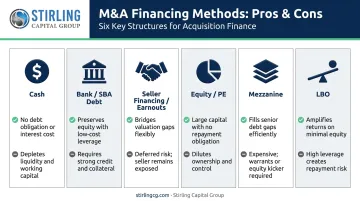
Debt Financing (Bank Loans and SBA Loans)
Traditional bank loans and SBA 7(a) loans are the most common acquisition financing instruments for small and mid-market deals. Bank loans use the acquired business's assets or cash flows as collateral. SBA 7(a) loans provide government-guaranteed financing up to $5 million, with the SBA guaranteeing up to 85% on loans up to $150,000 and 75% on larger amounts.
Pros:
- Lower cost of capital than equity financing
- Interest payments are tax-deductible
- Buyer retains full ownership
Cons:
- Requires strong credit history and collateral
- Debt covenants can restrict business decisions post-closing (dividends, additional borrowing, capex)
- Traditional banks frequently decline deals outside their standard underwriting criteria — especially for businesses with limited hard assets or irregular cash flow history
Seller Financing and Earnouts
Seller financing occurs when the seller accepts a portion of the purchase price over time via a promissory note — typically secured against the business. An earnout is a performance-contingent payment: the seller receives additional funds if the acquired business hits agreed targets after closing.
Earnouts appear most often when buyers and sellers disagree on valuation — they let both sides share the risk of post-closing performance rather than argue over a fixed price at signing.
Pros:
- Bridges valuation gaps without requiring more upfront capital
- Signals seller confidence in the business's ongoing performance
- Structured payment terms can break negotiation deadlocks by tying part of the price to future results
Cons:
- Seller financing typically covers only 10–30% of the total purchase price
- Earnout disputes are common when performance metrics are poorly defined or subject to post-closing management decisions
- Sellers accepting notes bear credit risk on the buyer
Equity and Private Equity Financing
Equity financing uses company shares (in a stock swap) or capital raised from outside investors — including private equity firms — to fund the acquisition. PE firms provide capital in exchange for an ownership stake and typically active involvement in strategic decisions.
Pros:
- No mandatory debt repayments or principal obligations
- Does not increase leverage or strain credit ratings
- Access to PE networks and operational expertise alongside capital
Cons:
- Dilutes existing ownership — sometimes substantially
- Private equity investors typically seek exits within 3–7 years, which may conflict with a buyer's long-term vision
- PE involvement often comes with growth targets and governance requirements
Mezzanine and Hybrid Financing
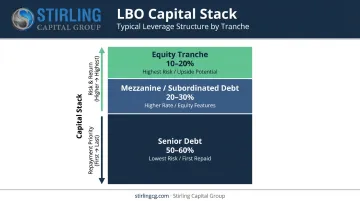
Mezzanine financing sits between senior debt and equity in the capital stack. It's subordinated debt — meaning it's repaid after senior lenders — and often carries equity conversion features such as warrants or convertible notes. Preferred equity and convertible bonds are also common hybrid instruments in mid-market M&A.
Mezz financing fills the gap when senior debt capacity is maxed out — typically around 3–4x EBITDA for most lenders — and raising pure equity would dilute existing ownership below acceptable thresholds.
Pros:
- Provides capital when senior debt capacity is maxed out
- Less dilutive than raising pure equity
- Flexible repayment structures, sometimes including payment-in-kind (PIK) interest
Cons:
- Higher interest rates than senior debt, reflecting the subordinated risk position
- Complex documentation and terms require experienced legal and financial advisors
- Typically reserved for mid-market transactions with sufficient EBITDA to support layered debt
Leveraged Buyouts (LBOs)
An LBO uses the target company's own assets and projected cash flows as collateral to secure the majority of acquisition financing — minimizing the buyer's equity contribution. The capital stack layers senior debt, subordinated or mezzanine debt, and a smaller equity tranche. This is the dominant structure for private equity-backed acquisitions.
Pros:
- Allows buyers to acquire large businesses with limited upfront equity
- Amplifies return on equity when the business performs as projected
- Established deal structure with well-understood lender expectations
Cons:
- High debt loads significantly increase default risk if post-closing cash flows disappoint
- Lenders conduct rigorous due diligence and debt capacity analysis before committing
- Rising interest rates since 2022 have compressed LBO returns, as higher debt costs eat directly into projected equity upside
How to Choose the Right M&A Financing Structure
Match Structure to the Business Profile
Deal size and the target's cash flow profile are the primary drivers. Asset-light businesses with strong, recurring revenue can support higher leverage; lenders view predictable cash flows as reliable debt service coverage. Asset-heavy businesses with volatile earnings require more equity or seller financing to get to the finish line.
Before choosing a structure, model the target's projected free cash flow against debt service obligations under each scenario. A deal that works at a 4x leverage multiple may become unmanageable at 5x if integration costs spike in year one.
Expand Beyond a Single Bank
Buyer creditworthiness and balance sheet capacity limit access to certain options directly. Buyers with limited credit history, or those who have already been declined by a traditional bank, often assume their options are exhausted. They're not.
Private credit markets, specialty lenders, and non-bank financing sources (including debt funds and SBA lenders) operate with different underwriting criteria than conventional banks. Stirling Capital Group's network of 60+ private lending sources gives buyers access to capital structures that a single bank simply can't offer, including senior secured, mezzanine, and equity-backed solutions for deals that fall outside standard credit boxes.
Seller Preferences Shape the Structure
Some sellers demand all-cash certainty at closing. Others will accept earnouts or equity rollovers to achieve a higher headline price. Understanding what the seller actually wants shapes which financing structure makes negotiation easier.
A buyer who offers flexibility on structure — say, cash at closing plus a modest earnout tied to revenue — may outcompete a higher all-cash bid if the seller has confidence concerns about the buyer's operating plan.
Model Post-Closing Cash Needs
Over-leveraged acquisitions frequently stumble in the integration phase. Cash that should fund systems integration, key hire retention, and customer communication gets absorbed by debt service instead.
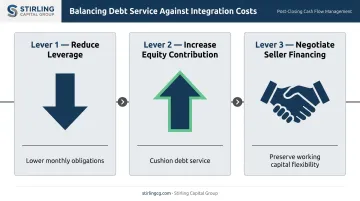
Before committing to a capital structure, model debt service coverage alongside realistic integration costs for the first 18 months. If the numbers are tight, you have three levers:
- Reduce leverage to lower monthly obligations
- Increase equity contribution to cushion debt service
- Negotiate seller financing to preserve working capital flexibility
Conclusion
No single M&A financing method is universally superior. The optimal structure balances cost of capital, ownership control, seller expectations, and the buyer's capacity to service debt while running the business post-acquisition.
One of the most common mistakes buyers make is approaching only one bank or financing source — which limits visibility into the full range of structures available, particularly for deals that don't fit standard bank underwriting criteria.
Stirling Capital Group works with middle-market buyers to map the right capital structure across institutional lenders, private credit funds, SBA lenders, and specialty finance sources — matching the deal to the right financing rather than forcing it into a single credit box.
If you're evaluating an acquisition and want to understand your options before the process gets competitive, reach out for a free consultation at stirlingcg.com or call 614-470-4716.
Frequently Asked Questions
What are the financing options in mergers and acquisitions?
The main categories are cash, debt (bank loans and SBA loans), equity financing, seller financing, mezzanine instruments, and leveraged buyouts. Most transactions use a combination — single-source deals are rare, particularly in the middle market.
What are the four types of M&A?
The four deal types are horizontal (same industry), vertical (supply chain integration), conglomerate (unrelated industries), and market-extension (same product, new geography). These classify the strategic rationale behind a deal, not how it's financed.
What is the most common way to finance an M&A deal?
Most acquisitions use a combination of debt and equity. All-cash deals are possible for well-capitalized buyers, but hybrid structures — layering senior debt, equity contributions, and sometimes seller notes — are far more common across small and mid-market transactions.
What is mezzanine financing in M&A?
Mezzanine financing is subordinated debt sitting between senior debt and equity in the capital stack, typically carrying equity conversion features like warrants. It fills the gap when senior debt falls short — more expensive than senior debt, but less dilutive than pure equity.
How does the financing structure affect post-merger integration?
Heavy debt loads can drain the cash available for integration activities — systems upgrades, talent retention, and customer transition costs. Model debt service against integration budgets before finalizing the capital structure — otherwise, a cash shortfall in year one post-closing can derail the entire deal thesis.
Can a buyer use multiple M&A financing methods in one transaction?
Yes — blended structures combining senior debt, seller notes, equity, and mezzanine are standard in middle-market deals. Layering sources optimizes cost of capital and aligns the structure with both buyer capacity and seller preferences.