Introduction
GP-led secondaries now account for $115 billion — 48% of the $240 billion total secondary market in 2025, according to Jefferies. That's roughly half of all secondary activity, measured in annual transaction volume exceeding $100 billion.
What was once a niche restructuring tool for struggling funds has become a mainstream portfolio management strategy. Nearly 80% of top 100 sponsors by AUM had completed a continuation vehicle transaction as of 2025, according to Jefferies. That adoption rate reflects a structural shift: continuation vehicles are no longer a last resort — they're a deliberate tool for managing high-performing assets beyond the standard fund lifecycle.
Understanding how these vehicles are structured, priced, and governed matters whether you're a GP managing the transaction, an LP weighing a liquidity option, or a secondary buyer evaluating entry. The sections below break down each dimension in practical terms.
Key Takeaways
- GP-led continuation vehicles surpassed $100 billion in annual volume, representing 48–50% of total secondary market activity
- Two primary structures exist: single-asset CVs (one trophy company) and multi-asset CVs (bundled portfolio assets)
- CV growth is structural, not cyclical — volume held strong even during the robust 2019–2021 exit environment
- The GP's dual role as both seller and buyer is the central governance risk; independent valuation and carry rollover are the primary mitigants
- Relationship capital as an existing LP or trusted partner consistently matters more than lead investor status for securing allocations
What Are GP-Led Continuation Vehicles?
A continuation vehicle (CV) is a new investment vehicle created by a fund's general partner to acquire one or more assets from an existing fund, transferring those assets into a new legal entity with a fresh lifecycle. This is distinct from an LP interest secondary, where a limited partner sells their stake in a fund to a third-party buyer — in a GP-led transaction, the GP initiates the process and remains in control throughout.
Two motivations drive these transactions:
- GPs want to retain high-conviction assets that haven't reached their full value creation potential, rather than selling prematurely in an unfavorable exit environment
- Existing LPs receive the option to either sell their interest for cash or roll into the new vehicle and continue participating in future upside
Single-Asset vs. Multi-Asset Continuation Vehicles
GP-led CVs come in two primary structures, each with distinct pricing dynamics and buyer requirements.
Single-asset continuation vehicles (SACVs) focus on one "crown jewel" portfolio company, often structured as a special purpose vehicle. These are increasingly viewed as a direct alternative to a traditional M&A sale. Hamilton Lane reports that while the GP-led secondary market grew at a 26% CAGR since 2019, single-asset CVs grew at approximately 48% CAGR — nearly double the pace of the broader market. In 2025, SACVs represented 55% of GP-led volume at $60 billion, per William Blair.
Multi-asset continuation vehicles (MACVs) bundle several remaining portfolio companies, typically used to facilitate liquidity across a fund's remaining assets or in wind-down scenarios. They trade at steeper discounts to NAV, and buyers need portfolio-level analysis skills rather than single-company underwriting expertise.
Pricing data illustrates the difference clearly:
| Structure | % of Deals Above 90% of NAV | % at or Above Par |
|---|---|---|
| Single-asset CVs | 87% (Lazard 2025) | ~47% (William Blair) |
| Multi-asset CVs | 84% (Lazard 2025) | ~31% (William Blair) |
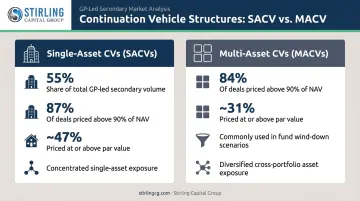
These pricing differences directly affect the LP election process that runs alongside every CV launch. When a CV closes, existing LPs receive a formal election package offering them the choice to sell for cash (improving the fund's DPI metric) or roll their interest forward. ILPA recommends LPs receive at least 30 calendar days or 20 business days to make this decision — compressed timelines remain a persistent LP concern.
Why CVs Have Become a Permanent Feature of Private Equity
The Liquidity Backdrop
Global buyout distributions as a percentage of NAV fell from an average of 29% in 2014–2017 to approximately 11% today, according to Bain. That collapse in distributions pushed LPs to scrutinize DPI as a performance metric and pushed GPs to engineer alternative liquidity solutions rather than waiting for traditional exits to materialize.
Supply-Side Tailwinds for GPs
Beyond addressing LP liquidity pressure, GPs benefit economically from CVs in multiple ways:
- Carry retention: Retaining a trophy asset means capturing reinvested carry and future upside rather than transferring it to an acquirer
- Capital deployment: CVs enable GPs to deploy additional capital into buy-and-build strategies within the existing asset
- LP relationship deepening: William Blair reports that 49% of U.S. investors who participated in a continuation fund went on to commit primary capital to the sponsor's next flagship fund — making CVs a meaningful relationship tool
The Demand Side Has Expanded
The buyer universe now includes traditional secondary funds, direct private equity firms with dedicated GP-led strategies, evergreen vehicles, and direct LP investors. Evercore reported secondary dry powder of $216 billion at year-end 2024 with a capital overhang multiple of approximately 1.7x for GP-led transactions, illustrating meaningful demand relative to available deal flow.
Structural, Not Cyclical
A common assumption ties CV growth to weak exit markets. The volume data tells a different story. Evercore's historical GP-led figures show steady expansion through a strong M&A environment: $26B (2019) → $32B (2020) → $68B (2021).
Volume dipped to $48B in 2022, then recovered to $71B in 2024 before crossing $100B in 2025. Growth held across both strong and soft exit conditions — which means GPs aren't turning to CVs as a fallback. They've integrated them as a standard portfolio management tool.
How a GP-Led Continuation Vehicle Transaction Works
The typical transaction follows a defined sequence:
- Asset identification — GP identifies one or more assets nearing fund life-end with remaining upside potential
- Vehicle formation — A new continuation vehicle is legally formed as the acquiring entity
- Independent valuation — A third-party firm issues a fairness opinion to address the GP's inherent conflict of interest
- Lead investor selection — The GP engages an investment bank to run a process selecting a lead secondary investor who anchors the transaction and sets price
- LP election — Existing LPs receive their election package to sell or roll
- Close and transfer — The lead investor closes with any syndicate co-investors; the asset transfers; selling LPs receive cash proceeds
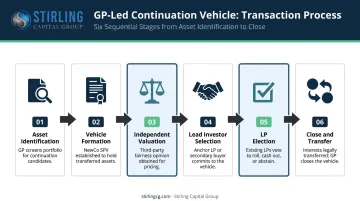
Lazard data shows 88% of CV transactions closed in under five months, with 28% closing within two months. Houlihan Lokey found the median period from reference-date NAV to final term sheet was approximately 4.8 months.
The Role of the Lead Investor vs. Syndicate Members
The lead investor anchors the process, sets price and governance terms, and often receives a guaranteed baseline allocation in oversubscribed deals — along with preferential terms such as a modest fee discount or an LPAC seat. However, the GP — not the lead investor — ultimately controls which investors receive allocations. In practice, established GP relationships and existing LP status are often equally — or more — important than lead status when securing allocations in competitive situations.
For syndication by deal size, GCM Grosvenor, citing Evercore data, shows:
- $250M–$500M transactions: average of 7 investors
- $500M–$1B transactions: average of 12 investors
- Over $1B transactions: average of 17 investors
Syndicate investors invest at the same price and on equivalent economic terms as the lead.
Understanding those terms requires real diligence — and the depth of that diligence varies considerably depending on where an investor enters the process.
Due Diligence in CV Transactions
Standard diligence access for both lead and syndicate investors typically includes:
- Quality of earnings reports and financial projections
- Third-party industry analyses
- Management presentations and valuation reports
- Direct access to the sponsor and portfolio company management
Existing LPs in the underlying fund carry a meaningful advantage here — years of asset monitoring provide diligence depth that new investors must build from scratch within a compressed timeline.
Key Economics, Pricing, and Governance Terms
Key Economics, Pricing, and Governance Terms
Standard Economic Terms
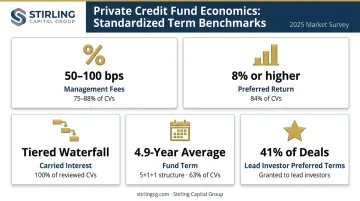
Across the CV market, economic terms have largely standardized — here's what the data shows:
- Management fees: Sub-1% is the norm. William Blair found 75% of CVs carry fees of 50–100 bps; Houlihan Lokey put that figure at 88.1%
- Preferred return: GCM cites data showing 84% of CVs have preferred return hurdles of 8% or higher
- Carried interest: Every CV in Houlihan Lokey's review used a tiered carry waterfall structure — no flat-carry outliers
- Fund term: Houlihan Lokey reports an average base term of 4.9 years, with 63% using a 5-year base plus two 1-year extensions
- Lead investor preferred terms: Granted in 41% of deals, per William Blair 2026
GP Co-Investment
In approximately 37–50% of CV transactions (William Blair and GCM cite different figures), the GP commits capital from its current active flagship fund alongside the continuation vehicle. Hamilton Lane reports the average GP commitment runs approximately 9% of total commitments over the last three years. That's a strong alignment signal. It does, however, reduce available secondary buyer capacity in smaller transactions.
That GP skin-in-the-game context matters directly when evaluating pricing — because the GP's economic incentives shape how transfer prices are set.
Pricing Dynamics
CVs are not priced like competitive auctions. The GP has no incentive to maximize transfer price because doing so would disadvantage rolling LPs. Houlihan Lokey reports median CV pricing improved from 92.5% of reference-date NAV in 2023 to 93.6% in 2024, with approximately 40% priced at or above par. Single-asset CVs consistently price closer to NAV than multi-asset vehicles — and valuation conservatism among smaller, middle-market GPs creates additional opportunity for buyers with strong underwriting capabilities.
Navigating Conflicts of Interest and Key Risks
The Core Conflict
The GP operates simultaneously as seller (representing the legacy fund's LPs) and buyer (controlling the new vehicle). Three specific conflict vectors emerge:
- Pricing: The GP controls valuation and benefits from the transfer price
- Carry crystallization: Carry may crystallize at transfer, creating potential misalignment on go-forward economics
- Deferred value creation: GP incentives to delay operational improvements until after the transfer is complete
Industry Best Practices for Conflict Mitigation
ILPA published formal GP-led guidance in 2019 and updated continuation fund-specific guidance in 2023. Key recommendations include:
- Independent third-party valuations and fairness opinions
- LPAC conflict waiver votes, with at least 10 business days for LPAC review
- GP rollover of 100% of crystallized carry into the new vehicle — William Blair reports 88% of transactions involved active GP members rolling 100% of available proceeds
- At least 30 calendar days or 20 business days for LP election decisions
- No increase in fee basis, no decrease in preferred return hurdle, no carry crystallization for rolling LPs
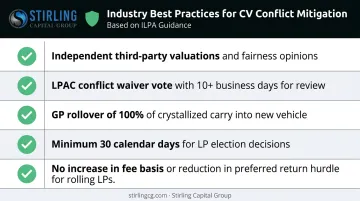
For LPs without dedicated secondary underwriting expertise, these structural protections are especially critical given compressed decision timelines and the complexity of re-underwriting an asset mid-lifecycle.
Fund managers and portfolio companies with capital structure questions tied to GP-led transitions — including NAV loans, capital call facilities, or recapitalization needs — can work with a capital advisory firm like Stirling Capital Group, which provides access to specialized fund financing structures and over 60 private lending sources.
Frequently Asked Questions
What is the difference between a single-asset and multi-asset continuation vehicle?
Single-asset CVs focus on one high-conviction company — typically higher asset quality, pricing closer to NAV, and increasingly viewed as a direct M&A alternative. Multi-asset CVs bundle several remaining portfolio companies, generally priced at steeper discounts, offering more diversification, and often used in fund wind-down scenarios.
How do LPs decide whether to roll over or sell in a continuation vehicle?
LPs weigh their liquidity needs against conviction in the asset's continued upside. The decision is complicated by compressed timelines, the need to re-underwrite the investment from scratch, and the fact that rolling means accepting a new fund lifecycle with potentially extended holding periods of five or more years.
Are continuation vehicles a sign of a struggling fund, or a high-quality opportunity?
Historically, CVs were associated with underperforming funds seeking a reset. Today, the market is dominated by high-quality GPs transferring strong assets — Jefferies reports nearly 80% of top 100 sponsors have completed a CV. What separates a strong CV from a weak one comes down to the underlying asset quality, the sponsor's track record, and how well the alignment terms protect incoming investors.
What fees and carried interest structures are typical in a continuation vehicle?
Management fees typically fall between 50 and 100 basis points, with a preferred return hurdle of 8% or higher and a tiered carried interest structure. GPs are generally expected to roll 100% of crystallized carry (accrued carried interest) from the legacy fund into the new vehicle. Industry data shows 88% compliance with this standard.
How does a GP-led continuation vehicle differ from a traditional LP interest secondary?
In a traditional LP secondary, a limited partner sells their entire fund interest to a third-party buyer, exiting the picture entirely. In a GP-led CV, the GP initiates the transaction, selects specific assets to transfer, and existing LPs choose whether to sell or roll. The GP retains control of the asset throughout the process.
What is the most important factor for secondary investors seeking access to high-quality CV deals?
Relationship capital drives allocation more than anything else. Existing LPs in the selling fund have a structural edge, and sponsors consistently favor investors they view as long-term strategic partners over those offering the highest anchor check. In oversubscribed transactions, GPs allocate to partners they trust, not to whoever simply shows up first.