Key Takeaways
- GP-led secondaries hit $116B in volume in 2025, nearly half of all secondary market activity
- Continuation funds dominate the GP-led market, representing 65% of GP-led deal volume
- Existing LPs receive a binary choice: cash out at approximately NAV or roll into the new vehicle
- Conflicts of interest are inherent; independent valuations and LPAC oversight serve as the primary safeguards
- For secondary buyers, capital timing is a decisive advantage — pre-qualified financing determines who moves first
Introduction
The secondary market for private equity interests has grown from a niche liquidity tool into one of the most active corners of structured finance. According to Lazard's 2025 Secondary Market Report, global secondary transaction volume reached $233B in 2025 — with GP-led transactions accounting for $116B, nearly matching LP-led volume for the first time.
That near-parity with LP-led volume signals a structural change: GP-led secondaries have moved from an occasional workaround for distressed situations into a deliberate portfolio management tool. Understanding how they work is now essential for GPs, LPs, and investors navigating private markets.
This guide covers the key structures, transaction mechanics, benefits, risks, and capital financing considerations that define GP-led secondary transactions, including how they differ from LP-led deals and what makes them particularly complex in structured finance and credit contexts.
What Are GP-Led Secondaries?
A GP-led secondary is a transaction initiated by a fund's General Partner, distinct from the more familiar LP-driven exit. Rather than selling a portfolio company outright, the GP transfers one or more assets into a new vehicle and continues managing those assets under a fresh set of economic terms.
Why GPs Use Them
The fund's remaining life often isn't long enough to capture the full value a GP believes an asset can generate. Forcing a sale into an unfavorable market destroys that value. A GP-led secondary sidesteps that pressure entirely.
Three scenarios drive most transactions:
- GP conviction — the manager believes more value remains and wants additional time and capital to realize it
- LP liquidity demand — existing investors need distributions, but the GP doesn't want to sell prematurely
- Valuation timing — secondary market pricing makes a continuation vehicle more attractive than an outright sale at current marks
The LP Election Mechanism
At the heart of every GP-led deal is a binary choice for existing LPs:
- Sell — receive cash liquidity at or near the asset's current NAV
- Roll — maintain exposure by transferring their interest into the new vehicle alongside incoming secondary buyers
William Blair's 2024 Secondary Market Report found that nearly two-thirds of continuation fund transactions had more than 75% LP selling volume in 2023 — meaning most existing LPs take the liquidity rather than rolling over.
GP-Led vs. LP-Led Secondaries: Key Differences
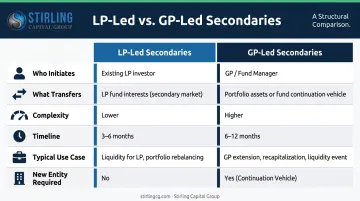
LP-led secondaries are investor-initiated: an existing LP sells their fund stake to a new buyer. The fund structure doesn't change, assets don't move, and the GP isn't centrally involved in negotiating the transfer. Operationally, these are comparatively straightforward.
GP-led secondaries are structurally distinct. The GP drives the process, new legal entities are formed, and every material term — management fees, carried interest, governance rights — gets renegotiated with incoming buyers.
Side-by-Side Comparison
| Dimension | LP-Led | GP-Led |
|---|---|---|
| Who initiates | Existing LP | General Partner |
| What transfers | LP's fund stake | Portfolio assets into new vehicle |
| Complexity | Lower | Significantly higher |
| Timeline | Weeks to months | Several months to nine months+ |
| Typical use case | LP portfolio rebalancing | GP value extension, LP liquidity |
| New entity required | No | Yes |
GP Stakes vs. GP-Led Secondaries
These two terms are frequently confused and shouldn't be. The distinction comes down to what's actually being acquired:
- GP stakes transaction: An outside investor buys an ownership interest in the management company itself — a stake in the GP entity, not the underlying assets.
- GP-led secondary: Portfolio assets are transferred into a new vehicle, with the GP structuring the transaction and renegotiating terms with incoming buyers.
These are different instruments with different purposes and different counterparties.
Common Structures in GP-Led Secondary Transactions
Continuation Funds
Continuation funds are the dominant GP-led structure. Houlihan Lokey's 2024 Continuation Fund Study found that single-asset continuation funds represented 65% of GP-led volume in 2023, with multi-asset funds adding another 8%.
The mechanics: the GP creates a new SPV that acquires one or more high-conviction assets from the original fund. Secondary buyers commit capital to the new vehicle, and the GP continues managing the assets under freshly negotiated terms.
What gets selected for continuation funds:
- Top-performing holdings with significant remaining upside
- Assets that need more capital or time than the fund's remaining life allows
- Companies where a forced sale would undervalue the GP's work
These are not underperforming assets being quietly offloaded. The median portfolio company had been held approximately 4 years at the time of transfer, according to Houlihan Lokey — mature enough to underwrite, but with runway remaining.
Secondary buyers negotiate new management fees, carried interest, and governance protections at closing. This alignment reset is a critical structural safeguard — one that distinguishes continuation funds from simple asset rollovers.
Tender Offers and Strip Sales
Not every GP-led deal requires forming a new vehicle:
- Tender offers — A secondary buyer offers to purchase LP interests at a set price, without moving assets out of the original fund. Useful when only some LPs need liquidity and the fund structure should remain intact.
- Strip sales — The GP sells a proportional slice of every asset in the portfolio rather than cherry-picking individual holdings. Buyers get diversified exposure; GPs avoid adverse selection accusations.
Structured Finance and Credit-Specific Applications
GP-led mechanics have expanded well beyond traditional buyout funds. Credit fund managers — running direct lending books, CLO equity, or ABS portfolios — increasingly use continuation vehicles when traditional exit routes aren't available or when performing credit assets have more yield to generate.
The Coller Capital / Ares transaction announced in early 2025 illustrates the trend: a $1.6B continuation vehicle for Ares U.S. Direct Lending's 2018-vintage fund. Jefferies reported that credit GP-led secondaries more than tripled in volume over the prior year.
That growth comes with added analytical demands. Credit-focused continuation funds are considerably more complex than their PE equivalents — buyers must assess:
- Underlying loan quality and covenant compliance
- Cash flow stability and interest coverage
- Collateral characteristics and recovery assumptions
- Regulatory considerations specific to credit structures
How a GP-Led Secondary Transaction Works: Step-by-Step
Step 1: Strategic Decision and LP Consultation
The process begins with the GP identifying an asset or portfolio worth continuing. Before going further, the GP must consult existing LPs — the fund's Limited Partnership Agreement (LPA) typically governs whether LP Advisory Committee (LPAC) approval is required and what transfer restrictions apply. Skipping this step exposes the GP to legal liability and reputational damage with the broader LP community.
Step 2: Valuation and Deal Structuring
The GP commissions an independent valuation establishing a Net Asset Value baseline. This anchors negotiations. Unlike LP-led deals — which often trade at a discount to NAV — GP-led transactions typically price near or at NAV. Lazard reported that 2024 GP-led pricing averaged 97% of NAV.
The GP controls the process and has informational advantages, making independent valuations the primary safeguard against pricing disputes and LP conflict claims.
Step 3: Secondary Buyer Engagement and Due Diligence
The GP (often with a placement agent) runs a structured process to identify buyers. Several competing dynamics play out simultaneously at this stage:
- Buyers conduct deep diligence on assets, GP track record, and proposed terms
- Adverse selection risk must be assessed — are these actually the best assets, or assets the GP couldn't sell elsewhere?
- The GP sits on both sides of the deal: seller and continuing manager
ILPA's 2023 guidance recommends independent LP representation, LPAC approval, and third-party fairness opinions as standard conflict mitigants. Without these safeguards, LP elections in Step 4 become harder to defend as genuinely informed decisions.
Step 4: LP Election, Closing, and Administration
Existing LPs formally elect to sell or roll. ILPA recommends a minimum election window of 30 calendar days or 20 business days. After elections close:
- The new vehicle is funded and legally formed
- Assets transfer from the original fund to the new SPV
- Partnership registers are updated
- New LPs are onboarded with KYC/AML compliance
- Relevant fund documents are amended
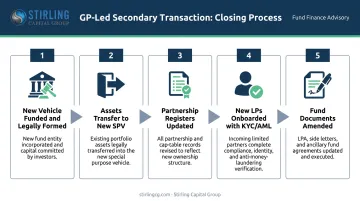
From initial LP consultation to final close, the entire process typically takes several months to nine months or longer, depending on deal complexity.
Benefits, Risks, and Conflicts of Interest
Benefits by Stakeholder
For GPs:
- Extend ownership of high-conviction assets beyond the original fund's term
- Avoid forced sales at unfavorable prices
- Crystallize carried interest and reset economic alignment with new investors
For LPs:
- Optionality — take liquidity now or stay invested in a known, de-risked asset
- Lower blind-pool risk than a new primary commitment
- 57% of LPs in 2024 expected to use the secondary market for liquidity, reflecting persistent demand for this flexibility
For secondary buyers:
- Reduced J-curve effect by stepping into mature assets
- Known company with historical performance data to underwrite
- Attractive entry points relative to long-term growth potential
Key Risks and Conflicts to Watch
Those benefits come with real trade-offs. Three structural risks define most GP-led deals.
Conflict of interest is the central risk. The GP controls the process, selects the assets, negotiates terms, and continues managing post-close. Standard mitigants include:
- Independent third-party valuation
- LPAC oversight and formal approval
- Arm's-length buyer process
- Fairness opinion from an independent adviser
Information asymmetry compounds this. The GP has owned the asset for years; secondary buyers work from disclosed materials and diligence access — always a thinner data set. Experienced buyers close this gap through intensive management interviews, site visits, and protective purchase agreement provisions.
Valuation and exit risk is the final concern. If the growth thesis fails or conditions deteriorate post-close, secondary buyers hold an illiquid position with limited alternatives. Unlike public markets, there is no ready venue to exit a secondary market interest before the continuation vehicle resolves.
Financing and Capital Access in GP-Led Secondaries
GP-led transactions often require capital solutions that fall well outside conventional bank lending parameters. A continuation fund may need bridge financing to provide interim LP liquidity before the new vehicle closes, NAV-based facilities secured against portfolio value, or equity co-investment capital to properly capitalize the structure.
Common capital types in GP-led transactions:
- NAV lending: credit facilities secured against the portfolio's net asset value
- Subscription line facilities: short-term facilities secured by unfunded LP commitments
- Continuation fund equity: committed capital from secondary buyers entering the new vehicle
- Hybrid structures: combining NAV and subscription-line collateral for blended advance rates
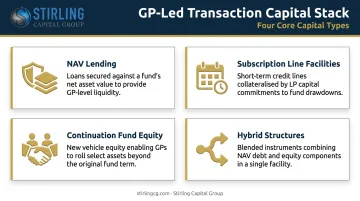
No single lender covers all of these needs within a given transaction. The capital stack for a continuation fund often requires coordinating across multiple specialized providers — each with distinct underwriting criteria, collateral requirements, and advance rates.
For GPs and investors navigating this complexity, working with a capital advisor that spans both debt and equity sources can compress timelines and reduce execution risk. Stirling Capital Group maintains a network of over 60 private lending sources and operates a Fund Financing vertical built for investment funds and fund managers.
Their consultative model — including pre-qualification and pre-underwriting capabilities — is designed for the time-sensitive execution that GP-led transactions demand.
For secondary buyers specifically, capital certainty is a competitive advantage. When the GP controls the timeline and process, buyers who arrive with pre-qualified financing can move decisively. Those still arranging capital when the election window closes miss the deal entirely.
Frequently Asked Questions
What is a GP-led secondaries fund?
A GP-led secondaries fund — often called a continuation fund — is a new investment vehicle created by a General Partner to acquire one or more assets from an existing fund. Existing LPs can cash out or roll their interest into the new vehicle alongside incoming secondary investors, while the same GP continues managing the assets.
What is the difference between GP-led and LP-led secondaries?
LP-led secondaries are initiated by an existing investor selling their fund stake to a new buyer, with no change to fund structure or asset ownership. GP-led secondaries are initiated by the fund manager to transfer specific assets into a new vehicle — a more complex process involving new legal entities, renegotiated economics, and active GP involvement throughout.
Are GP stakes the same as secondaries?
No. GP stakes involve an outside investor buying an ownership interest in the GP's management company itself. GP-led secondaries involve transferring portfolio assets into a new continuation vehicle. The two are unrelated — one is a transaction in fund assets, the other is a transaction in the firm managing them.
Are GP-led secondaries compatible with evergreen funds?
Compatibility depends on the fund's governing documents. Evergreen funds already include built-in liquidity mechanisms and have no fixed term, so GP-led continuation vehicles are less common in these structures. They can still occur when the GP wants to reset economics or recapitalize a specific asset.
What are the main risks for investors in GP-led secondary transactions?
The primary risks include:
- Conflicts of interest — the GP controls both sides of the transaction
- Adverse selection — buyers have less information than the GP about asset quality
- Illiquidity — the resulting position offers limited exit options
- Valuation risk — the asset's growth thesis may not materialize after closing
How long does a GP-led secondary transaction typically take?
From initial LP consultation through secondary buyer diligence, LP election, and legal closing, the process typically takes several months to nine months or longer. Timeline varies based on the number of assets involved and overall transaction complexity.