
Introduction
Most ownership transitions don't fail because of a bad business — they fail because of a bad capital structure. Whether a founder is retiring, a partner is buying in, or a management team is stepping up to take control, how the deal is financed often determines whether it closes at all.
According to McKinsey, roughly 6 million U.S. small and midsize businesses will face ownership transitions by 2035 — representing approximately $5 trillion in enterprise value. Yet the Exit Planning Institute reports that historically only 20–30% of businesses that go to market result in a successful sale. Financing mismatches are a primary reason deals stall or collapse entirely.
That gap is largely a financing problem — and it's solvable. This guide covers the full spectrum of ownership transition financing: seller carry-back notes, SBA loans, private credit, equity-based structures, and more. It also explains how lenders evaluate these deals and how to match the right capital structure to your specific transaction.
Key Takeaways
- Lenders evaluate both the incoming owner's creditworthiness and the business's standalone post-transition cash flow
- Most successful transitions blend multiple financing sources: seller notes, bank debt, and buyer equity
- The 5 C's of financing apply to both the buyer and the business being acquired
- When banks decline, private and non-bank lenders often accept deals that fall outside conventional credit criteria
- Starting lender conversations before deal terms are set gives buyers and sellers the most flexibility
What Makes Ownership Transition Financing Unique
Standard commercial loans underwrite a borrower's ability to repay. Ownership transition financing requires something more: lenders must underwrite an entire change in control.
That means evaluating:
- The incoming owner's creditworthiness, industry experience, and management capability
- The departing owner's terms, retained obligations, and any ongoing seller involvement
- The business's ability to maintain performance without the original owner
This multi-party dynamic creates added complexity. Buyers, sellers, lenders, and advisors must align on valuation, deal structure, and repayment timing — and that alignment is harder to achieve than in a standard loan. When any element falls out of sync, transactions stall. That's why understanding where deals break down is as important as understanding how they're funded.
Why Deals Fail Despite a Sound Business
A good business does not guarantee a fundable deal. Common financing failure points include:
- Loan terms misaligned with the business's cash flow cycle
- Collateral that doesn't meet conventional bank thresholds
- Buyer's personal capital or creditworthiness falling short of lender requirements
- Deal timelines that bank approval processes can't accommodate
Engaging lenders early — before a deal is fully structured — gives buyers and sellers time to identify these gaps and adjust terms before they become deal-killers.
Financing Options for Ownership Transition
Internal Financing Methods
Seller financing (also called a seller carry-back note) is often the most accessible starting point. Rather than receiving the full purchase price at closing, the departing owner accepts payments over time, effectively acting as the lender. BizBuySell reports that sellers typically finance a third or more of the total sale price, with terms generally running 5–7 years at 8–10% interest.
Seller financing is particularly useful when:
- The buyer has limited capital for a large down payment
- The business is difficult to appraise using standard methods
- The seller wants to signal confidence in the business's future performance
Deferred compensation and retained earnings serve as supplementary internal tools. Deferred compensation spreads payouts to the seller over time, often tied to a transitional advisory role. Retained earnings can fund a partial buyout or serve as a buyer's equity contribution — though drawing down working capital reserves carries real operational risk.
Internal methods preserve buyer control and reduce deal complexity, but they require longer repayment horizons and keep buyer and seller financially linked well after closing.
Traditional Bank Loans and SBA-Backed Financing
Commercial banks offer term loans and asset-backed loans for business acquisitions. Underwriting centers on the business's historical EBITDA, cash flow stability, collateral value, and the buyer's personal creditworthiness. According to Pepperdine's 2025 Private Capital Markets Report, bank lenders typically require a minimum senior debt service coverage ratio (DSCR) of 1.35x and a total DSCR of 1.25x for acquisition financing.
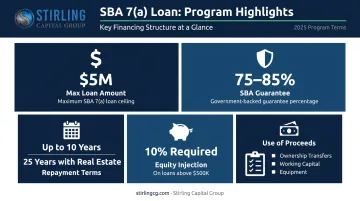
SBA 7(a) loans are specifically designed for business acquisitions and ownership changes. Key features:
- Maximum loan amount of $5 million
- SBA guarantees 75–85% of the loan, reducing lender risk
- Repayment terms up to 10 years (25 years if real estate is involved)
- For loans above $500,000, complete ownership changes require a 10% equity injection
- Proceeds can fund partial or complete ownership transfers, working capital, and equipment
SBA 504 loans serve a narrower purpose — fixed asset acquisition (real estate, major equipment) — and cannot fund working capital or the business purchase price directly. They work best when the transition involves significant real property.
The tradeoff: both SBA and bank financing involve rigid documentation requirements and approval timelines of 60–90 days, which can create friction in competitive or time-sensitive deals.
Private and Non-Bank Lenders
That friction is exactly where private credit fills the gap. Global private credit reached nearly $2 trillion by end of 2023 and is forecast to reach $2.8 trillion by 2028, according to Preqin — driven largely by middle-market firms that can't meet bank requirements or need faster execution.
Private and non-bank lenders evaluate deals differently:
- Cash flow and asset value take precedence over rigid credit-box criteria
- Deal structure and collateral can substitute for perfect EBITDA history
- Borrowers who've been declined by banks often qualify here
Common private lending structures for ownership transitions include:
| Structure | Best Used For |
|---|---|
| Bridge loans | Time-sensitive closings while permanent financing is arranged |
| Mezzanine financing | Filling the capital gap between senior debt and equity |
| Asset-backed lending | Transitions supported by strong receivables, inventory, or equipment |
Mezzanine financing deserves specific attention. It sits between senior debt and pure equity in the capital stack, functioning as subordinate debt repaid as a lump sum after a few years rather than via monthly principal payments.
It costs more than senior debt but is less dilutive than equity — the right tool when a buyer needs capital beyond what a bank will provide but wants to retain ownership.
Firms like Stirling Capital Group, which maintains a portfolio of over sixty private lending sources authorized to pre-qualify, pre-underwrite, and originate loans across multiple categories, give buyers and sellers access to these non-bank structures without having to approach each lender independently.
Equity-Based Options: Private Equity, ESOPs, and Management Buyouts
Private equity recapitalization involves selling a majority or minority stake to a PE firm, which provides liquidity to the seller and operational resources to the business. According to Bain's Global Private Equity Report 2026, buyout holding periods now average around seven years. PE suits sellers who are comfortable with a defined exit timeline and formal governance — full operational control transfers to the new structure.
Employee Stock Ownership Plans (ESOPs) allow employees to gradually acquire ownership through a tax-advantaged structure. Key considerations:
- Sellers who qualify may defer capital gains under Section 1042 (requires the ESOP to own at least 30% of shares post-sale)
- ESOPs carry ongoing ERISA compliance requirements and repurchase obligations
- They work best when the business has strong, stable cash flow and an engaged employee base
The NCEO reports there are currently 6,609 ESOP plans in the U.S., covering more than 15 million participants — evidence of their viability as a succession vehicle across many industries.
Management Buyouts (MBOs) allow the existing leadership team to purchase the business. Operational continuity is the primary advantage — the new owners already know the business. The challenge is financing: management teams rarely have sufficient personal capital. MBOs almost always require a blended structure combining seller financing, bank debt, and sometimes private equity participation to close the gap.
Internal vs. External Financing: Trade-offs to Understand
Choosing between internal and external financing involves real trade-offs, not just a search for the lowest interest rate.
Internal financing (seller notes, retained earnings):
- Preserves buyer control, reduces lender scrutiny
- Signals seller confidence in the business's future
- Creates ongoing financial ties between buyer and seller
- Limits the seller's immediate liquidity
External financing (bank loans, SBA, private lenders, PE):
- Provides larger capital pools and cleaner seller exits
- Introduces covenants, collateral requirements, and approval timelines
- Equity financing means diluted control for the incoming owner
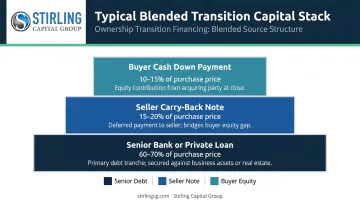
Most real-world transitions use a blended approach. A typical structure looks like this:
- Senior bank or private loan: 60–70% of the purchase price
- Seller carry-back note: 15–20%
- Buyer cash down payment: 10–15%
This distribution spreads risk across multiple parties — making the deal workable for everyone involved.
How to Choose the Right Financing for Your Ownership Transition
There is no universal answer — the right structure depends on four variables:
1. The seller's exit timeline and liquidity needs Sellers who need full liquidity at closing point toward external financing or a strategic buyer. Those open to a phased exit can layer in a carry-back note, which reduces the external capital required and often improves deal terms for both sides.
2. The business's cash flow stability Predictable EBITDA opens the door to more debt and better bank or SBA terms. Cyclical or project-based revenue calls for more flexible structures — seller financing or mezzanine debt — that can accommodate variable repayment capacity.
3. The buyer's capital and creditworthiness Credit score, available down payment, and personal guarantee ability determine which lenders are in play. Buyers with limited collateral or credit history often find SBA-backed or private lender options more accessible than conventional bank financing.
4. Deal size and complexity Smaller transitions — a professional practice, a partnership buy-in — typically work well with seller financing plus a bank loan. Larger middle-market deals with multiple stakeholders often require a full capital stack: senior debt, mezzanine, and equity.
Bringing in a commercial finance specialist before deal terms are finalized lets buyers and sellers design the capital structure alongside negotiations — not after. Stirling Capital Group offers free consultations and can evaluate multiple lenders across its network simultaneously, matching the right financing structure to each deal's specific variables.
What Lenders Evaluate: The 5 C's of Financing
Every lender — bank or private — applies some version of the 5 C's when reviewing a transition financing request.
| C | What Lenders Assess |
|---|---|
| Character | Borrower's credit history, reputation, and demonstrated willingness to repay |
| Capacity | Cash flow's ability to service the debt — in transition deals, this is typically the business's standalone EBITDA |
| Capital | The buyer's own financial contribution — down payment, equity injection, personal net worth |
| Collateral | Assets securing the loan as a secondary repayment source |
| Conditions | Loan purpose, industry dynamics, and the broader economic environment |
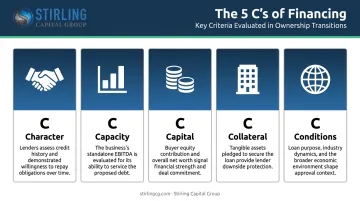
In ownership transitions, Capacity is typically evaluated based on the business's post-transition EBITDA — not the incoming owner's personal income. This distinction matters: lenders want to see that the business can service the debt on its own, independent of who is running it.
Knowing how lenders weight these factors, buyers and sellers can target the right preparation steps:
- Document maintainable cash flow with clean financials and add-back schedules
- Identify collateral-rich assets that can serve as a secondary repayment source
- Secure a personal guarantee to offset a thinner credit profile or limited operating history
Frequently Asked Questions
What financing options are available for ownership transition?
The primary options are seller financing, traditional bank loans, SBA 7(a) and 504 loans, private and non-bank lenders, mezzanine financing, private equity recapitalization, ESOPs, and management buyouts. Most successful transitions draw from more than one of these sources rather than relying on a single facility.
What is transitional financing and how does it work?
Transitional financing is the funding arrangement put in place to transfer business ownership from one party to another. It can use debt, equity, or hybrid instruments — and lenders underwrite it based on the deal structure and the business's post-transition cash flow capacity.
What are the 5 C's of financing?
The 5 C's are Character, Capacity, Capital, Collateral, and Conditions. In ownership transitions, lenders apply these criteria to both the incoming owner and the business being acquired — with particular weight placed on the business's standalone EBITDA.
Can I use SBA loans for a business ownership transition?
Yes. SBA 7(a) loans are one of the most common vehicles for business acquisitions, offering longer repayment terms and lower down payment requirements than conventional bank loans. These loans are issued through SBA-approved lenders, not directly from the SBA.
What happens when a bank declines financing for a business transition?
A bank decline does not end the process. Private lenders, specialty finance companies, and mezzanine providers regularly fund deals that fall outside conventional credit criteria — often structured around collateral or deal terms rather than EBITDA.
How long does financing for a business transition typically take?
Timelines vary by financing type: SBA loans typically take 60–90 days from application to funding, conventional bank loans average around 60 days, and private lenders can often move faster. Starting lender discussions before deal terms are finalized is the most reliable way to avoid delays at closing.