
ABS has quietly become a foundational piece of modern finance. It unlocks liquidity for lenders, diversifies funding sources for businesses, and gives investors a way to earn yield outside traditional corporate bonds. U.S. ABS issuance hit $388.1 billion in 2024, up 43.3% from the year before, according to SIFMA's Capital Markets Fact Book.
This article breaks down what ABS actually is, why it matters, the main types you'll encounter, and how to think about choosing the right structure whether you're investing or seeking financing.
Key Takeaways
- ABS securities are backed by pooled loans and receivables, not company balance sheets
- Securitization turns illiquid assets into tradeable securities via an SPV
- Three broad categories exist: Consumer ABS, Commercial/Esoteric ABS, and CDOs/CLOs
- The right ABS type depends on asset quality, risk appetite, and liquidity needs
What Is an Asset-Backed Security (ABS)?
An ABS is a bond-like instrument. But instead of relying on a single borrower's promise to pay, its returns come from a pool of contractual cash flows—think loans, leases, or receivables bundled together.
Here's how the mechanics work:
- An originator (a bank, auto lender, or finance company) makes loans or leases to customers
- The originator sells those assets to a Special Purpose Vehicle (SPV), a legal entity created solely to hold the collateral
- The SPV issues securities backed exclusively by the cash flows from those assets
- Investors receive payments as borrowers repay their loans, according to a set priority (the "waterfall")
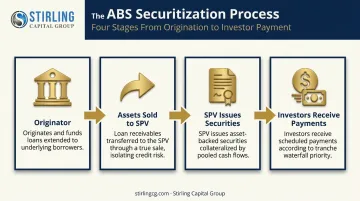
This structure isolates investors from the originator's own bankruptcy risk. If the original lender collapses, the SPV's assets remain untouched because of a legal "true sale."
ABS vs. MBS: What's the Difference?
Technically, mortgage-backed securities (MBS) are a form of ABS. They're backed by mortgages, which are just another type of income-generating asset. But the market treats them separately.
SIFMA (the Securities Industry and Financial Markets Association) and most industry data track ABS and MBS as distinct categories. SEC Regulation AB defines ABS broadly enough to include mortgage pools, but in everyday market conversation, "ABS" typically refers to non-mortgage collateral: auto loans, credit cards, equipment leases, and similar assets. MBS gets its own (much larger) category.
Why Does ABS Matter in Finance?
Securitization exists because it solves a real problem: illiquid assets tie up capital. A lender holding thousands of auto loans on its books can't easily use that value to make new loans. ABS changes that.
Research from the New York Fed points out that securitization allows banks to transfer credit risk, tap new funding sources, and economize on the capital they're required to hold. This doesn't guarantee lower costs for every issuer, but it does open doors that wouldn't otherwise exist.
What happens without ABS-style structures?
- Illiquid assets pile up on lender balance sheets
- Lenders originate fewer new loans because capital is locked up
- Growing or credit-constrained companies face fewer financing options
- Businesses become more dependent on traditional bank credit lines
That last point is where things get interesting. The Federal Reserve's Senior Loan Officer Opinion Survey showed banks reported weaker demand and tighter standards across every commercial real estate loan category in the second half of 2023. When banks pull back, businesses need somewhere else to turn.
This is exactly the dynamic that pushes many businesses toward alternative and private capital sources. Stirling Capital Group connects clients with exactly this kind of financing when traditional bank credit is too restrictive, or simply unavailable. With access to a network of over sixty private lending and equity capital sources, the firm helps businesses find structures that fit their specific collateral and cash flow. Options include asset-based lending, receivables financing, or another non-bank solution entirely.
Types of Asset-Backed Securities
ABS is an umbrella term. The specific type depends on the underlying collateral and how the deal gets structured. Recognizing these differences helps investors assess risk and return, and it helps borrowers figure out which financing route actually fits their assets.
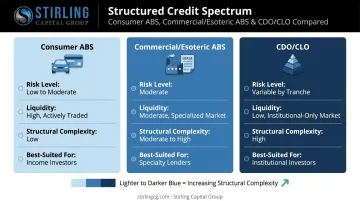
Three broad categories dominate the market: Consumer ABS, Commercial/Esoteric ABS, and CDOs/CLOs. Each serves a different purpose and carries a distinct risk profile.
Consumer ABS (Auto Loans, Credit Cards, Student Loans, Home Equity)
Consumer ABS pools loans made directly to individual borrowers. Payments consist of principal, interest, and sometimes prepayments, depending on the asset type.
What sets consumer ABS apart is scale and granularity. A single deal might pool payments from tens of thousands of individual borrowers, giving investors strong diversification. No single default meaningfully moves the needle.
Who uses it:
- Auto finance companies freeing up balance sheet capacity
- Credit card issuers funding revolving receivables
- Student loan originators managing large loan books
- Income-focused investors seeking predictable cash flow
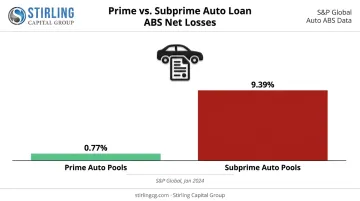
Performance data backs up the diversification story, though it varies sharply by credit tier. S&P Global's January 2024 auto loan tracker found annualized net losses of just 0.77% for prime auto pools, compared to 9.39% for subprime pools. That's a massive gap, and it illustrates why understanding the specific collateral tier matters more than the "consumer ABS" label alone.
Limitations to keep in mind:
- Exposed to consumer credit cycles (subprime pools feel this first)
- Prepayment risk in amortizing pools like auto and home equity loans
- Revolving structures in credit card ABS carry no fixed maturity date
Commercial and Esoteric ABS
This category covers securities backed by business-related contracts: equipment leases, aircraft leases, trade receivables, franchise royalties, or whole-business securitizations.
Unlike consumer ABS, the collateral here ties to commercial cash flows rather than individual borrowers. That means deeper due diligence on niche industries. An aircraft lease deal, for example, requires analysis of engine depreciation, re-leasing risk, and secondary market conditions for the specific aircraft type, not something you'd need for a car loan pool.
Best suited for:
- Specialty finance companies and equipment lessors
- Franchise businesses monetizing royalty income
- Corporate borrowers seeking cheaper financing than unsecured debt
Key strengths: These structures unlock financing for assets that are otherwise hard to collateralize. Many carry protections like cash traps or rapid amortization triggers that kick in if performance weakens.
Limitations: Less standardized, heavier documentation, and thinner secondary market liquidity. FINRA's TRACE data shows auto and credit card ABS trade far more actively than "miscellaneous" categories, which include many esoteric structures.
Collateralized Debt/Loan Obligations (CDO/CLO)
CLOs pool corporate loans, typically leveraged loans made to businesses. CDOs cast a wider net, potentially mixing bonds, loans, and other structured products. Both get issued in multiple risk-based tranches.
The core difference from consumer or commercial ABS: instead of one asset class, CDOs/CLOs pool diverse or lower-rated corporate credit and lean heavily on tranching and subordination to manage risk. Senior tranches get paid first; equity tranches absorb losses first but capture more upside.
Best suited for:
- Institutional investors wanting customizable risk/return exposure
- Corporate lenders (including private equity-backed leveraged loans) distributing credit risk
- Insurance companies and asset managers seeking diversified corporate credit exposure
Key strength: Tranching lets investors select their risk exposure directly. And CLOs have a notably strong track record. S&P Global counted just 77 defaults among 26,298 U.S. CLO tranches, a 0.29% cumulative rate, from the mid-1990s through the study period. Zero originally-rated AAA tranches defaulted.
Limitations: This is the most structurally complex of the three categories, with performance tied directly to correlated defaults across underlying loans.
Mortgage-related and synthetic CDOs, a different beast entirely from today's corporate-loan CLOs, drove much of the damage in the 2008 financial crisis. Don't confuse the two when evaluating risk.
How to Choose the Right Type of ABS
The "right" ABS type depends on your position. Are you an investor evaluating risk and return, or a business exploring asset-based financing? The right choice comes down to fit, not popularity.
Factors to Consider
- Purpose and goals - Investors want income generation; originators and borrowers want capital access
- Asset quality and diversification - Look at the depth, historical performance, and payer diversity of the underlying pool
- Structural protections - Tranching, overcollateralization, and performance triggers all affect risk exposure
- Liquidity needs - Consumer ABS generally trades more actively than niche commercial or CLO tranches
- Complexity and resources - CDO/CLO analysis demands specialized credit expertise; simpler consumer ABS doesn't
What to Check Before Finalizing
Two mistakes come up again and again.
First, don't reach for the most complex structure when something simpler works. A multi-tranche CDO isn't necessary if a straightforward consumer ABS deal, or even a direct asset-based loan, meets the goal.
Second, don't ignore the trade-offs. Prepayment risk in amortizing pools and limited liquidity in esoteric ABS are real constraints, not fine print.
For businesses exploring securitization or asset-based lending as a financing alternative, working with an experienced commercial finance consultant makes the process far less overwhelming.
Stirling Capital Group evaluates options across its network of over sixty private lending and equity capital sources before recommending a structure. The firm matches businesses with the specific lender type suited to their collateral, whether receivables, inventory, equipment, or real estate-backed assets, rather than forcing a one-size-fits-all approach.
Conclusion
ABS anchors modern capital markets by converting illiquid, income-generating assets into securities that trade in public and private markets. That's not a small thing. It's the mechanism that keeps credit flowing when balance sheets would otherwise get stuck.
That flow takes different forms depending on the collateral behind it. Consumer ABS, Commercial/Esoteric ABS, and CDOs/CLOs each exist to serve different collateral types, risk appetites, and financing goals. None is universally "better." The right choice depends entirely on what you're trying to accomplish.
Understanding these distinctions sharpens both investment decisions and financing strategy. If your business holds receivables, inventory, or other assets suited for alternative financing, Stirling Capital Group can help you determine whether asset-based lending, specialty finance, or securitization fits your goals.
Frequently Asked Questions
What is an ABS in finance?
An ABS is a bond-like security backed by a pool of income-generating assets, such as loans, leases, or receivables, rather than a company's general credit. Payments to investors come directly from those underlying cash flows.
Is an ABS a loan?
No. An ABS is a security, not a loan. Pools of underlying loans or receivables create it, and the payments on those loans fund the security's returns to investors.
What is the difference between ABS and MBS?
MBS are backed specifically by mortgage loans, while ABS describes consumer and commercial collateral like auto loans, credit cards, and equipment leases. Technically MBS is a form of ABS, but markets track them separately.
What are the main risks of investing in ABS?
The primary risks are credit risk (borrowers defaulting), prepayment risk (loans paying off early), liquidity risk (varies by product type), and structural complexity, especially in multi-tranche deals like CLOs.
How does the securitization process work?
An originator sells assets to a Special Purpose Vehicle, which issues tranched securities backed by those assets. A servicer collects payments, and a trustee distributes cash flows to investors according to a set priority.
Are asset-backed securities a good investment?
ABS can offer diversification and potentially higher yields than similarly rated corporate bonds. Suitability ultimately depends on your risk tolerance and how well you understand the specific underlying collateral.