
Introduction
Every buyer wants to hold onto cash longer. Stretching payment terms from 30 to 60 or 90 days is one of the easiest ways to do it.
But that same move can leave suppliers waiting on money they've already earned, straining the working capital they need to keep production running.
Reverse factoring resolves that standoff. It's a buyer-led financing arrangement that lets suppliers collect payment early on approved invoices, funded by a bank or fintech rather than the buyer's own cash. You'll also hear it called supply chain finance.
This post breaks down how reverse factoring actually works, who benefits and how, where it differs from similar-sounding financing terms, and what to weigh before pursuing it.
Key Takeaways
- Reverse factoring lets suppliers get paid early on approved invoices, funded by a bank or fintech at the buyer's request
- Pricing is based on the buyer's credit rating, not the supplier's, resulting in cheaper financing
- Unlike traditional invoice factoring, suppliers initiate it using their own credit profile
- Suppliers gain faster cash flow and lower DSO, while buyers extend DPO and cut disruption risk
- Access is largely limited to large, investment-grade buyers and their top-tier suppliers
What Is Reverse Factoring?
Reverse factoring works like this: a financial institution pays a supplier's approved invoice early, at the buyer's request. The buyer then repays the financier the full invoice amount on the invoice's original due date.
The name comes from the direction of the request. In traditional factoring, the supplier reaches out to a factor on its own. In reverse factoring, the buyer sets up the program and invites suppliers in.
You'll see this arrangement referred to under a few different names, including:
- Supply chain finance
- Accounts payable finance
- Buyer-led supply chain financing
- Payables finance (a term favored by trade finance bodies like the Global Supply Chain Finance Forum)
These terms mostly overlap, though "supply chain finance" is sometimes used as a broader umbrella that includes reverse factoring alongside other techniques, such as dynamic discounting.
Why "Approved" Invoices Matter
The financier only pays invoices the buyer has already approved. Approval confirms the goods or services were delivered and the buyer accepts the debt as valid. Without that confirmation, there's nothing for the financier to fund. This approval step is what makes the buyer's credit, not the supplier's, the basis for financing.
The Credit Mechanism and Why It's Cheaper
Because the financier is repaid by the buyer, not the supplier, pricing reflects the buyer's credit rating. A large, investment-grade buyer typically has stronger credit than most of its smaller suppliers. That gap is what makes reverse factoring cheaper for suppliers than financing they could arrange on their own.
The Accounting Wrinkle
Those savings come with a catch: reverse factoring programs need careful accounting structuring. FASB's Accounting Standards Update 2022-04 now requires buyers to disclose program terms, outstanding confirmed obligations, and where those obligations sit on the balance sheet.
The update doesn't change how obligations are classified. It just makes them visible, even when they're folded into accounts payable. Buyers should not assume the arrangement is automatically off-balance-sheet.
How Does Reverse Factoring Work?
A buyer starts by partnering with a bank or fintech financier, then invites select suppliers into the program. From there, the transaction follows a predictable sequence:
- Buyer places a purchase order with a participating supplier.
- Supplier delivers goods or services and submits an invoice.
- Buyer reviews and approves the invoice, confirming the debt is valid.
- Financier notifies the supplier that early payment is now available.
- Supplier requests early payment (optional) and receives funds minus a small discount or fee.
- Buyer repays the financier the full invoice amount on the original due date, not the supplier.
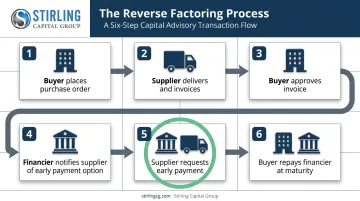
That last step matters. The supplier's relationship with the financier ends once it's paid. The buyer's obligation continues until maturity, just redirected to a new creditor.
Onboarding Has Gotten Easier
Reverse factoring used to be reserved for a buyer's top 20 to 50 vendors because manual onboarding was expensive and slow. Digital platforms have changed that math.
According to Taulia's 2023/24 supplier survey of over 11,000 businesses, 61% took early payment at least some of the time. 25% took it every time it was offered, up from 20% the year before.
Global supply chain finance volume hit $2.462 trillion in 2024, up 8% year over year, per the Citi World Supply Chain Finance Report 2025. Broader supplier participation is a real trend, even if it's not yet universal.
Benefits of Reverse Factoring
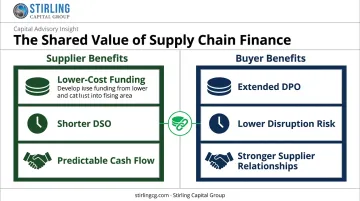
Benefits for Suppliers
Suppliers get more than just faster payment. The program changes their financial position in a few concrete ways:
- Lower-cost funding: Pricing rides on the buyer's stronger credit, often beating what a supplier could secure independently
- Shorter DSO: Early payment frees up working capital for reinvestment, hiring, or R&D instead of sitting in receivables
- Predictable cash flow: Knowing exactly when payment lands improves forecasting accuracy, particularly for suppliers running lean
Benefits for Buyers
Buyers gain leverage on the payables side while keeping suppliers financially healthy:
- Extended DPO: Buyers can lengthen payment terms without pushing suppliers into a cash crunch, since suppliers can get paid early through the financier
- Lower disruption risk: Well-funded suppliers are less likely to miss a production run or delay a shipment because of a cash shortfall
- Stronger supplier relationships: Offering early payment as an option gives buyers negotiating room on price or terms without straining the partnership
These benefits aren't just theoretical. According to Bloomberg Law's 2023 analysis, roughly 80 S&P 500 companies reported a combined $64.1 billion in supply chain finance obligations under new FASB disclosure rules. That's a disclosure count, not a full adoption survey, but it confirms the practice is common among large corporates.
Reverse Factoring vs. Related Financing Terms
These terms get used loosely, which causes confusion. Here's how they actually differ:
| Term | Who initiates | Whose credit sets pricing | Who funds it |
|---|---|---|---|
| Traditional invoice factoring | Supplier | Supplier (risk shifts with recourse terms) | Third-party factor |
| Reverse factoring | Buyer | Buyer | Third-party bank or fintech |
| Dynamic discounting | Buyer | N/A (no third-party financing) | Buyer's own cash |
Supplier financing is the broader umbrella term covering all of these approaches. Reverse factoring is one specific technique within that category, distinguished by third-party funding tied to buyer credit.
Dynamic discounting looks similar on the surface: a buyer still offers early payment, but the difference lies in where the money comes from.
With dynamic discounting, the buyer pays out of its own cash reserves, and the discount typically scales with how early payment happens. No third-party financier is involved, so there's no reliance on an outside balance sheet or lending appetite.
Is Reverse Factoring the Right Fit? Key Considerations
Reverse factoring isn't available to everyone. Programs typically require an investment-grade buyer with the scale to justify setup costs and strategic suppliers worth onboarding.
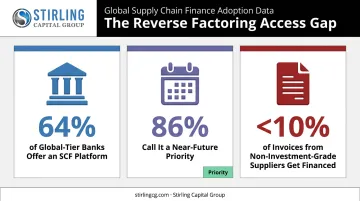
The ICC's 2020 Global Survey found 64% of global-tier banks already offered an SCF platform, and 86% of respondents called it an immediate or near-future priority, according to the ICC Global Survey on Trade Finance 2020. That's strong institutional appetite, but availability still skews toward larger, creditworthy participants.
Risks worth understanding:
- Buyer dependency: If the buyer's credit deteriorates, the financier may pull back or restructure the program, leaving suppliers exposed
- Accounting scrutiny: Poorly structured programs can draw regulatory or investor attention over hidden leverage
- Limited access: Suppliers left out of a program get no benefit and may face longer terms without an early-payment option
McKinsey estimated that less than 10% of invoices from non-investment-grade suppliers get financed through these programs, according to McKinsey's supply chain finance research. That's a meaningful gap for businesses that don't fit the profile these programs are built for.
Maybe you're a buyer without the scale to launch a program. Maybe you're a supplier left off the invite list. Either way, that doesn't mean your working capital options end there.
Stirling Capital Group works with businesses in exactly this position. With a consultative approach and a network of over 60 private lending sources, the firm helps buyers and suppliers find tailored capital solutions. These include working capital, accounts receivable financing, and debt or equity options when traditional supply chain finance isn't on the table.
Frequently Asked Questions
What is reverse factoring in supply chain finance?
Reverse factoring is a buyer-initiated program where a bank or fintech pays a supplier's approved invoices early. The buyer then repays the financier in full on the invoice's original due date, with pricing based on the buyer's creditworthiness.
What is the difference between supplier financing and reverse factoring?
Supplier financing is the umbrella term for all early-payment techniques, including reverse factoring, factoring, and dynamic discounting. Reverse factoring specifically refers to the buyer-led, third-party-funded version of this financing.
How does reverse factoring differ from traditional invoice factoring?
The supplier initiates traditional factoring, with pricing based on the supplier's credit profile. The buyer initiates reverse factoring instead, with pricing based on the buyer's stronger credit, which usually results in lower financing costs for the supplier.
Is reverse factoring considered debt on the balance sheet?
It depends on how the program is structured. FASB's disclosure rules require buyers to report program terms and outstanding obligations, but they don't automatically reclassify the arrangement as debt versus accounts payable.
Which companies typically use reverse factoring?
Large, creditworthy buyers with long-term, stable supplier relationships use reverse factoring most often. Common industries include manufacturing, automotive, and retail, where anchor buyers manage extensive supplier networks.
What are the risks of reverse factoring for suppliers?
Suppliers depend on the buyer's ongoing credit health, since a downgrade can shrink or end the program. They also have limited control over which invoices get accelerated, and smaller suppliers are often excluded entirely.