A warehouse facility solves that funding gap. It's a revolving credit line built specifically for companies that need to finance assets as they create them, not months after the fact.
One quick clarification before we go further: this article covers the financial warehouse facility, a lending structure used by originators of loans, leases, and receivables. It's a different animal from commodity-backed "warehouse financing," where physical goods like grain or coffee sit in a licensed storage facility as loan collateral. We'll touch on that distinction briefly, but the rest of this guide focuses on the financial version.
Here's what we'll cover: what a warehouse facility actually is, how the mechanics work, who typically uses one, the benefits and risks involved, and how to line up the right facility for your business.
Key Takeaways
- A warehouse facility is a revolving, short-term credit line secured by loans or receivables until sold or refinanced.
- Businesses draw funds as they originate new assets, avoiding the idle-interest cost of a lump-sum loan.
- Advance rates typically range from 60% to 85%, depending on collateral quality and structure.
- Fintech lenders and specialty finance firms use these facilities to scale without diluting equity.
What Is a Warehouse Facility?
A warehouse facility is a revolving, short-term credit line secured by a pool of financial or physical assets, such as loans, receivables, or leases, that stay on the facility's books until they're sold, refinanced, or securitized.
The name comes from the analogy of a warehouse itself. Assets sit there temporarily, not permanently.
A fintech lender might originate a batch of personal loans, "warehouse" them against the credit line for a few weeks or months, then move them off the books through a whole-loan sale or securitization. The facility then resets, ready to fund the next batch.
Who's Involved
A typical warehouse structure has four main players:
- The originator/borrower – the company generating loans, leases, or receivables
- The warehouse lender – usually a bank, institutional lender, or specialty finance fund providing the credit line
- A collateral manager or trustee – tracks and verifies the pledged assets
- Capital markets buyers – purchase or refinance the assets once they're ready to move off the warehouse balance sheet
Typical users include fintech and marketplace lenders, specialty finance companies, mortgage originators, and other businesses whose growth is tied directly to how many assets they can originate and fund.
Not the Same as Commodity Warehouse Financing
This structure differs entirely from traditional commodity-based "warehouse financing," where a business pledges physical inventory, like grain, metals, or other goods, stored at a licensed third-party warehouse. In that model, a warehouse receipt backed by stored crops or commodities supports a loan while the sale is delayed.
The collateral, custody, and risk structure are entirely different from a financial-asset warehouse facility. If you're financing loans or receivables, that commodity framework doesn't apply to you.
Why Businesses Choose This Structure Over Traditional Loans
A term loan hands you a lump sum with a fixed repayment schedule, whether you need all that capital today or not. A warehouse facility works differently.
Instead of borrowing a fixed amount upfront, a business draws capital incrementally, matched to the pace of its originations. That means:
- No idle interest costs on capital sitting unused
- Funding scales up or down with actual origination volume
- Capital stays available for reuse as assets are paid down or sold off
For a company originating dozens or hundreds of loans a month, that flexibility often matters more than the interest rate itself.
How Does a Warehouse Facility Work?
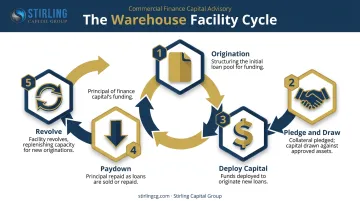
The mechanics follow a repeatable cycle. Understanding each step makes it easier to see why this structure fits fast-growing originators so well.
- Origination – The company originates loans, leases, or receivables in the normal course of business.
- Pledge and draw – Those assets are pledged as collateral to the warehouse lender, who advances funds against them at a negotiated advance rate.
- Deploy capital – The advanced funds finance new originations, so the company isn't tying up its own equity capital in every loan it makes.
- Paydown – As underlying assets are paid off, sold, or refinanced into permanent capital, such as through securitization or a whole-loan sale, the proceeds pay down the warehouse balance.
- Revolve – The facility resets and the cycle repeats, funding new originations as the business grows.
What Advance Rate Should You Expect?
There's no single industry-wide number here, despite what some sources claim. Verified examples show advance rates commonly landing in the 60% to 80% range, with some structures reaching as high as 85%, according to Mayer Brown's analysis of loan portfolio back-leverage structures.
The exact rate depends on the collateral type and lender risk appetite. Asset quality, eligibility criteria, and the strength of the borrower's underwriting all move that number.
A Simple Example
Picture a fintech personal loan originator. It underwrites and funds $10 million in personal loans this month. Instead of using its own cash, it pledges those loans to its warehouse lender and draws an advance, say 70% of the loan pool's value. That $7 million funds next month's originations.
Once the original loans are packaged and sold into a securitization, the proceeds pay down the warehouse balance, freeing up capacity to do it all again.
Who Uses Warehouse Facilities and What Assets Do They Fund?
Warehouse facilities aren't limited to one industry. Any business that originates financial assets faster than it can hold them on its own balance sheet is a candidate. Common categories include:
Consumer lending assets (common in bank and captive-finance warehouse lines):
- Personal loans
- Auto loans
- Student loans
- Credit card receivables
Commercial and specialty finance assets:
- Invoice and factoring receivables
- Equipment finance contracts
- Merchant cash advances
- Commercial mortgages
Physical and inventory-related collateral:
- Vehicle inventory
- Trade receivables tied to marketplace or inventory-based platforms
Not every asset in these categories automatically qualifies. Lenders set eligibility criteria and concentration limits that determine which specific loans or receivables count as usable collateral within the facility.
A single borrower concentration cap, for instance, might limit how much of the pool can come from one customer or asset type. These limits protect the lender, but they also shape how a borrower structures its origination pipeline.
Key Benefits of Using a Warehouse Facility
The appeal of a warehouse facility comes down to capital efficiency and growth flexibility. Here's what businesses gain:
- Preserves equity capital – growth gets funded with debt instead of diluting ownership through repeated equity raises
- Improves capital efficiency – interest generally applies to capital actively deployed, not the entire committed facility size
- Bridges the timing gap – covers the space between originating an asset and moving it into permanent financing like securitization
- Scales with the business – facility size can often expand as asset volume and performance grow, without a full refinancing
- Builds a track record – consistent reporting and performance history position a company for larger institutional facilities later
Fundbox's $2 Billion Origination Boost
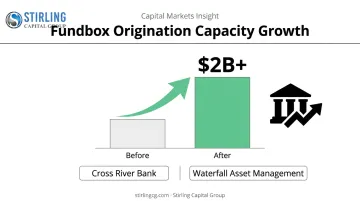
In September 2024, fintech lender Fundbox secured a new warehouse facility from Cross River Bank and Waterfall Asset Management. According to a joint announcement from Cross River Bank and Waterfall Asset Management, the deal pushed Fundbox's total annual origination capacity, including existing facilities, above $2 billion. That kind of added funding capacity is the practical benefit warehouse facilities offer: more room to originate without waiting on a new equity round every time volume picks up.
Structures, Key Terms, and Risks to Understand
Not all warehouse facilities are built the same way, and the differences matter for how much risk sits on your company's balance sheet.
Two Common Structures
| Structure | How It Works | Best Fit |
|---|---|---|
| On-balance-sheet facility | Assets stay with the operating company; borrower pledges collateral directly under a borrowing base | Simpler setup, fewer moving parts |
| Off-balance-sheet SPV structure | Assets transfer to a bankruptcy-remote special purpose vehicle that borrows against the pool | Preferred by institutional lenders for risk isolation |
The SPV route creates isolation between the originator and the lender, but it also introduces complexity, custody requirements, and servicing obligations that on-balance-sheet deals don't require.
Terms Every Borrower Should Know
- Advance rate – the percentage of eligible collateral value the lender will fund, often 70-90% depending on asset quality
- Eligibility criteria – the specific requirements an asset must meet to count as usable collateral
- Concentration limits – caps on how much of the pool can come from a single borrower, asset type, or geography, commonly 10-20% per obligor
- Reinvestment/amortization period – the window when collections can fund new assets, versus when they must pay down the balance
Risks to Watch
- Covenant breaches can trigger a shift from reinvestment to amortization, cutting off access to new draws
- Mark-to-market risk on pledged assets can reduce available borrowing capacity if collateral values decline
- Takeout financing dependency means a company can hit a funding wall if it can't sell or refinance assets into permanent capital when needed
Ongoing compliance matters too. Lenders typically require regular borrowing-base certificates, portfolio reporting, and periodic collateral audits to keep the facility active. Skipping these isn't an option if you want continued access.
How to Secure the Right Warehouse Facility for Your Business
Lenders evaluate several factors before extending a warehouse facility:
- Underwriting quality – how consistently the company applies credit standards
- Asset performance history – delinquency rates, losses, and payment patterns on prior originations
- Reporting infrastructure – whether the company can produce accurate, timely borrowing-base reports
- Management experience – the team's track record running a similar asset class through market cycles
Why a Single Bank Isn't Always the Answer
Approaching one bank means fitting into that bank's specific credit box, whether it matches your asset class or not. That mismatch can result in lower advance rates, tighter covenants, or eligibility rules that don't reflect the business's actual risk profile. Working with a commercial finance consultant instead opens up options.
Stirling Capital Group, for example, works with a network of over sixty private lending sources. This allows the firm to pre-qualify a business and match it to a warehouse lender suited to its specific collateral type and growth stage, rather than forcing a fit that doesn't work.

Practical Tips Before You Start
- Start early – setup involves due diligence, documentation, and negotiation, so give yourself months of lead time, not weeks.
- Prepare clean data – organized underwriting files and performance history speed up lender review significantly.
- Negotiate terms that match reality – advance rates, covenant triggers, and eligibility criteria should reflect your actual cash flow, not just what a lender's standard term sheet offers.
Frequently Asked Questions
What is a warehouse facility?
A warehouse facility is a revolving credit line secured by a pool of assets like loans or receivables. It funds new originations until those assets are sold, refinanced, or securitized.
How does a warehousing facility work?
A company originates assets, pledges them as collateral, and draws funds at an agreed advance rate. As those assets get paid down or sold, the proceeds repay the facility, and the cycle repeats.
What's the difference between a warehouse facility and a term loan?
A warehouse facility revolves and draws incrementally as new assets are originated. A term loan provides a fixed lump sum upfront with a set repayment schedule, regardless of how quickly the borrower deploys it.
Who typically uses warehouse facilities?
Fintech and marketplace lenders, specialty finance companies, mortgage originators, and other asset-heavy businesses rely on warehouse facilities to fund growth without waiting on equity raises.
What advance rate can a company expect on a warehouse facility?
Advance rates commonly fall between 60% and 85%, depending on asset quality, eligibility criteria, and the lender's risk assessment. There's no fixed industry-wide number.
How long does it take to set up a warehouse facility?
Timelines vary by lender and asset class. Between initial discussions, due diligence, and documentation, the full process often takes several months, so starting conversations early helps avoid funding gaps.