Introduction
Most mortgage borrowers never think about where the money actually comes from. But behind the scenes, a specialized credit facility keeps the entire system moving.
A warehouse line of credit is a short-term, revolving facility that lets loan originators fund loans before selling them to investors. According to the Mortgage Bankers Association, warehouse lines fund more than 60% of U.S. single-family mortgage originations. That's the quiet engine behind most of the housing market.
Here's the problem: many independent originators, fintech lenders, and asset-heavy businesses can't get one. Traditional banks often view them as too niche or too risky for standard underwriting.
This guide breaks down what a warehouse line of credit is, how it works, and who uses it. You'll also see how Stirling Capital Group helps businesses find the right private lending source when big banks say no.
Key Takeaways
- Warehouse lines fund over 60% of U.S. mortgage originations
- The facility revolves — capacity frees up once a loan sells and the line repays
- Advance rates on mortgage warehouse lines typically run 97-100% of loan value
- Fintech lenders, BNPL platforms, and receivables-heavy companies now use similar structures
- Bank-declined businesses can often qualify through private and specialty lending sources
What Is a Warehouse Line of Credit?
A warehouse line of credit is a short-term, revolving credit facility that lets loan originators or asset-heavy companies fund loans and other assets without tying up their own capital. The originator draws on the line to close a loan, then repays it once that loan is sold or securitized to a permanent investor.
The warehouse line differs from the mortgage itself. It's a financing tool that sits behind the loan, existing only until the asset moves off the originator's books and bridges origination with the secondary market.
Who Provides and Uses These Facilities
Warehouse lines typically come from:
- Large commercial banks
- Institutional lenders
- Specialty private lending groups
The borrowers on the other side of that transaction look different depending on the industry:
- Independent mortgage bankers
- Fintech and marketplace lenders
- Real estate investors
- Inventory-heavy businesses
This mix of banks, institutions, and borrowers shows how far warehouse lending has traveled from its mortgage-banking roots. Similar facilities now finance receivables, equipment leases, inventory pools, and even vehicle loans — anything that generates a predictable, sellable asset can potentially sit on a warehouse line.
That's exactly the kind of solution Stirling Capital Group helps clients uncover. If your business gets declined by a traditional bank but has a steady stream of originated assets, a warehouse-style facility might be the flexible, asset-based capital solution you didn't know existed.
How Does a Warehouse Line of Credit Work?
The mechanics follow a consistent cycle, whether the underlying asset is a mortgage, a small-business loan, or a lease receivable.
- Origination: The originator closes a loan or finalizes an asset purchase.
- Funding: The warehouse lender advances funds, and the closing agent sends the note or supporting documentation to the lender as collateral.
- Sale or securitization: The originator sells the asset to a permanent investor or bundles it into a securitization.
- Repayment: The investor's payment flows back to the warehouse lender, who deducts principal, interest, and fees before releasing the balance.
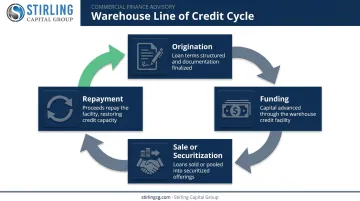
Once that loop closes, the capacity resets. That's the revolving part: the same facility can fund the next loan immediately, without waiting for a new credit approval.
Dwell Time Matters
The period a loan sits on the warehouse line before it's sold is called dwell time. The MBA reports an average residential mortgage dwell time of roughly 15-18 days. Every day a loan stays on the line, interest accrues, and it must be repaid by the originator, not the eventual investor.
If a loan lingers past its expected window because of a documentation issue or a stalled investor sale, the lender's risk exposure grows. Extended agings get flagged in reviews, and lenders watch for loans that stay unsold longer than expected.
Wet Funding vs. Dry Funding
These two funding methods differ in timing and risk exposure:
- Wet funding releases money at closing, before the lender reviews final documentation — faster, but riskier if paperwork issues surface later.
- Dry funding holds funds until the lender verifies documentation is complete, adding a day or two but reducing risk before money moves.
Most warehouse lenders build their risk tolerance and pricing around which method a given deal uses.
Collateral and Security Interest
The warehouse lender doesn't just hand over cash on faith. It takes a security interest in the loan note or asset pool, holding that lien until the asset sells or the advance is repaid.
This works through the same legal framework that governs most commercial lending: a security agreement, value given by the lender, and the borrower's rights in the collateral. Lenders typically perfect that interest by filing a UCC financing statement, which establishes their priority claim against other creditors.
Why Businesses Use Warehouse Lines of Credit
Capital recycling is the whole point. Instead of tying up permanent cash in every loan it originates, a company draws the warehouse line, funds the loan, sells it, repays the line, and does it again.
This lets an originator move a volume of assets far larger than what its own balance sheet could carry alone.
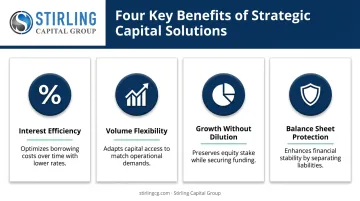
That structure creates a few concrete advantages:
- Interest efficiency — Borrowers pay interest only on funds actually deployed, not on an idle lump sum sitting in reserve.
- Volume flexibility — Independent mortgage banks often use multiple warehouse lenders at once and pre-position liquidity to handle application spikes without missing closings.
- Growth without dilution — Businesses fund origination growth using debt secured by the assets themselves, rather than issuing new equity every time they need to scale volume.
- Balance sheet protection — Loans move off the books within weeks, keeping leverage ratios manageable even as origination volume scales.
For a fast-growing fintech lender or a mortgage bank riding a rate-driven refinance wave, that combination of speed and capital efficiency can be the difference between capturing volume and turning business away.
Who Qualifies, and What Are the Risks?
Warehouse lenders aren't handing out blank checks. They're underwriting the originator almost as carefully as the originator underwrites its borrowers.
Typical qualification factors include:
- Track record and operating history
- Underwriting quality and documentation standards
- Historical asset performance (delinquencies, defaults, repurchase claims)
- Strength of internal controls and quality-control programs
Lenders monitor these facilities closely once they're in place. FDIC examination guidance calls for independent quality-control reviews, pre-funding and post-closing checks, and management reporting on how quickly loans move through the pipeline.
The biggest risk factors lenders watch for:
- Fraud or falsified documentation
- Loans that don't meet investor purchase standards
- Dependency on a stable secondary market to resell assets
- Delinquent or aged loans that become harder to sell
Here's the part that matters most for smaller and mid-sized originators: eligibility isn't limited to the largest players. Both large and small originators can access warehouse facilities if they meet a lender's underwriting criteria.
Many still get declined by traditional banks anyway. The reason usually comes down to regulatory capital requirements, which make niche or newer originators less attractive to hold on a bank's balance sheet. Firms like Stirling Capital Group help these originators secure non-bank warehouse lending suited to their situation.
Warehouse Lines Beyond the Mortgage Industry
The warehouse concept has moved well past mortgage banking, and two recent examples show how.
Idea Financial, a small-business lender, secured a $50 million warehouse facility led by Performance Trust Capital Partners, backed by its small-business lines of credit.
The added capacity let the company raise its maximum credit limit for established small businesses from $250,000 to $350,000 — a direct capacity increase tied to warehouse funding, not fresh equity.
Oportun, a fintech lender, closed a $245 million committed warehouse facility with a three-year revolving period, collateralized by its unsecured and secured loan originations. The company tied the facility directly to funding continued origination growth.
Neither example is a mortgage company. That's the point. BNPL platforms, marketplace lenders, and receivables-heavy operators all use the same underlying mechanic:
- Borrow against assets about to be originated
- Sell or securitize those assets into the market
- Repay the warehouse line with the proceeds
- Repeat the cycle for the next origination pool
For Stirling Capital Group's audience, this matters directly. Real estate investors, growth-oriented SMEs, and middle-market companies sitting on a pool of receivables, leases, or originated loans can explore this same structure for flexible growth capital, even without a mortgage license.
How Stirling Capital Group Helps You Access the Right Warehouse Line of Credit
Warehouse facilities aren't one-size-fits-all. Matching the right lender to your asset type, origination volume, and risk profile takes more than a Google search and a cold call.
That's the gap Stirling Capital Group fills. With a portfolio of over sixty private lending sources, the firm matches a borrower's specific collateral type and volume against lenders built to underwrite that risk. Instead of pushing every applicant through the same narrow bank credit box, Stirling finds the lender suited to the deal.
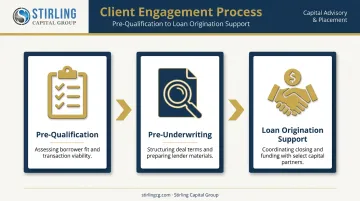
The process runs through three stages:
- Pre-qualification: Understanding your asset type, volume expectations, and financial position upfront.
- Pre-underwriting: Packaging the deal so it moves quickly once it reaches a lender.
- Loan origination support: Coordinating closing and funding for time-sensitive capital needs.
If a warehouse line alone doesn't cover your full capital stack, Stirling can also connect clients to equity capital alongside debt solutions, filling gaps that a single facility can't.
If your business has been turned down by a traditional bank or you're scaling origination volume and need flexible, asset-based capital, we can help. Request a free consultation with Robert Gittings, Managing Partner at Stirling Capital Group, to talk through warehouse lending and other financing options built for your situation.
Frequently Asked Questions
What are warehouse lines?
Warehouse lines are short-term, revolving credit facilities that fund loans or assets until they're sold to a permanent investor or securitized. The originator repays the line from the sale proceeds, then reuses the same capacity for the next loan.
What is the difference between wet funding and dry funding?
Wet funding releases money at closing before the lender reviews final documentation, which is faster but carries more risk. Dry funding waits until documentation is verified, adding a small delay but more security for the lender.
How much leverage can a warehouse line of credit provide?
Leverage varies by lender and asset type, but warehouse facilities generally let originators fund far more loan volume than their own capital alone would support. Mortgage warehouse lines commonly advance 97-100% of the loan amount.
Who typically qualifies for a warehouse line of credit?
Lenders look at the originator's track record, underwriting quality, and historical asset performance, along with the strength of internal controls. Both large and small originators can qualify if they meet these standards.
Is warehouse lending only for mortgage companies?
No. While it started in mortgage banking, warehouse structures now support fintech lenders, BNPL platforms, and receivables- or inventory-heavy businesses across other industries.
How long can a loan stay on a warehouse line before it must be sold?
Residential mortgages typically sit on a warehouse line for roughly 15 to 18 days on average. Loans held longer accrue additional interest and draw closer scrutiny from the lender.